 Français
 English

| ELK.No | ES11138 |
| Product name | LITAF rabbit pAb |
| Reactivity | Human;Rat;Mouse |
| Applications | WB;ELISA |
| Other name | |
| Size | 50μL |
| Unit price ($) | 148 |
| Human gene ID | 9516 |
| Human Swiss-Prot | Q99732 |
| Source | Rabbit |
| Isotype | IgG |
| Target | LITAF |
| Fields | >>Lysosome |
| Gene name | LITAF PIG7 SIMPLE |
| Protein name | Lipopolysaccharide-induced tumor necrosis factor-alpha factor (LPS-induced TNF-alpha factor) (Small integral membrane protein of lysosome/late endosome) (p53-induced gene 7 protein) |
| Human gene link | |
| Human Swiss link | View Human Swiss-Prot |
| Mouse gene ID | |
| Mouse gene link | |
| Mouse Swiss-Prot | Q9JLJ0 |
| Mouse Swiss link | View Mouse Swiss-Prot |
| Rat gene ID | |
| Rat gene link | |
| Rat Swiss-Prot | P0C0T0 |
| Rat Swiss link | View Rat Swiss-Prot |
| Immunogen | Synthesized peptide derived from part region of human protein |
| Specificity | LITAF Polyclonal Antibody detects endogenous levels of protein. |
| Formulation | Liquid in PBS containing 50% glycerol, and 0.02% sodium azide. |
| Clonality | Polyclonal |
| Dilution | WB 1:500-2000 ELISA 1:5000-20000 |
| Purification | The antibody was affinity-purified from rabbit antiserum by affinity-chromatography using epitope-specific immunogen. |
| Concentration | 1 mg/ml |
| Storage stability | -20°C/1 year |
| Molecular Weight (Da) | |
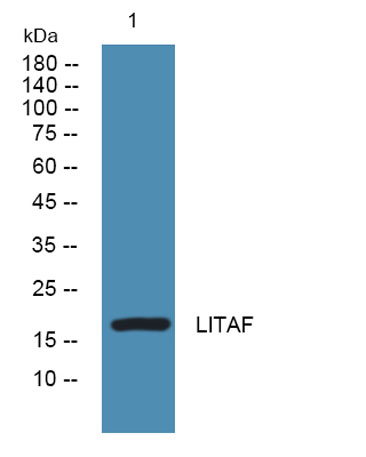
| Observed band (KD) | 17kD |
| Background | Lipopolysaccharide is a potent stimulator of monocytes and macrophages, causing secretion of tumor necrosis factor-alpha (TNF-alpha) and other inflammatory mediators. This gene encodes lipopolysaccharide-induced TNF-alpha factor, which is a DNA-binding protein and can mediate the TNF-alpha expression by direct binding to the promoter region of the TNF-alpha gene. The transcription of this gene is induced by tumor suppressor p53 and has been implicated in the p53-induced apoptotic pathway. Mutations in this gene cause Charcot-Marie-Tooth disease type 1C (CMT1C) and may be involved in the carcinogenesis of extramammary Paget's disease (EMPD). Multiple alternatively spliced transcript variants have been found for this gene. [provided by RefSeq, Dec 2014], |
| Function | disease:Defects in LITAF are the cause of Charcot-Marie-Tooth disease type 1C (CMT1C) [MIM:601098]. CMT1C is a form of Charcot-Marie-Tooth disease, the most common inherited disorder of the peripheral nervous system. Charcot-Marie-Tooth disease is classified in two main groups on the basis of electrophysiologic properties and histopathology: primary peripheral demyelinating neuropathy or CMT1, and primary peripheral axonal neuropathy or CMT2. Neuropathies of the CMT1 group are characterized by severely reduced nerve conduction velocities (less than 38 m/sec), segmental demyelination and remyelination with onion bulb formations on nerve biopsy, slowly progressive distal muscle atrophy and weakness, absent deep tendon reflexes, and hollow feet.,disease:Defects in LITAF may be involved in extramammary Paget disease (EMPD) carcinogenesis. EMPD is a cancerous disease representing about 8% of |
| Subcellular location | Cytoplasm . Nucleus . Lysosome membrane ; Peripheral membrane protein ; Cytoplasmic side . Early endosome membrane . Late endosome membrane . Endosome membrane ; Peripheral membrane protein ; Cytoplasmic side . Cell membrane ; Peripheral membrane protein ; Cytoplasmic side . Golgi apparatus membrane . Associated with membranes of lysosomes, early and late endosomes (PubMed:11274176, PubMed:27927196, PubMed:27582497). Can translocate from the cytoplasm into the nucleus (PubMed:15793005). Detected at Schmidt-Lanterman incisures and in nodal regions of myelinating Schwann cells (By similarity). . |
| Expression | Ubiquitously and abundantly expressed. Expressed predominantly in the placenta, peripheral blood leukocytes, lymph nodes and spleen. |

Use collapsible tabs for more detailed information that will help customers make a purchasing decision.
Ex: Shipping and return policies, size guides, and other common questions.