 Français
 English
PTEN (Acetyl Lys402) rabbit pAb
AO-06-ES1128-50

| ELK.No | ES1128 |
| Product name | PTEN (Acetyl Lys402) rabbit pAb |
| Reactivity | Human;Mouse;Rat |
| Applications | WB;ELISA;IHC |
| Other name | PTEN; MMAC1; TEP1; Phosphatidylinositol 3,4,5-trisphosphate 3-phosphatase and dual-specificity protein phosphatase PTEN; Mutated in multiple advanced cancers 1; Phosphatase and tensin homolog |
| Size | 50μL |
| Unit price ($) | 148 |
| Human gene ID | 5728 |
| Human Swiss-Prot | P60484 |
| Source | Rabbit |
| Isotype | IgG |
| Target | PTEN |
| Fields | >>Inositol phosphate metabolism;>>Metabolic pathways;>>EGFR tyrosine kinase inhibitor resistance;>>FoxO signaling pathway;>>Phosphatidylinositol signaling system;>>Sphingolipid signaling pathway;>>p53 signaling pathway;>>Autophagy - animal;>>mTOR signaling pathway;>>PI3K-Akt signaling pathway;>>Cellular senescence;>>Focal adhesion;>>Insulin resistance;>>Human papillomavirus infection;>>Human T-cell leukemia virus 1 infection;>>Pathways in cancer;>>MicroRNAs in cancer;>>Chemical carcinogenesis - reactive oxygen species;>>Endometrial cancer;>>Glioma;>>Prostate cancer;>>Melanoma;>>Small cell lung cancer;>>Breast cancer;>>Hepatocellular carcinoma;>>Central carbon metabolism in cancer;>>PD-L1 expression and PD-1 checkpoint pathway in cancer;>>Diabetic cardiomyopathy |
| Gene name | PTEN |
| Protein name | Phosphatidylinositol 3,4,5-trisphosphate 3-phosphatase and dual-specificity protein phosphatase PTEN |
| Human gene link | View Human Gene |
| Human Swiss link | View Human Swiss-Prot |
| Mouse gene ID | 19211 |
| Mouse gene link | View Mouse Gene |
| Mouse Swiss-Prot | O08586 |
| Mouse Swiss link | View Mouse Swiss-Prot |
| Rat gene ID | |
| Rat gene link | |
| Rat Swiss-Prot | |
| Rat Swiss link | |
| Immunogen | Synthesized acetyl-peptide derived from the human PTEN around the acetylation site of K402. |
| Specificity | Acetyl-PTEN (K402) Polyclonal AntibodySynthesized peptide derived from the human PTEN around the acetylation site of K402. |
| Formulation | Liquid in PBS containing 50% glycerol, 0.5% BSA and 0.02% sodium azide. |
| Clonality | Polyclonal |
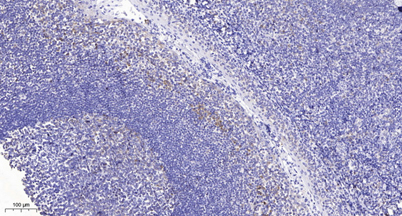
| Dilution | WB 1:500-2000;IHC-p 1:50-300; ELISA 2000-20000 |
| Purification | The antibody was affinity-purified from rabbit antiserum by affinity-chromatography using epitope-specific immunogen. |
| Concentration | 1 mg/ml |
| Storage stability | -20°C/1 year |
| Molecular Weight (Da) | |
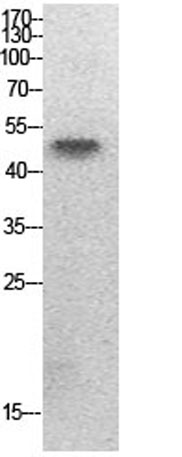
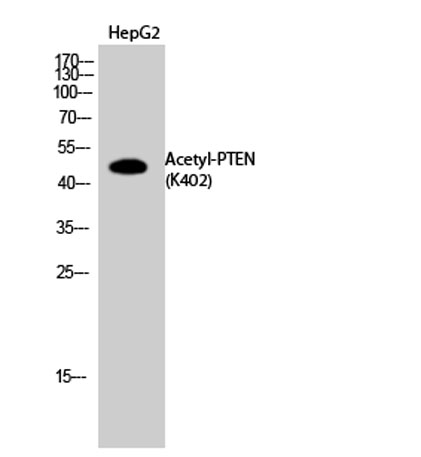
| Observed band (KD) | 47kD |
| Background | This gene was identified as a tumor suppressor that is mutated in a large number of cancers at high frequency. The protein encoded by this gene is a phosphatidylinositol-3,4,5-trisphosphate 3-phosphatase. It contains a tensin like domain as well as a catalytic domain similar to that of the dual specificity protein tyrosine phosphatases. Unlike most of the protein tyrosine phosphatases, this protein preferentially dephosphorylates phosphoinositide substrates. It negatively regulates intracellular levels of phosphatidylinositol-3,4,5-trisphosphate in cells and functions as a tumor suppressor by negatively regulating AKT/PKB signaling pathway. The use of a non-canonical (CUG) upstream initiation site produces a longer isoform that initiates translation with a leucine, and is thought to be preferentially associated with the mitochondrial inner membrane. This longer isoform may help regulate ener |
| Function | catalytic activity:A phosphoprotein + H(2)O = a protein + phosphate.,catalytic activity:Phosphatidylinositol 3,4,5-trisphosphate + H(2)O = phosphatidylinositol 4,5-bisphosphate + phosphate.,catalytic activity:Protein tyrosine phosphate + H(2)O = protein tyrosine + phosphate.,cofactor:Magnesium.,disease:A microdeletion of chromosome 10q23 involving PTEN and BMPR1A is a cause of chromosome 10q23 deletion syndrome [MIM:612242]. This syndrome shows overlapping features of the following three disorders: Bannayan-Zonana syndrome, Cowden disease and juvenile polyposis syndrome.,disease:Defects in PTEN are a cause of Bannayan-Zonana syndrome (BZS) [MIM:153480]; also known as Ruvalcaba-Riley-Smith or Bannayan-Riley-Ruvalcaba syndrome (BRRS). In BZS there seems not to be an increased risk of malignancy. It has a partial clinical overlap with CD. BZS is characterized by the classic triad of macroce |
| Subcellular location | Cytoplasm . Nucleus . Nucleus, PML body . Monoubiquitinated form is nuclear. Nonubiquitinated form is cytoplasmic. Colocalized with PML and USP7 in PML nuclear bodies (PubMed:18716620). XIAP/BIRC4 promotes its nuclear localization (PubMed:19473982). .; [Isoform alpha]: Secreted . May be secreted via a classical signal peptide and reenter into cells with the help of a poly-Arg motif. |
| Expression | Expressed at a relatively high level in all adult tissues, including heart, brain, placenta, lung, liver, muscle, kidney and pancreas. |

Use collapsible tabs for more detailed information that will help customers make a purchasing decision.
Ex: Shipping and return policies, size guides, and other common questions.