 Français
 English

| ELK.No | ES11364 |
| Product name | LECT1 rabbit pAb |
| Reactivity | Human;Rat;Mouse |
| Applications | WB;ELISA |
| Other name | |
| Size | 100μL |
| Unit price ($) | 248 |
| Human gene ID | 11061 |
| Human Swiss-Prot | O75829 |
| Source | Rabbit |
| Isotype | IgG |
| Target | LECT1 |
| Fields | |
| Gene name | LECT1 CHMI |
| Protein name | Leukocyte cell-derived chemotaxin 1 [Cleaved into: Chondrosurfactant protein (CH-SP); Chondromodulin-1 (Chondromodulin-I) (ChM-I)] |
| Human gene link | |
| Human Swiss link | View Human Swiss-Prot |
| Mouse gene ID | |
| Mouse gene link | |
| Mouse Swiss-Prot | Q9Z1F6 |
| Mouse Swiss link | View Mouse Swiss-Prot |
| Rat gene ID | |
| Rat gene link | |
| Rat Swiss-Prot | O70367 |
| Rat Swiss link | View Rat Swiss-Prot |
| Immunogen | Synthesized peptide derived from human protein . at AA range: 150-230 |
| Specificity | LECT1 Polyclonal Antibody detects endogenous levels of protein. |
| Formulation | Liquid in PBS containing 50% glycerol, and 0.02% sodium azide. |
| Clonality | Polyclonal |
| Dilution | WB 1:500-2000 ELISA 1:5000-20000 |
| Purification | The antibody was affinity-purified from rabbit antiserum by affinity-chromatography using epitope-specific immunogen. |
| Concentration | 1 mg/ml |
| Storage stability | -20°C/1 year |
| Molecular Weight (Da) | |
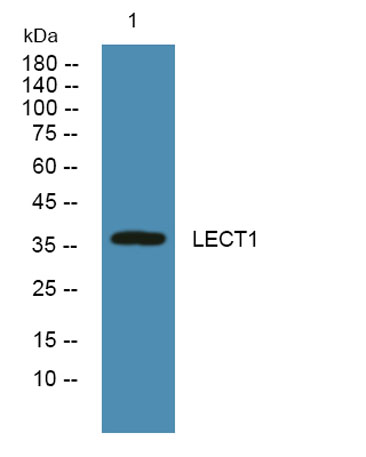
| Observed band (KD) | 36kD |
| Background | This gene encodes a glycosylated transmembrane protein that is cleaved to form a mature, secreted protein. The N-terminus of the precursor protein shares characteristics with other surfactant proteins and is sometimes called chondrosurfactant protein although no biological activity has yet been defined for it. The C-terminus of the precursor protein contains a 25 kDa mature protein called leukocyte cell-derived chemotaxin-1 or chondromodulin-1. The mature protein promotes chondrocyte growth and inhibits angiogenesis. This gene is expressed in the avascular zone of prehypertrophic cartilage and its expression decreases during chondrocyte hypertrophy and vascular invasion. The mature protein likely plays a role in endochondral bone development by permitting cartilaginous anlagen to be vascularized and replaced by bone. It may be involved also in the broad control of tissue vascularizat |
| Function | developmental stage:Expressed at 9 weeks in developing cartilagenous bone rudiments.,function:Bifunctional growth regulator that stimulates the growth of cultured chondrocytes in the presence of basic fibroblast growth factor (FGF) but inhibits the growth of cultured vascular endothelial cells. May contribute to the rapid growth of cartilage and vascular invasion prior to the replacement of cartilage by bone during endochondral bone development.,PTM:After cleavage, the post-translationally modified ChM-I is secreted as a glycoprotein.,similarity:Belongs to the chondromodulin-1 family.,similarity:Contains 1 BRICHOS domain.,subcellular location:Accumulated in the inter-territorial matrix of cartilage.,tissue specificity:Cartilage specific. Weakly expressed in chondrosarcoma., |
| Subcellular location | [Chondromodulin-1]: Secreted, extracellular space, extracellular matrix. Accumulated in the inter-territorial matrix of cartilage.; [Chondrosurfactant protein]: Endomembrane system ; Single-pass membrane protein . |
| Expression | Detected in cartilage and cardiac valves (at protein level). Detected in the laminae fibrosa, spongiosa and ventricularis layers of normal cardiac valves (at protein level). Expression is decreased cardiac valves of patients with valvular heart disease (at protein level). Weakly expressed in chondrosarcoma. |

Use collapsible tabs for more detailed information that will help customers make a purchasing decision.
Ex: Shipping and return policies, size guides, and other common questions.