 Français
 English

| ELK.No | ES11418 |
| Product name | PGRP3 rabbit pAb |
| Reactivity | Human;Mouse |
| Applications | WB;ELISA |
| Other name | |
| Size | 100μL |
| Unit price ($) | 248 |
| Human gene ID | 114771 |
| Human Swiss-Prot | Q96LB9 |
| Source | Rabbit |
| Isotype | IgG |
| Target | PGRP3 |
| Fields | |
| Gene name | PGLYRP3 PGRPIA |
| Protein name | Peptidoglycan recognition protein 3 (Peptidoglycan recognition protein I-alpha) (PGLYRPIalpha) (PGRP-I-alpha) (Peptidoglycan recognition protein intermediate alpha) |
| Human gene link | |
| Human Swiss link | View Human Swiss-Prot |
| Mouse gene ID | |
| Mouse gene link | |
| Mouse Swiss-Prot | A1A547 |
| Mouse Swiss link | View Mouse Swiss-Prot |
| Rat gene ID | |
| Rat gene link | |
| Rat Swiss-Prot | |
| Rat Swiss link | |
| Immunogen | Synthesized peptide derived from human protein . at AA range: 51-100 |
| Specificity | PGRP3 Polyclonal Antibody detects endogenous levels of protein. |
| Formulation | Liquid in PBS containing 50% glycerol, and 0.02% sodium azide. |
| Clonality | Polyclonal |
| Dilution | WB 1:500-2000 ELISA 1:5000-20000 |
| Purification | The antibody was affinity-purified from rabbit antiserum by affinity-chromatography using epitope-specific immunogen. |
| Concentration | 1 mg/ml |
| Storage stability | -20°C/1 year |
| Molecular Weight (Da) | |
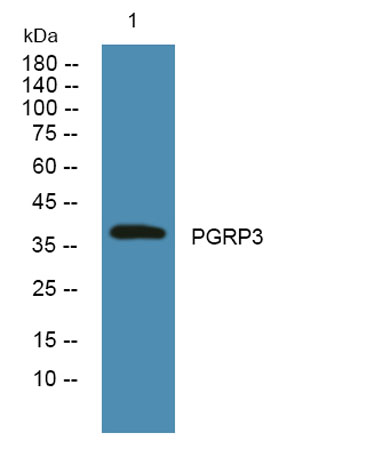
| Observed band (KD) | 37kD |
| Background | This gene encodes a peptidoglycan recognition protein, which belongs to the N-acetylmuramoyl-L-alanine amidase 2 family. These proteins are part of the innate immune system and recognize peptidoglycan, a ubiquitous component of bacterial cell walls. This antimicrobial protein binds to murein peptidoglycans of Gram-positive bacteria. [provided by RefSeq, Oct 2014], |
| Function | function:Binds to murein peptidoglycans (PGN) of Gram-positive bacteria. May play a role in innate immunity.,similarity:Belongs to the N-acetylmuramoyl-L-alanine amidase 2 family.,subunit:Monomer and dimer.,tissue specificity:Highly expressed in the esophagus, expressed also in tonsils and thymus and to a much lesser extent in the stomach, descending colon, rectum and brain., |
| Subcellular location | Secreted . |
| Expression | Detected in skin epidermis, eccrine sweat glands and ducts, ciliary body epithelial cells of the eye, in small intestine, colon, stomach and in mature epithelial cells of the tongue (at protein level). Highly expressed in skin and esophagus, expressed also in tonsils and thymus and to a much lesser extent in the stomach, descending colon, rectum and brain. |

Use collapsible tabs for more detailed information that will help customers make a purchasing decision.
Ex: Shipping and return policies, size guides, and other common questions.