 Français
 English

| ELK.No | ES11457 |
| Product name | CCR10 rabbit pAb |
| Reactivity | Human;Mouse |
| Applications | WB;ELISA |
| Other name | |
| Size | 100μL |
| Unit price ($) | 248 |
| Human gene ID | 2826 |
| Human Swiss-Prot | P46092 |
| Source | Rabbit |
| Isotype | IgG |
| Target | CCR10 |
| Fields | >>Cytokine-cytokine receptor interaction;>>Viral protein interaction with cytokine and cytokine receptor;>>Chemokine signaling pathway;>>Intestinal immune network for IgA production |
| Gene name | CCR10 GPR2 |
| Protein name | C-C chemokine receptor type 10 (C-C CKR-10) (CC-CKR-10) (CCR-10) (G-protein coupled receptor 2) |
| Human gene link | |
| Human Swiss link | View Human Swiss-Prot |
| Mouse gene ID | |
| Mouse gene link | |
| Mouse Swiss-Prot | Q9JL21 |
| Mouse Swiss link | View Mouse Swiss-Prot |
| Rat gene ID | |
| Rat gene link | |
| Rat Swiss-Prot | |
| Rat Swiss link | |
| Immunogen | Synthesized peptide derived from human protein . at AA range: 120-200 |
| Specificity | CCR10 Polyclonal Antibody detects endogenous levels of protein. |
| Formulation | Liquid in PBS containing 50% glycerol, and 0.02% sodium azide. |
| Clonality | Polyclonal |
| Dilution | WB 1:500-2000 ELISA 1:5000-20000 |
| Purification | The antibody was affinity-purified from rabbit antiserum by affinity-chromatography using epitope-specific immunogen. |
| Concentration | 1 mg/ml |
| Storage stability | -20°C/1 year |
| Molecular Weight (Da) | |
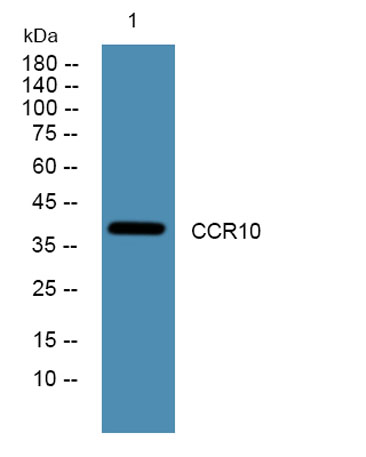
| Observed band (KD) | 39kD |
| Background | Chemokines are a group of small (approximately 8 to 14 kD), mostly basic, structurally related molecules that regulate cell trafficking of various types of leukocytes through interactions with a subset of 7-transmembrane, G protein-coupled receptors. Chemokines also play fundamental roles in the development, homeostasis, and function of the immune system, and they have effects on cells of the central nervous system as well as on endothelial cells involved in angiogenesis or angiostasis. Chemokines are divided into 2 major subfamilies, CXC and CC, based on the arrangement of the first 2 of the 4 conserved cysteine residues; the 2 cysteines are separated by a single amino acid in CXC chemokines and are adjacent in CC chemokines. CCR10 is the receptor for CCL27 (SCYA27; MIM 604833); CCR10-CCL27 interactions are involved in T cell-mediated skin inflammation (Homey et al., 2002 [PubMed 11821900]) |
| Function | function:Receptor for chemokines SCYA27 and SCYA28. Subsequently transduces a signal by increasing the intracellular calcium ions level and stimulates chemotaxis in a pre-B cell line.,online information:CC chemokine receptors entry,similarity:Belongs to the G-protein coupled receptor 1 family.,tissue specificity:Expressed at high levels in adult testis, small intestine, fetal lung, fetal kidney. Weaker expression was observed in many other adult tissues including spleen, thymus, lymph node, Peyer patches, colon, heart, ovary, peripheral blood lymphocytes, thyroid and spinal cord. Also expressed by melanocytes, dermal fibroblasts, dermal microvascular endothelial cells. Also detected in T-cells and in skin-derived Langerhans cells., |
| Subcellular location | Cell membrane; Multi-pass membrane protein. |
| Expression | Expressed at high levels in adult testis, small intestine, fetal lung, fetal kidney. Weaker expression was observed in many other adult tissues including spleen, thymus, lymph node, Peyer patches, colon, heart, ovary, peripheral blood lymphocytes, thyroid and spinal cord. Also expressed by melanocytes, dermal fibroblasts, dermal microvascular endothelial cells. Also detected in T-cells and in skin-derived Langerhans cells. |

Use collapsible tabs for more detailed information that will help customers make a purchasing decision.
Ex: Shipping and return policies, size guides, and other common questions.