 Français
 English

| ELK.No | ES11471 |
| Product name | GPER rabbit pAb |
| Reactivity | Human;Mouse;Rat |
| Applications | WB;ELISA |
| Other name | |
| Size | 50μL |
| Unit price ($) | 148 |
| Human gene ID | 2852 |
| Human Swiss-Prot | Q99527 |
| Source | Rabbit |
| Isotype | IgG |
| Target | GPER |
| Fields | >>Endocrine resistance;>>Estrogen signaling pathway;>>GnRH secretion |
| Gene name | GPER CEPR CMKRL2 DRY12 GPR30 |
| Protein name | G-protein coupled estrogen receptor 1 (Chemoattractant receptor-like 2) (Flow-induced endothelial G-protein coupled receptor 1) (FEG-1) (G-protein coupled receptor 30) (GPCR-BR) (IL8-related receptor |
| Human gene link | |
| Human Swiss link | View Human Swiss-Prot |
| Mouse gene ID | |
| Mouse gene link | |
| Mouse Swiss-Prot | Q8BMP4 |
| Mouse Swiss link | View Mouse Swiss-Prot |
| Rat gene ID | |
| Rat gene link | |
| Rat Swiss-Prot | O08878 |
| Rat Swiss link | View Rat Swiss-Prot |
| Immunogen | Synthesized peptide derived from human protein . at AA range: 300-380 |
| Specificity | GPER Polyclonal Antibody detects endogenous levels of protein. |
| Formulation | Liquid in PBS containing 50% glycerol, and 0.02% sodium azide. |
| Clonality | Polyclonal |
| Dilution | WB 1:500-2000 ELISA 1:5000-20000 |
| Purification | The antibody was affinity-purified from rabbit antiserum by affinity-chromatography using epitope-specific immunogen. |
| Concentration | 1 mg/ml |
| Storage stability | -20°C/1 year |
| Molecular Weight (Da) | |
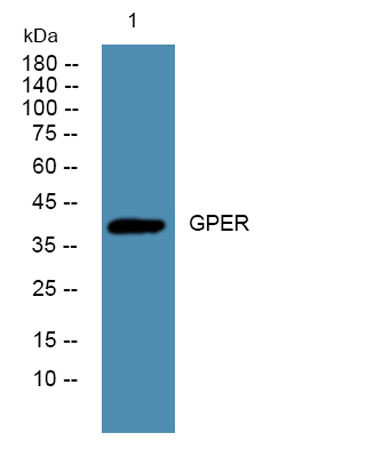
| Observed band (KD) | 41kD |
| Background | This gene is a member of the G-protein coupled receptor 1 family and encodes a multi-pass membrane protein that localizes to the endoplasmic reticulum. The protein binds estrogen, resulting in intracellular calcium mobilization and synthesis of phosphatidylinositol 3,4,5-trisphosphate in the nucleus. This protein therefore plays a role in the rapid nongenomic signaling events widely observed following stimulation of cells and tissues with estrogen. Alternate transcriptional splice variants which encode the same protein have been characterized. [provided by RefSeq, Jul 2008], |
| Function | function:Receptor for estrogen.,similarity:Belongs to the G-protein coupled receptor 1 family.,subcellular location:Protein has been detected in the cell membrane, endoplasmic reticulum and Golgi apparatus. It is currently unclear whether this is a cell surface or intracellular receptor.,tissue specificity:Ubiquitously expressed, but is most abundant in placenta. In brain regions, expressed as a 2.8 kb transcript in basal forebrain, frontal cortex, thalamus, hippocampus, caudate and putamen., |
| Subcellular location | Nucleus. Cytoplasm . Cytoplasm, perinuclear region. Cytoplasm, cytoskeleton. Cell membrane; Multi-pass membrane protein. Basolateral cell membrane; Multi-pass membrane protein. Cytoplasmic vesicle membrane; Multi-pass membrane protein. Early endosome. Recycling endosome. Golgi apparatus membrane ; Multi-pass membrane protein . Golgi apparatus, trans-Golgi network. Endoplasmic reticulum membrane ; Multi-pass membrane protein. Cell projection, dendrite . Cell projection, dendritic spine membrane ; Multi-pass membrane protein . Cell projection, axon . Cell junction, synapse, postsynaptic density . Mitochondrion membrane ; Multi-pass membrane protein . Colocalized with BSN to the active zone of presynaptic density. Colocalized with DLG4/PSD95 and neurabin-2 PPP1R9B in neuronal synaptosomes (By |
| Expression | Expressed in placenta, endothelial and epithelial cells, non laboring and laboring term myometrium, fibroblasts and cancer-associated fibroblasts (CAF), prostate cancer cells and invasive adenocarcinoma (at protein level). Ubiquitously expressed, but is most abundant in placenta. In brain regions, expressed as a 2.8 kb transcript in basal forebrain, frontal cortex, thalamus, hippocampus, caudate and putamen. |

Use collapsible tabs for more detailed information that will help customers make a purchasing decision.
Ex: Shipping and return policies, size guides, and other common questions.