 Français
 English

| ELK.No | ES11732 |
| Product name | TAAR8 rabbit pAb |
| Reactivity | Human;Rat;Mouse; |
| Applications | WB;ELISA |
| Other name | |
| Size | 100μL |
| Unit price ($) | 248 |
| Human gene ID | 83551 |
| Human Swiss-Prot | Q969N4 |
| Source | Rabbit |
| Isotype | IgG |
| Target | TAAR8 |
| Fields | >>Neuroactive ligand-receptor interaction |
| Gene name | TAAR8 GPR102 TA5 TAR5 TRAR5 |
| Protein name | Trace amine-associated receptor 8 (TaR-8) (Trace amine receptor 8) (G-protein coupled receptor 102) (Trace amine receptor 5) (TaR-5) |
| Human gene link | |
| Human Swiss link | View Human Swiss-Prot |
| Mouse gene ID | |
| Mouse gene link | |
| Mouse Swiss-Prot | |
| Mouse Swiss link | |
| Rat gene ID | |
| Rat gene link | |
| Rat Swiss-Prot | |
| Rat Swiss link | |
| Immunogen | Synthesized peptide derived from human protein . at AA range: 110-190 |
| Specificity | TAAR8 Polyclonal Antibody detects endogenous levels of protein. |
| Formulation | Liquid in PBS containing 50% glycerol, and 0.02% sodium azide. |
| Clonality | Polyclonal |
| Dilution | WB 1:500-2000 ELISA 1:5000-20000 |
| Purification | The antibody was affinity-purified from rabbit antiserum by affinity-chromatography using epitope-specific immunogen. |
| Concentration | 1 mg/ml |
| Storage stability | -20°C/1 year |
| Molecular Weight (Da) | |
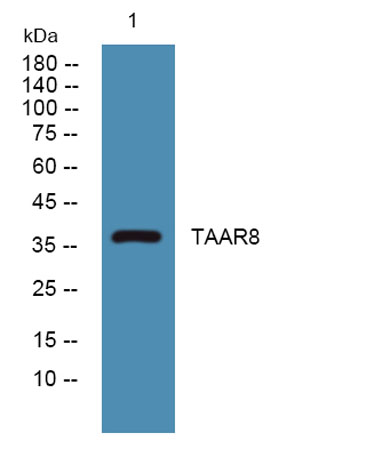
| Observed band (KD) | 37kD |
| Background | This gene is part of the trace amine receptor cluster on chromosome 6 and encodes an orphan G-protein coupled receptor. Upregulated expression of this gene in astroglial cells upon exposure to lipopolysaccharides suggests a function for the encoded protein in the brain. [provided by RefSeq, Jul 2016], |
| Function | function:Orphan receptor. Could be a receptor for trace amines. Trace amines are biogenic amines present in very low levels in mammalian tissues. Although some trace amines have clearly defined roles as neurotransmitters in invertebrates, the extent to which they function as true neurotransmitters in vertebrates has remained speculative. Trace amines are likely to be involved in a variety of physiological functions that have yet to be fully understood.,similarity:Belongs to the G-protein coupled receptor 1 family.,tissue specificity:Expressed in kidney and amygdala. Not expressed in other tissues or brain regions tested., |
| Subcellular location | Cell membrane; Multi-pass membrane protein. |
| Expression | Expressed in kidney and amygdala. Not expressed in other tissues or brain regions tested. |

Use collapsible tabs for more detailed information that will help customers make a purchasing decision.
Ex: Shipping and return policies, size guides, and other common questions.