 Français
 English

| ELK.No | ES11906 |
| Product name | GSTM2 rabbit pAb |
| Reactivity | Human;Rat;Mouse; |
| Applications | WB;ELISA |
| Other name | |
| Size | 100μL |
| Unit price ($) | 248 |
| Human gene ID | 2946 |
| Human Swiss-Prot | P28161 |
| Source | Rabbit |
| Isotype | IgG |
| Target | GSTM2 |
| Fields | >>Glutathione metabolism;>>Metabolism of xenobiotics by cytochrome P450;>>Drug metabolism - cytochrome P450;>>Drug metabolism - other enzymes;>>Metabolic pathways;>>Platinum drug resistance;>>Pathways in cancer;>>Chemical carcinogenesis - DNA adducts;>>Chemical carcinogenesis - receptor activation;>>Chemical carcinogenesis - reactive oxygen species;>>Hepatocellular carcinoma;>>Fluid shear stress and atherosclerosis |
| Gene name | GSTM2 GST4 |
| Protein name | Glutathione S-transferase Mu 2 (EC 2.5.1.18) (GST class-mu 2) (GSTM2-2) |
| Human gene link | |
| Human Swiss link | View Human Swiss-Prot |
| Mouse gene ID | |
| Mouse gene link | |
| Mouse Swiss-Prot | P15626 |
| Mouse Swiss link | View Mouse Swiss-Prot |
| Rat gene ID | |
| Rat gene link | |
| Rat Swiss-Prot | P08010 |
| Rat Swiss link | View Rat Swiss-Prot |
| Immunogen | Synthesized peptide derived from part region of human protein |
| Specificity | GSTM2 Polyclonal Antibody detects endogenous levels of protein. |
| Formulation | Liquid in PBS containing 50% glycerol, and 0.02% sodium azide. |
| Clonality | Polyclonal |
| Dilution | WB 1:500-2000 ELISA 1:5000-20000 |
| Purification | The antibody was affinity-purified from rabbit antiserum by affinity-chromatography using epitope-specific immunogen. |
| Concentration | 1 mg/ml |
| Storage stability | -20°C/1 year |
| Molecular Weight (Da) | |
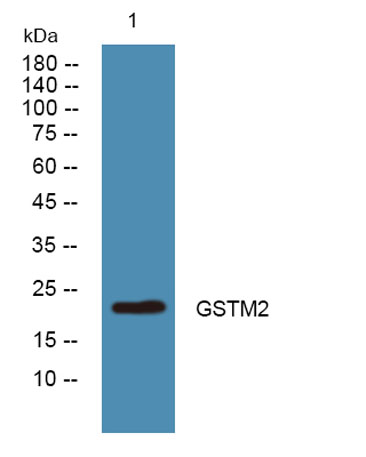
| Observed band (KD) | 23kD |
| Background | Cytosolic and membrane-bound forms of glutathione S-transferase are encoded by two distinct supergene families. At present, eight distinct classes of the soluble cytoplasmic mammalian glutathione S-transferases have been identified: alpha, kappa, mu, omega, pi, sigma, theta and zeta. This gene encodes a glutathione S-transferase that belongs to the mu class. The mu class of enzymes functions in the detoxification of electrophilic compounds, including carcinogens, therapeutic drugs, environmental toxins and products of oxidative stress, by conjugation with glutathione. The genes encoding the mu class of enzymes are organized in a gene cluster on chromosome 1p13.3 and are known to be highly polymorphic. These genetic variations can change an individual's susceptibility to carcinogens and toxins as well as affect the toxicity and efficacy of certain drugs. [provided by RefSeq, Jul 2008], |
| Function | catalytic activity:RX + glutathione = HX + R-S-glutathione.,function:Conjugation of reduced glutathione to a wide number of exogenous and endogenous hydrophobic electrophiles.,similarity:Belongs to the GST superfamily. Mu family.,similarity:Contains 1 GST C-terminal domain.,similarity:Contains 1 GST N-terminal domain.,subunit:Homodimer.,tissue specificity:Muscle., |
| Subcellular location | Cytoplasm. |
| Expression | Muscle. |

Use collapsible tabs for more detailed information that will help customers make a purchasing decision.
Ex: Shipping and return policies, size guides, and other common questions.