 Français
 English

| ELK.No | ES11951 |
| Product name | I23O1 rabbit pAb |
| Reactivity | Human;Mouse;Rat |
| Applications | WB;ELISA |
| Other name | |
| Size | 100μL |
| Unit price ($) | 248 |
| Human gene ID | 3620 |
| Human Swiss-Prot | P14902 |
| Source | Rabbit |
| Isotype | IgG |
| Target | I23O1 |
| Fields | >>Tryptophan metabolism;>>Metabolic pathways;>>Biosynthesis of cofactors;>>African trypanosomiasis |
| Gene name | IDO1 IDO INDO |
| Protein name | Indoleamine 2,3-dioxygenase 1 (IDO-1) (EC 1.13.11.52) (Indoleamine-pyrrole 2,3-dioxygenase) |
| Human gene link | |
| Human Swiss link | View Human Swiss-Prot |
| Mouse gene ID | |
| Mouse gene link | |
| Mouse Swiss-Prot | P28776 |
| Mouse Swiss link | View Mouse Swiss-Prot |
| Rat gene ID | |
| Rat gene link | |
| Rat Swiss-Prot | Q9ERD9 |
| Rat Swiss link | View Rat Swiss-Prot |
| Immunogen | Synthesized peptide derived from part region of human protein |
| Specificity | I23O1 Polyclonal Antibody detects endogenous levels of protein. |
| Formulation | Liquid in PBS containing 50% glycerol, and 0.02% sodium azide. |
| Clonality | Polyclonal |
| Dilution | WB 1:500-2000 ELISA 1:5000-20000 |
| Purification | The antibody was affinity-purified from rabbit antiserum by affinity-chromatography using epitope-specific immunogen. |
| Concentration | 1 mg/ml |
| Storage stability | -20°C/1 year |
| Molecular Weight (Da) | |
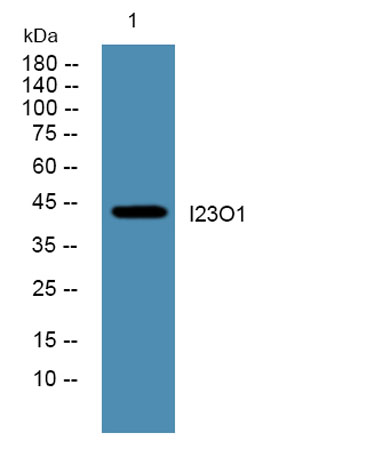
| Observed band (KD) | 44kD |
| Background | This gene encodes indoleamine 2,3-dioxygenase (IDO) - a heme enzyme that catalyzes the first and rate-limiting step in tryptophan catabolism to N-formyl-kynurenine. This enzyme acts on multiple tryptophan substrates including D-tryptophan, L-tryptophan, 5-hydroxy-tryptophan, tryptamine, and serotonin. This enzyme is thought to play a role in a variety of pathophysiological processes such as antimicrobial and antitumor defense, neuropathology, immunoregulation, and antioxidant activity. Through its expression in dendritic cells, monocytes, and macrophages this enzyme modulates T-cell behavior by its peri-cellular catabolization of the essential amino acid tryptophan.[provided by RefSeq, Feb 2011], |
| Function | cytokine production, regulation of cytokine production, negative regulation of cytokine production, positive regulation of cytokine production, response to molecule of bacterial origin, acute inflammatory response, production of molecular mediator of acute inflammatory response, cytokine production during acute inflammatory response, regulation of tolerance induction, positive regulation of tolerance induction, regulation of T cell tolerance induction, positive regulation of T cell tolerance induction, regulation of chronic inflammatory response, positive regulation of chronic inflammatory response, negative regulation of immune system process, positive regulation of immune system process,regulation of leukocyte activation, negative regulation of leukocyte activation, regulation of adaptive immune response, positive regulation of adaptive immune response, regulation of adaptive immune re |
| Subcellular location | Cytoplasm, cytosol . |
| Expression | Expressed in mature dendritic cells located in lymphoid organs (including lymph nodes, spleen, tonsils, Peyers's patches, the gut lamina propria, and the thymic medulla), in some epithelial cells of the female genital tract, as well as in endothelial cells of term placenta and in lung parenchyma (PubMed:25691885). Weakly or not expressed in most normal tissues, but mostly inducible in most tissues (PubMed:25691885). Expressed in more than 50% of tumors, either by tumoral, stromal, or endothelial cells (expression in tumor is associated with a worse clinical outcome) (PubMed:18418598). Not overexpressed in tumor-draining lymph nodes (PubMed:26155395, PubMed:25691885). |

Use collapsible tabs for more detailed information that will help customers make a purchasing decision.
Ex: Shipping and return policies, size guides, and other common questions.