 Français
 English

| ELK.No | ES12539 |
| Product name | TRY6 rabbit pAb |
| Reactivity | Human;Rat;Mouse; |
| Applications | WB |
| Other name | |
| Size | 100μL |
| Unit price ($) | 248 |
| Human gene ID | |
| Human Swiss-Prot | Q8NHM4 |
| Source | Rabbit |
| Isotype | IgG |
| Target | TRY6 |
| Fields | |
| Gene name | TRY6 T6 |
| Protein name | TRY6 |
| Human gene link | |
| Human Swiss link | View Human Swiss-Prot |
| Mouse gene ID | |
| Mouse gene link | |
| Mouse Swiss-Prot | |
| Mouse Swiss link | |
| Rat gene ID | |
| Rat gene link | |
| Rat Swiss-Prot | |
| Rat Swiss link | |
| Immunogen | Synthesized peptide derived from human TRY6 AA range: 21-71 |
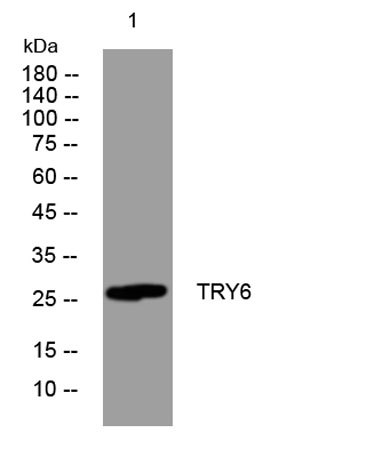
| Specificity | This antibody detects endogenous levels of TRY6 at Human |
| Formulation | Liquid in PBS containing 50% glycerol, 0.5% BSA and 0.02% sodium azide. |
| Clonality | Polyclonal |
| Dilution | WB 1:500-2000 |
| Purification | The antibody was affinity-purified from rabbit serum by affinity-chromatography using specific immunogen. |
| Concentration | 1 mg/ml |
| Storage stability | -20°C/1 year |
| Molecular Weight (Da) | 27kD |
| Observed band (KD) | |
| Background | Although this locus appears to encode a protein similar to trypsinogen, the locus is thought to be a transcribed pseudogene. ESTs support its transcription, but expression of its predicted protein has not been observed. Its predicted protein sequence differs significantly from the known functional trypsinogens, including a different amino acid at the conserved residue 122 which is important for autolysis. This pseudogene and several other trypsinogen genes are localized to the T cell receptor beta locus on chromosome 7. [provided by RefSeq, Jul 2008], |
| Function | catalytic activity:Preferential cleavage: Arg-|-Xaa, Lys-|-Xaa.,caution:Tyr-154 was proposed to be phosphorylated (PubMed:8683601) but it has been shown (PubMed:17087724) to be sulfated instead. Phosphate and sulfate groups are similar in mass and size, and this can lead to erroneous interpretation of the results.,cofactor:Binds 1 calcium ion per subunit.,disease:Defects in PRSS1 are a cause of hereditary pancreatitis (HPC) [MIM:167800]; also known as chronic pancreatitis (CP). HPC is an autosomal dominant disease characterized by the presence of calculi in pancreatic ducts. It causes severe abdominal pain attacks.,function:Has activity against the synthetic substrates Boc-Phe-Ser-Arg-Mec, Boc-Leu-Thr-Arg-Mec, Boc-Gln-Ala-Arg-Mec and Boc-Val-Pro-Arg-Mec. The single-chain form is more active than the two-chain form against all of these substrates.,mass spectrometry: PubMed:8683601,PTM:Occ |
| Subcellular location | Secreted . |
| Expression | Overexpressed in metastasing in non small cell lung tumors, leading to an enhanced cell migration. |

Use collapsible tabs for more detailed information that will help customers make a purchasing decision.
Ex: Shipping and return policies, size guides, and other common questions.