 Français
 English
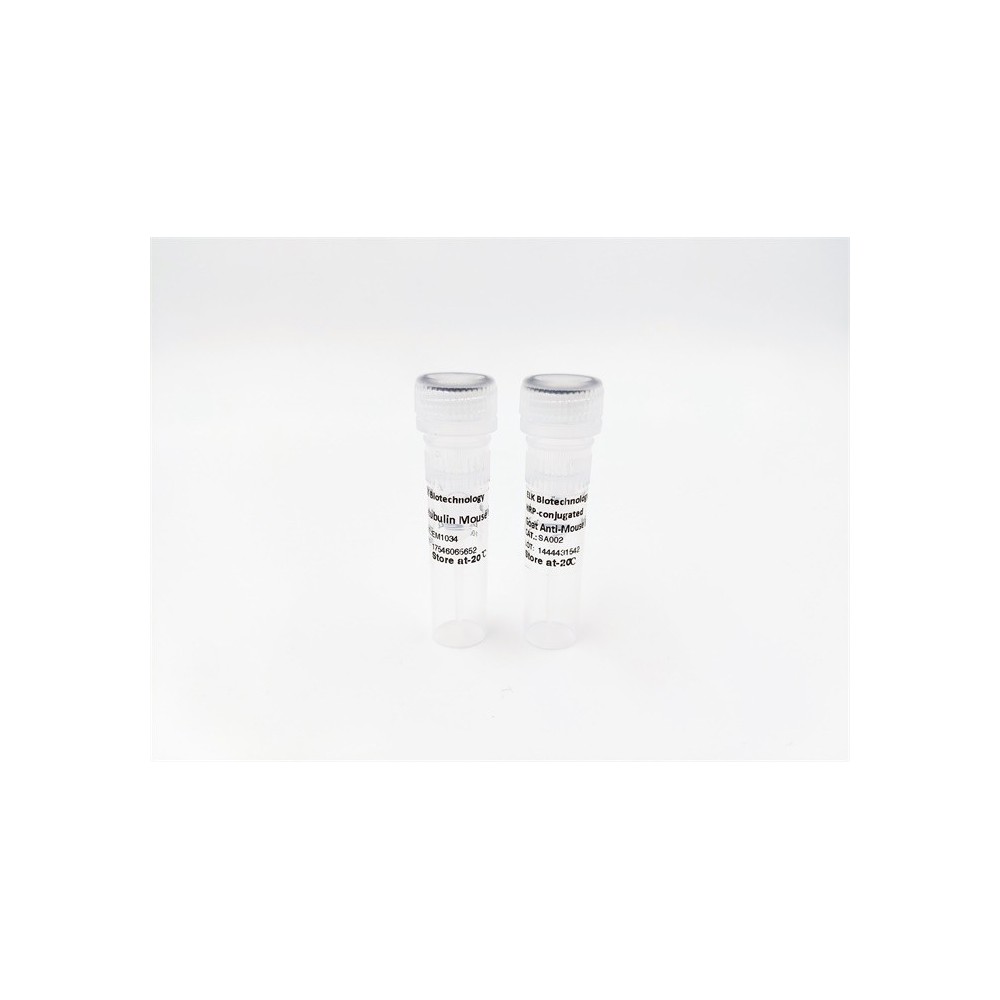

| ELK.No | ES12602 |
| Product name | TPM4 rabbit pAb |
| Reactivity | Human; Mouse;Rat |
| Applications | WB |
| Other name | |
| Size | 100μL |
| Unit price ($) | 248 |
| Human gene ID | 7171 |
| Human Swiss-Prot | P67936 |
| Source | Rabbit |
| Isotype | IgG |
| Target | TPM4 |
| Fields | >>Cardiac muscle contraction;>>Adrenergic signaling in cardiomyocytes;>>Hypertrophic cardiomyopathy;>>Dilated cardiomyopathy |
| Gene name | TPM4 |
| Protein name | TPM4 |
| Human gene link | View Human Gene |
| Human Swiss link | View Human Swiss-Prot |
| Mouse gene ID | 326618 |
| Mouse gene link | View Mouse Gene |
| Mouse Swiss-Prot | Q6IRU2 |
| Mouse Swiss link | View Mouse Swiss-Prot |
| Rat gene ID | 24852 |
| Rat gene link | View Rat Gene |
| Rat Swiss-Prot | P09495 |
| Rat Swiss link | View Rat Swiss-Prot |
| Immunogen | Synthesized peptide derived from human TPM4 AA range: 127-177 |
| Specificity | This antibody detects endogenous levels of TPM4 at Human/Mouse/Rat |
| Formulation | Liquid in PBS containing 50% glycerol, 0.5% BSA and 0.02% sodium azide. |
| Clonality | Polyclonal |
| Dilution | WB 1:500-2000 |
| Purification | The antibody was affinity-purified from rabbit serum by affinity-chromatography using specific immunogen. |
| Concentration | 1 mg/ml |
| Storage stability | -20°C/1 year |
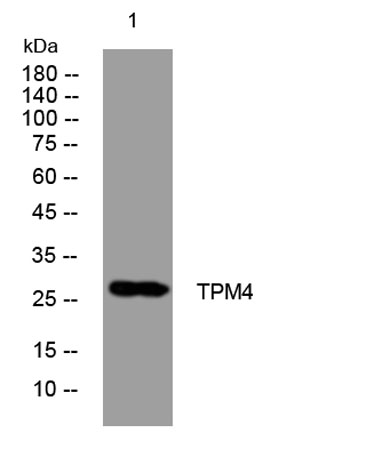
| Molecular Weight (Da) | 27kD |
| Observed band (KD) | |
| Background | This gene encodes a member of the tropomyosin family of actin-binding proteins involved in the contractile system of striated and smooth muscles and the cytoskeleton of non-muscle cells. Tropomyosins are dimers of coiled-coil proteins that polymerize end-to-end along the major groove in most actin filaments. They provide stability to the filaments and regulate access of other actin-binding proteins. In muscle cells, they regulate muscle contraction by controlling the binding of myosin heads to the actin filament. Multiple transcript variants encoding different isoforms have been found for this gene. [provided by RefSeq, Nov 2009], |
| Function | domain:The molecule is in a coiled coil structure that is formed by 2 polypeptide chains. The sequence exhibits a prominent seven-residues periodicity.,function:Binds to actin filaments in muscle and non-muscle cells. Plays a central role, in association with the troponin complex, in the calcium dependent regulation of vertebrate striated muscle contraction. Smooth muscle contraction is regulated by interaction with caldesmon. In non-muscle cells is implicated in stabilizing cytoskeleton actin filaments. Binds calcium.,similarity:Belongs to the tropomyosin family.,subunit:Heterodimer of an alpha and a beta chain.,tissue specificity:Detected in cardiac tissue and platelets, the form found in cardiac tissue is a higher molecular weight than the form found in platelets. Expressed at higher levels in the platelets of hypertensive patients with cardiac hypertrophy than in the platelets of hyp |
| Subcellular location | Cytoplasm, cytoskeleton . Associates with F-actin stress fibers. . |
| Expression | Detected in cardiac tissue and platelets, the form found in cardiac tissue is a higher molecular weight than the form found in platelets. Expressed at higher levels in the platelets of hypertensive patients with cardiac hypertrophy than in the platelets of hypertensive patients without cardiac hypertrophy (at protein level). |

Use collapsible tabs for more detailed information that will help customers make a purchasing decision.
Ex: Shipping and return policies, size guides, and other common questions.