 Français
 English

| ELK.No | ES12895 |
| Product name | STRUM rabbit pAb |
| Reactivity | Human; Mouse |
| Applications | WB;IHC |
| Other name | |
| Size | 50μL |
| Unit price ($) | 148 |
| Human gene ID | 9897 |
| Human Swiss-Prot | Q12768 |
| Source | Rabbit |
| Isotype | IgG |
| Target | STRUM |
| Fields | >>Endocytosis |
| Gene name | KIAA0196 |
| Protein name | STRUM |
| Human gene link | View Human Gene |
| Human Swiss link | View Human Swiss-Prot |
| Mouse gene ID | 223593 |
| Mouse gene link | View Mouse Gene |
| Mouse Swiss-Prot | Q8C2E7 |
| Mouse Swiss link | View Mouse Swiss-Prot |
| Rat gene ID | |
| Rat gene link | |
| Rat Swiss-Prot | |
| Rat Swiss link | |
| Immunogen | Synthesized peptide derived from human STRUM AA range: 515-565 |
| Specificity | This antibody detects endogenous levels of STRUM at Human/Mouse |
| Formulation | Liquid in PBS containing 50% glycerol, 0.5% BSA and 0.02% sodium azide. |
| Clonality | Polyclonal |
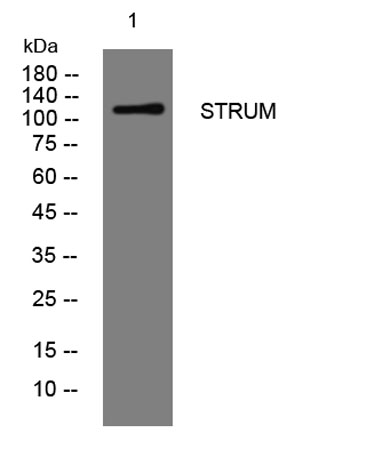
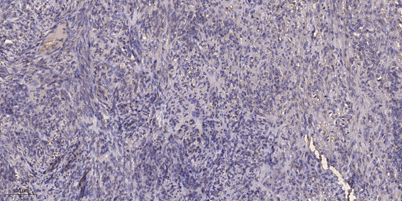
| Dilution | WB 1:500-2000;IHC-p 1:50-300 |
| Purification | The antibody was affinity-purified from rabbit serum by affinity-chromatography using specific immunogen. |
| Concentration | 1 mg/ml |
| Storage stability | -20°C/1 year |
| Molecular Weight (Da) | 127kD |
| Observed band (KD) | |
| Background | This gene encodes a 134 kDa protein named strumpellin that is predicted to have multiple transmembrane domains and a spectrin-repeat-containing domain. This ubiquitously expressed gene has its highest expression in skeletal muscle. The protein is named for Strumpell disease; a form of hereditary spastic paraplegia (HSP). Spastic paraplegias are a diverse group of disorders in which the autosomal dominant forms are characterized by progressive, lower extremity spasticity caused by axonal degeneration in the terminal portions of the longest descending and ascending corticospinal tracts. More than 30 loci (SPG1-33) have been implicated in hereditary spastic paraplegia diseases. [provided by RefSeq, Aug 2009], |
| Function | disease:Defects in KIAA0196 are the cause of spastic paraplegia autosomal dominant type 8 (SPG8) [MIM:603563]. Spastic paraplegia is a neurodegenerative disorder characterized by a slow, gradual, progressive weakness and spasticity of the lower limbs. Spastic paraplegia is a neurodegenerative disorder characterized by a slow, gradual, progressive weakness and spasticity of the lower limbs. Rate of progression and the severity of symptoms are quite variable. Initial symptoms may include difficulty with balance, weakness and stiffness in the legs, muscle spasms, and dragging the toes when walking. In some forms of the disorder, bladder symptoms (such as incontinence) may appear, or the weakness and stiffness may spread to other parts of the body.,similarity:Belongs to the strumpellin family.,tissue specificity:Expressed ubiquitously., |
| Subcellular location | Cytoplasm, cytosol . Endoplasmic reticulum . Early endosome . Colocalizes with SYP/synaptophysin in the external molecular layer of the dentate gyrus and in motoneurons of the ventral horn of spinal cord. . |
| Expression | Expressed ubiquitously. |

Use collapsible tabs for more detailed information that will help customers make a purchasing decision.
Ex: Shipping and return policies, size guides, and other common questions.