 Français
 English
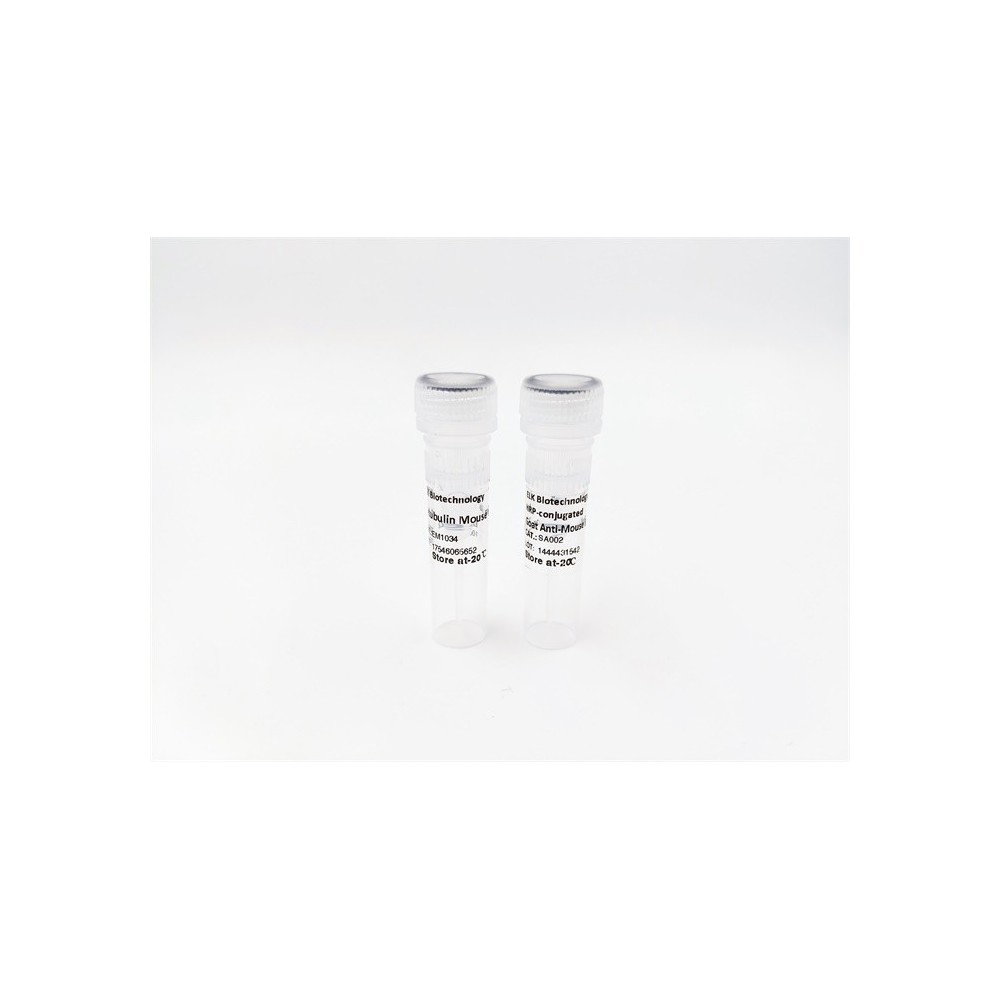

| ELK.No | ES12941 |
| Product name | SSX2 rabbit pAb |
| Reactivity | Human;Rat;Mouse; |
| Applications | WB |
| Other name | |
| Size | 100μL |
| Unit price ($) | 248 |
| Human gene ID | 6757 |
| Human Swiss-Prot | Q16385 |
| Source | Rabbit |
| Isotype | IgG |
| Target | SSX2 |
| Fields | >>Transcriptional misregulation in cancer |
| Gene name | SSX2 SSX2A; SSX2B |
| Protein name | SSX2 |
| Human gene link | View Human Gene |
| Human Swiss link | View Human Swiss-Prot |
| Mouse gene ID | |
| Mouse gene link | |
| Mouse Swiss-Prot | |
| Mouse Swiss link | |
| Rat gene ID | |
| Rat gene link | |
| Rat Swiss-Prot | |
| Rat Swiss link | |
| Immunogen | Synthesized peptide derived from human SSX2 AA range: 16-66 |
| Specificity | This antibody detects endogenous levels of SSX2 at Human |
| Formulation | Liquid in PBS containing 50% glycerol, 0.5% BSA and 0.02% sodium azide. |
| Clonality | Polyclonal |
| Dilution | WB 1:500-2000 |
| Purification | The antibody was affinity-purified from rabbit serum by affinity-chromatography using specific immunogen. |
| Concentration | 1 mg/ml |
| Storage stability | -20°C/1 year |
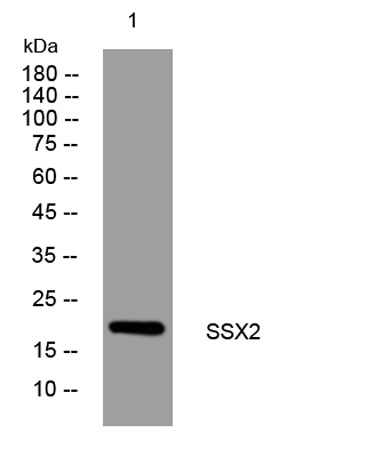
| Molecular Weight (Da) | 21kD |
| Observed band (KD) | |
| Background | The product of this gene belongs to the family of highly homologous synovial sarcoma X (SSX) breakpoint proteins. These proteins may function as transcriptional repressors. They are also capable of eliciting spontaneous humoral and cellular immune responses in cancer patients, and are potentially useful targets in cancer vaccine-based immunotherapy. This gene, and also the SSX1 and SSX4 family members, have been involved in t(X;18)(p11.2;q11.2) translocations that are characteristically found in all synovial sarcomas. This translocation results in the fusion of the synovial sarcoma translocation gene on chromosome 18 to one of the SSX genes on chromosome X. The encoded hybrid proteins are likely responsible for transforming activity. Alternative splicing of this gene results in multiple transcript variants. This gene also has an identical duplicate, GeneID: 727837, located about 45 kb downstream in the opposite orientation on chromosome X. [provided by RefSeq, Jul 2013], |
| Function | disease:A chromosomal aberration involving SSX2 may be a cause of synovial sarcoma. Translocation t(X;18)(p11.2;q11.2). The translocation is specifically found in more than 80% of synovial sarcoma. The fusion products SSXT-SSX1 or SSXT-SSX2 are probably responsible for transforming activity. Heterogeneity in the position of the breakpoint can occur (low frequency).,function:Could act as a modulator of transcription.,similarity:Belongs to the SSX family.,similarity:Contains 1 KRAB-related domain.,subunit:Interacts via its N-terminal region with RAB3IP and SSX2IP.,tissue specificity:Expressed at high level in the testis. Expressed at low level in thyroid. Not detected in tonsil, colon, lung, spleen, prostate, kidney, striated and smooth muscles. Detected in rhabdomyosarcoma and fibrosarcoma cell lines. Not detected in mesenchymal and epithelial cell lines., |
| Subcellular location | Nucleus. |
| Expression | Expressed at high level in the testis. Expressed at low level in thyroid. Not detected in tonsil, colon, lung, spleen, prostate, kidney, striated and smooth muscles. Detected in rhabdomyosarcoma and fibrosarcoma cell lines. Not detected in mesenchymal and epithelial cell lines. |

Use collapsible tabs for more detailed information that will help customers make a purchasing decision.
Ex: Shipping and return policies, size guides, and other common questions.