 Français
 English

| ELK.No | ES13047 |
| Product name | SMOX rabbit pAb |
| Reactivity | Human; Mouse |
| Applications | WB |
| Other name | |
| Size | 50μL |
| Unit price ($) | 148 |
| Human gene ID | 54498 |
| Human Swiss-Prot | Q9NWM0 |
| Source | Rabbit |
| Isotype | IgG |
| Target | SMOX |
| Fields | >>Arginine and proline metabolism;>>beta-Alanine metabolism;>>Metabolic pathways |
| Gene name | SMOX C20orf16 SMO UNQ3039/PRO9854 |
| Protein name | SMOX |
| Human gene link | View Human Gene |
| Human Swiss link | View Human Swiss-Prot |
| Mouse gene ID | 228608 |
| Mouse gene link | View Mouse Gene |
| Mouse Swiss-Prot | Q99K82 |
| Mouse Swiss link | View Mouse Swiss-Prot |
| Rat gene ID | |
| Rat gene link | |
| Rat Swiss-Prot | |
| Rat Swiss link | |
| Immunogen | Synthesized peptide derived from human SMOX AA range: 212-262 |
| Specificity | This antibody detects endogenous levels of SMOX at Human/Mouse |
| Formulation | Liquid in PBS containing 50% glycerol, 0.5% BSA and 0.02% sodium azide. |
| Clonality | Polyclonal |
| Dilution | WB 1:500-2000 |
| Purification | The antibody was affinity-purified from rabbit serum by affinity-chromatography using specific immunogen. |
| Concentration | 1 mg/ml |
| Storage stability | -20°C/1 year |
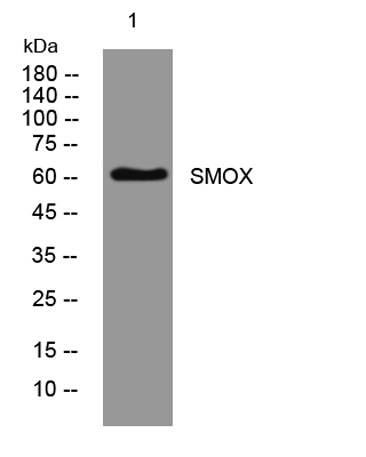
| Molecular Weight (Da) | 61kD |
| Observed band (KD) | |
| Background | Polyamines are ubiquitous polycationic alkylamines which include spermine, spermidine, putrescine, and agmatine. These molecules participate in a broad range of cellular functions which include cell cycle modulation, scavenging reactive oxygen species, and the control of gene expression. These molecules also play important roles in neurotransmission through their regulation of cell-surface receptor activity, involvement in intracellular signalling pathways, and their putative roles as neurotransmitters. This gene encodes an FAD-containing enzyme that catalyzes the oxidation of spermine to spermadine and secondarily produces hydrogen peroxide. Multiple transcript variants encoding different isoenzymes have been identified for this gene, some of which have failed to demonstrate significant oxidase activity on natural polyamine substrates. The characterized isoenzymes have distinctive biochemical characteristics and substrate specificities, suggesting the existence of additional levels of complexity in polyamine catabolism. [provided by RefSeq, Jul 2012], |
| Function | alternative products:At least 5 different isozymes are produced by alternative splicing of 8 exons. The resultant proteins have different biochemical characteristics and substrate specificity,catalytic activity:Spermidine + O(2) + H(2)O = putrescine + 3-aminopropanal + H(2)O(2).,catalytic activity:Spermine + O(2) + H(2)O = spermidine + 3-aminopropanal + H(2)O(2).,cofactor:Binds 1 FAD per subunit.,enzyme regulation:Inhibited at more than 90% by SL-11144, SL-11150 and SL-11158, at concentrations less than 1uM.,function:Flavoenzyme which catalyzes the oxidation of spermine to spermidine. Can also use N(1)-acetylspermine and spermidine as substrates, with different affinity depending on the isoform (isozyme) and on the experimental conditions. Plays an important role in the regulation of polyamine intracellular concentration and has the potential to act as a determinant of cellular sensitivi |
| Subcellular location | [Isoform 1]: Cytoplasm. Nucleus.; [Isoform 4]: Cytoplasm. Nucleus.; [Isoform 6]: Cytoplasm. Nucleus. |
| Expression | Widely expressed. Expressed in human tumor cell lines. Isoform 4 is only found in an embryonal kidney cell line. |

Use collapsible tabs for more detailed information that will help customers make a purchasing decision.
Ex: Shipping and return policies, size guides, and other common questions.