 Français
 English

| ELK.No | ES13109 |
| Product name | SIAH1 rabbit pAb |
| Reactivity | Human;Rat |
| Applications | WB |
| Other name | |
| Size | 100μL |
| Unit price ($) | 248 |
| Human gene ID | 6477 |
| Human Swiss-Prot | Q8IUQ4 |
| Source | Rabbit |
| Isotype | IgG |
| Target | SIAH1 |
| Fields | >>p53 signaling pathway;>>Ubiquitin mediated proteolysis;>>Wnt signaling pathway |
| Gene name | SIAH1 HUMSIAH |
| Protein name | SIAH1 |
| Human gene link | View Human Gene |
| Human Swiss link | View Human Swiss-Prot |
| Mouse gene ID | |
| Mouse gene link | |
| Mouse Swiss-Prot | |
| Mouse Swiss link | |
| Rat gene ID | 140941 |
| Rat gene link | View Rat Gene |
| Rat Swiss-Prot | Q920M9 |
| Rat Swiss link | View Rat Swiss-Prot |
| Immunogen | Synthesized peptide derived from human SIAH1 AA range: 157-207 |
| Specificity | This antibody detects endogenous levels of SIAH1 at Human/Rat |
| Formulation | Liquid in PBS containing 50% glycerol, 0.5% BSA and 0.02% sodium azide. |
| Clonality | Polyclonal |
| Dilution | WB 1:500-2000 |
| Purification | The antibody was affinity-purified from rabbit serum by affinity-chromatography using specific immunogen. |
| Concentration | 1 mg/ml |
| Storage stability | -20°C/1 year |
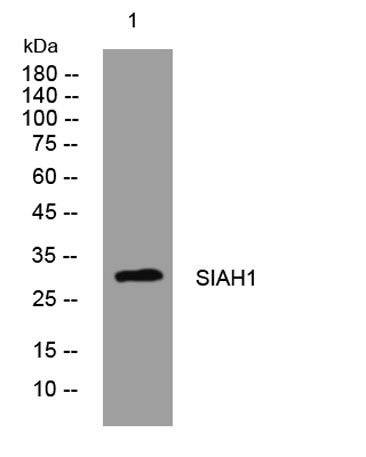
| Molecular Weight (Da) | 31kD |
| Observed band (KD) | |
| Background | This gene encodes a protein that is a member of the seven in absentia homolog (SIAH) family. The protein is an E3 ligase and is involved in ubiquitination and proteasome-mediated degradation of specific proteins. The activity of this ubiquitin ligase has been implicated in the development of certain forms of Parkinson's disease, the regulation of the cellular response to hypoxia and induction of apoptosis. Alternative splicing results in several additional transcript variants, some encoding different isoforms and others that have not been fully characterized. [provided by RefSeq, Jul 2008], |
| Function | domain:The RING-type zinc finger domain is essential for ubiquitin ligase activity.,domain:The SBD domain (substrate-binding domain) mediates the homodimerization and the interaction with substrate proteins. It is related to the TRAF family.,function:E3 ubiquitin-protein ligase that mediates ubiquitination and subsequent proteasomal degradation of target proteins. E3 ubiquitin ligases accept ubiquitin from an E2 ubiquitin-conjugating enzyme in the form of a thioester and then directly transfers the ubiquitin to targeted substrates. Mediates E3 ubiquitin ligase activity either through direct binding to substrates or by functioning as the essential RING domain subunit of larger E3 complexes. Triggers the ubiquitin-mediated degradation of many substrates, including proteins involved in transcription regulation (MYB, POU2AF1, PML and RBBP8), a cell surface receptor (DCC), cytoplasmic signal |
| Subcellular location | Cytoplasm. Nucleus. Predominantly cytoplasmic. Partially nuclear. |
| Expression | Widely expressed at a low level. Down-regulated in advanced hepatocellular carcinomas. |

Use collapsible tabs for more detailed information that will help customers make a purchasing decision.
Ex: Shipping and return policies, size guides, and other common questions.