 Français
 English
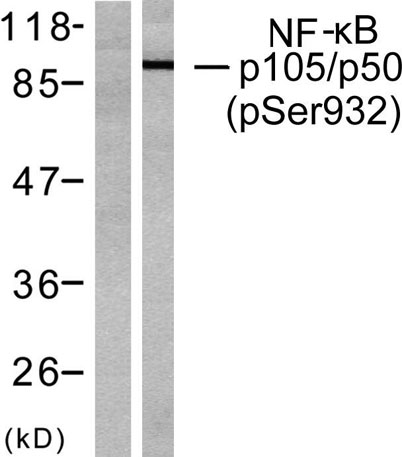
NFκB-p105 (phospho Ser932) rabbit pAb
AO-06-ES1367-100

| ELK.No | ES1367 |
| Product name | NFκB-p105 (phospho Ser932) rabbit pAb |
| Reactivity | Human;Mouse;Rat |
| Applications | WB;IHC;IF;ELISA |
| Other name | NFKB1; Nuclear factor NF-kappa-B p105 subunit; DNA-binding factor KBF1; EBP-1; Nuclear factor of kappa light polypeptide gene enhancer in B-cells 1 |
| Size | 100μL |
| Unit price ($) | 248 |
| Human gene ID | 4790 |
| Human Swiss-Prot | P19838 |
| Source | Rabbit |
| Isotype | IgG |
| Target | NFKB1 |
| Fields | >>Antifolate resistance;>>MAPK signaling pathway;>>Ras signaling pathway;>>cAMP signaling pathway;>>Chemokine signaling pathway;>>NF-kappa B signaling pathway;>>HIF-1 signaling pathway;>>Sphingolipid signaling pathway;>>PI3K-Akt signaling pathway;>>Apoptosis;>>Longevity regulating pathway;>>Cellular senescence;>>Osteoclast differentiation;>>Neutrophil extracellular trap formation;>>Toll-like receptor signaling pathway;>>NOD-like receptor signaling pathway;>>RIG-I-like receptor signaling pathway;>>Cytosolic DNA-sensing pathway;>>C-type lectin receptor signaling pathway;>>IL-17 signaling pathway;>>Th1 and Th2 cell differentiation;>>Th17 cell differentiation;>>T cell receptor signaling pathway;>>B cell receptor signaling pathway;>>TNF signaling pathway;>>Neurotrophin signaling pathway;>>Prolactin signaling pathway;>>Adipocytokine signaling pathway;>>Relaxin signaling pathway;>>Insulin resistance;>>Non-alcoholic fatty liver disease;>>AGE-RAGE signaling pathway in diabetic complications;>>A |
| Gene name | NFKB1 |
| Protein name | Nuclear factor NF-kappa-B p105 subunit |
| Human gene link | View Human Gene |
| Human Swiss link | View Human Swiss-Prot |
| Mouse gene ID | 18033 |
| Mouse gene link | View Mouse Gene |
| Mouse Swiss-Prot | P25799 |
| Mouse Swiss link | View Mouse Swiss-Prot |
| Rat gene ID | |
| Rat gene link | |
| Rat Swiss-Prot | Q63369 |
| Rat Swiss link | View Rat Swiss-Prot |
| Immunogen | The antiserum was produced against synthesized peptide derived from human NF-kappaB p105/p50 around the phosphorylation site of Ser932. AA range:899-948 |
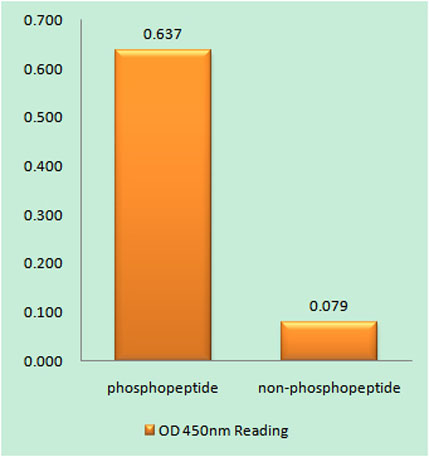
| Specificity | Phospho-NFκB-p105 (S932) Polyclonal Antibody detects endogenous levels of NFκB-p105 protein only when phosphorylated at S932. |
| Formulation | Liquid in PBS containing 50% glycerol, 0.5% BSA and 0.02% sodium azide. |
| Clonality | Polyclonal |
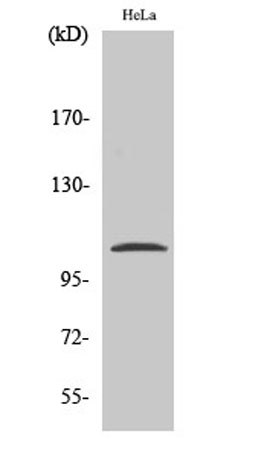
| Dilution | Western Blot: 1/500 - 1/2000. Immunohistochemistry: 1/100 - 1/300. ELISA: 1/10000. Not yet tested in other applications. |
| Purification | The antibody was affinity-purified from rabbit antiserum by affinity-chromatography using epitope-specific immunogen. |
| Concentration | 1 mg/ml |
| Storage stability | -20°C/1 year |
| Molecular Weight (Da) | |
| Observed band (KD) | 105kD |
| Background | nuclear factor kappa B subunit 1(NFKB1) Homo sapiens This gene encodes a 105 kD protein which can undergo cotranslational processing by the 26S proteasome to produce a 50 kD protein. The 105 kD protein is a Rel protein-specific transcription inhibitor and the 50 kD protein is a DNA binding subunit of the NF-kappa-B (NFKB) protein complex. NFKB is a transcription regulator that is activated by various intra- and extra-cellular stimuli such as cytokines, oxidant-free radicals, ultraviolet irradiation, and bacterial or viral products. Activated NFKB translocates into the nucleus and stimulates the expression of genes involved in a wide variety of biological functions. Inappropriate activation of NFKB has been associated with a number of inflammatory diseases while persistent inhibition of NFKB leads to inappropriate immune cell development or delayed cell growth. Alternative splicing results in multiple transcript variants encoding different isof |
| Function | domain:Glycine-rich region (GRR) appears to be a critical element in the generation of p50.,domain:The C-terminus of p105 might be involved in cytoplasmic retention, inhibition of DNA-binding, and transcription activation.,function:NF-kappa-B is a pleiotropic transcription factor which is present in almost all cell types and is involved in many biological processed such as inflammation, immunity, differentiation, cell growth, tumorigenesis and apoptosis. NF-kappa-B is a homo- or heterodimeric complex formed by the Rel-like domain-containing proteins RELA/p65, RELB, NFKB1/p105, NFKB1/p50, REL and NFKB2/p52 and the heterodimeric p65-p50 complex appears to be most abundant one. The dimers bind at kappa-B sites in the DNA of their target genes and the individual dimers have distinct preferences for different kappa-B sites that they can bind with distinguishable affinity and specificity. Diff |
| Subcellular location | Nucleus. Cytoplasm. Nuclear, but also found in the cytoplasm in an inactive form complexed to an inhibitor (I-kappa-B). |
| Expression | Muscle,Rectum tumor,Uterus, |

Use collapsible tabs for more detailed information that will help customers make a purchasing decision.
Ex: Shipping and return policies, size guides, and other common questions.