 Français
 English
p21 (phospho Thr145) rabbit pAb
AO-06-ES1377-50

| ELK.No | ES1377 |
| Product name | p21 (phospho Thr145) rabbit pAb |
| Reactivity | Human;Mouse;Rat |
| Applications | WB;IHC;IF;ELISA |
| Other name | CDKN1A; CAP20; CDKN1; CIP1; MDA6; PIC1; SDI1; WAF1; Cyclin-dependent kinase inhibitor 1; CDK-interacting protein 1; Melanoma differentiation-associated protein 6; MDA-6; p21 |
| Size | 50μL |
| Unit price ($) | 148 |
| Human gene ID | 1026 |
| Human Swiss-Prot | P38936 |
| Source | Rabbit |
| Isotype | IgG |
| Target | p21 |
| Fields | >>Endocrine resistance;>>Platinum drug resistance;>>ErbB signaling pathway;>>HIF-1 signaling pathway;>>FoxO signaling pathway;>>Cell cycle;>>p53 signaling pathway;>>PI3K-Akt signaling pathway;>>Cellular senescence;>>JAK-STAT signaling pathway;>>Oxytocin signaling pathway;>>Parathyroid hormone synthesis, secretion and action;>>Cushing syndrome;>>Hepatitis C;>>Hepatitis B;>>Human cytomegalovirus infection;>>Human papillomavirus infection;>>Human T-cell leukemia virus 1 infection;>>Kaposi sarcoma-associated herpesvirus infection;>>Epstein-Barr virus infection;>>Pathways in cancer;>>Transcriptional misregulation in cancer;>>Viral carcinogenesis;>>Proteoglycans in cancer;>>MicroRNAs in cancer;>>Colorectal cancer;>>Renal cell carcinoma;>>Pancreatic cancer;>>Endometrial cancer;>>Glioma;>>Prostate cancer;>>Thyroid cancer;>>Basal cell carcinoma;>>Melanoma;>>Bladder cancer;>>Chronic myeloid leukemia;>>Small cell lung cancer;>>Non-small cell lung cancer;>>Breast cancer;>>Hepatocellular carcinoma; |
| Gene name | CDKN1A |
| Protein name | Cyclin-dependent kinase inhibitor 1 |
| Human gene link | View Human Gene |
| Human Swiss link | View Human Swiss-Prot |
| Mouse gene ID | 12575 |
| Mouse gene link | View Mouse Gene |
| Mouse Swiss-Prot | P39689 |
| Mouse Swiss link | View Mouse Swiss-Prot |
| Rat gene ID | |
| Rat gene link | |
| Rat Swiss-Prot | |
| Rat Swiss link | |
| Immunogen | The antiserum was produced against synthesized peptide derived from human p21 Cip1 around the phosphorylation site of Thr145. AA range:111-160 |
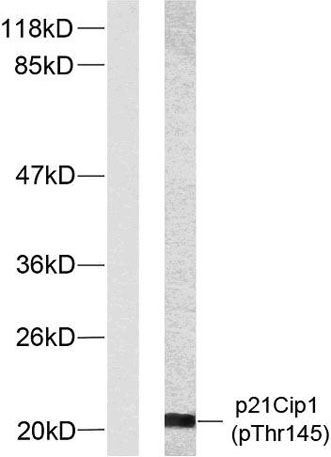
| Specificity | Phospho-p21 (T145) Polyclonal Antibody detects endogenous levels of p21 protein only when phosphorylated at T145. |
| Formulation | Liquid in PBS containing 50% glycerol, 0.5% BSA and 0.02% sodium azide. |
| Clonality | Polyclonal |
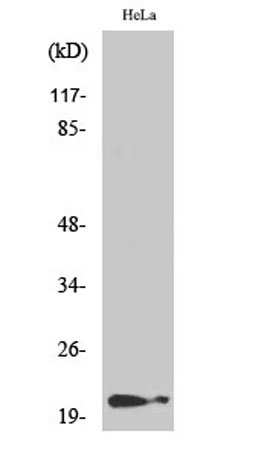
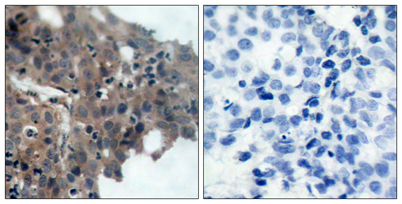
| Dilution | Western Blot: 1/500 - 1/2000. Immunohistochemistry: 1/100 - 1/300. ELISA: 1/10000. Not yet tested in other applications. |
| Purification | The antibody was affinity-purified from rabbit antiserum by affinity-chromatography using epitope-specific immunogen. |
| Concentration | 1 mg/ml |
| Storage stability | -20°C/1 year |
| Molecular Weight (Da) | 18kD |
| Observed band (KD) | |
| Background | This gene encodes a potent cyclin-dependent kinase inhibitor. The encoded protein binds to and inhibits the activity of cyclin-cyclin-dependent kinase2 or -cyclin-dependent kinase4 complexes, and thus functions as a regulator of cell cycle progression at G1. The expression of this gene is tightly controlled by the tumor suppressor protein p53, through which this protein mediates the p53-dependent cell cycle G1 phase arrest in response to a variety of stress stimuli. This protein can interact with proliferating cell nuclear antigen, a DNA polymerase accessory factor, and plays a regulatory role in S phase DNA replication and DNA damage repair. This protein was reported to be specifically cleaved by CASP3-like caspases, which thus leads to a dramatic activation of cyclin-dependent kinase2, and may be instrumental in the execution of apoptosis following caspase activation. Mice that lac |
| Function | function:May be the important intermediate by which p53 mediates its role as an inhibitor of cellular proliferation in response to DNA damage. Binds to and inhibits cyclin-dependent kinase activity, preventing phosphorylation of critical cyclin-dependent kinase substrates and blocking cell cycle progression.,induction:By p53, mezerein (antileukemic compound) and interferon beta.,PTM:Phosphorylation of Thr-145 by Akt or of Ser-146 by PKC impairs binding to PCNA.,similarity:Belongs to the CDI family.,tissue specificity:Expressed in all adult human tissues, with 5-fold lower levels observed in the brain., |
| Subcellular location | Cytoplasm . Nucleus . |
| Expression | Expressed in all adult tissues, with 5-fold lower levels observed in the brain. |

Use collapsible tabs for more detailed information that will help customers make a purchasing decision.
Ex: Shipping and return policies, size guides, and other common questions.