 Français
 English

| ELK.No | ES13828 |
| Product name | R9BP rabbit pAb |
| Reactivity | Human; Mouse |
| Applications | WB;ELISA;IHC |
| Other name | |
| Size | 50μL |
| Unit price ($) | 148 |
| Human gene ID | 388531 |
| Human Swiss-Prot | Q6ZS82 |
| Source | Rabbit |
| Isotype | IgG |
| Target | R9BP |
| Fields | |
| Gene name | RGS9BP R9AP |
| Protein name | R9BP |
| Human gene link | View Human Gene |
| Human Swiss link | View Human Swiss-Prot |
| Mouse gene ID | 243923 |
| Mouse gene link | View Mouse Gene |
| Mouse Swiss-Prot | Q148R9 |
| Mouse Swiss link | View Mouse Swiss-Prot |
| Rat gene ID | |
| Rat gene link | |
| Rat Swiss-Prot | |
| Rat Swiss link | |
| Immunogen | Synthesized peptide derived from human R9BP AA range: 138-188 |
| Specificity | This antibody detects endogenous levels of R9BP at Human/Mouse |
| Formulation | Liquid in PBS containing 50% glycerol, 0.5% BSA and 0.02% sodium azide. |
| Clonality | Polyclonal |
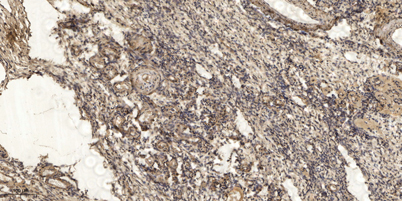
| Dilution | WB 1:500-2000;IHC-p 1:50-300; ELISA 2000-20000 |
| Purification | The antibody was affinity-purified from rabbit serum by affinity-chromatography using specific immunogen. |
| Concentration | 1 mg/ml |
| Storage stability | -20°C/1 year |
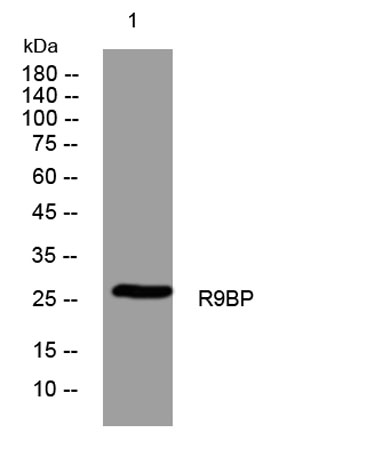
| Molecular Weight (Da) | 26kD |
| Observed band (KD) | |
| Background | The protein encoded by this gene functions as a regulator of G protein-coupled receptor signaling in phototransduction. Studies in bovine and mouse show that this gene is expressed only in the retina, and is localized in the rod outer segment membranes. This protein is associated with a heterotetrameric complex, specifically interacting with the regulator of G-protein signaling 9, and appears to function as the membrane anchor for the other largely soluble interacting partners. Mutations in this gene are associated with prolonged electroretinal response suppression (PERRS), also known as bradyopsia. [provided by RefSeq, Mar 2010], |
| Function | disease:Defects in RGS9BP are a cause of prolonged electroretinal response suppression (PERRS) [MIM:608415]; also known as bradyopsia. PERRS is characterized by difficulty adjusting to sudden changes in luminance levels mediated by cones.,function:Regulator of G protein-coupled receptor (GPCR) signaling in phototransduction. Participates to the recovery phase of visual transduction via its interaction with RGS9-1 isoform. Acts as a membrane-anchor that mediates the targeting of RGS9-1 to the photoreceptor outer segment, where phototransduction takes place. Enhances the ability of RGS9-1 to stimulate G protein GTPase activity, allowing the visual signal to be terminated on the physiologically time scale. It also controls the proteolytic stability of RGS9-1, probably by protecting it from degradation.,similarity:Belongs to the RGS7BP/RGS9BP family.,subunit:Specifically interacts with isofo |
| Subcellular location | Membrane ; Single-pass type IV membrane protein . |
| Expression |

Use collapsible tabs for more detailed information that will help customers make a purchasing decision.
Ex: Shipping and return policies, size guides, and other common questions.