 Français
 English

| ELK.No | ES13831 |
| Product name | QPCT rabbit pAb |
| Reactivity | Human; Mouse |
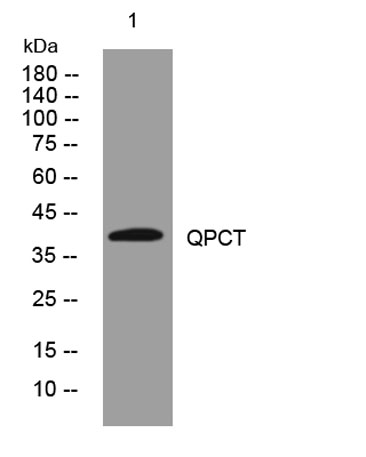
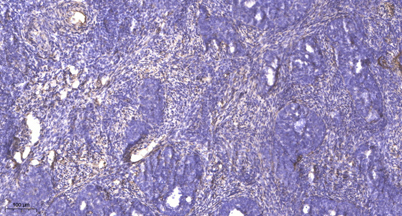
| Applications | WB;IHC |
| Other name | |
| Size | 100μL |
| Unit price ($) | 248 |
| Human gene ID | 25797 |
| Human Swiss-Prot | Q16769 |
| Source | Rabbit |
| Isotype | IgG |
| Target | QPCT |
| Fields | |
| Gene name | QPCT |
| Protein name | QPCT |
| Human gene link | View Human Gene |
| Human Swiss link | View Human Swiss-Prot |
| Mouse gene ID | 70536 |
| Mouse gene link | View Mouse Gene |
| Mouse Swiss-Prot | Q9CYK2 |
| Mouse Swiss link | View Mouse Swiss-Prot |
| Rat gene ID | |
| Rat gene link | |
| Rat Swiss-Prot | |
| Rat Swiss link | |
| Immunogen | Synthesized peptide derived from human QPCT AA range: 233-283 |
| Specificity | This antibody detects endogenous levels of QPCT at Human/Mouse |
| Formulation | Liquid in PBS containing 50% glycerol, 0.5% BSA and 0.02% sodium azide. |
| Clonality | Polyclonal |
| Dilution | WB 1:500-2000;IHC-p 1:50-300 |
| Purification | The antibody was affinity-purified from rabbit serum by affinity-chromatography using specific immunogen. |
| Concentration | 1 mg/ml |
| Storage stability | -20°C/1 year |
| Molecular Weight (Da) | 40kD |
| Observed band (KD) | |
| Background | This gene encodes human pituitary glutaminyl cyclase, which is responsible for the presence of pyroglutamyl residues in many neuroendocrine peptides. The amino acid sequence of this enzyme is 86% identical to that of bovine glutaminyl cyclase. [provided by RefSeq, Jul 2008], |
| Function | catalytic activity:L-glutaminyl-peptide = 5-oxoprolyl-peptide + NH(3).,cofactor:Binds 1 zinc ion per subunit.,function:Responsible for the biosynthesis of pyroglutamyl peptides. Has a bias against acidic and tryptophan residues adjacent to the N-terminal glutaminyl residue and a lack of importance of chain length after the second residue. Also catalyzes N-terminal pyroglutamate formation. In vitro, catalyzes pyroglutamate formation of N-terminally truncated form of APP amyloid-beta peptides [Glu-3]-beta-amyloid. May be involved in the N-terminal pyroglutamate formation of several amyloid-related plaque-forming peptides.,similarity:Belongs to the glutaminyl-peptide cyclotransferase family., |
| Subcellular location | Secreted . |
| Expression |

Use collapsible tabs for more detailed information that will help customers make a purchasing decision.
Ex: Shipping and return policies, size guides, and other common questions.