 Français
 English

| ELK.No | ES13985 |
| Product name | PPT2 rabbit pAb |
| Reactivity | Human; Mouse;Rat |
| Applications | WB |
| Other name | |
| Size | 100μL |
| Unit price ($) | 248 |
| Human gene ID | 9374 |
| Human Swiss-Prot | Q9UMR5 |
| Source | Rabbit |
| Isotype | IgG |
| Target | PPT2 |
| Fields | >>Fatty acid elongation;>>Metabolic pathways;>>Fatty acid metabolism;>>Lysosome |
| Gene name | PPT2 |
| Protein name | PPT2 |
| Human gene link | View Human Gene |
| Human Swiss link | View Human Swiss-Prot |
| Mouse gene ID | 54397 |
| Mouse gene link | View Mouse Gene |
| Mouse Swiss-Prot | O35448 |
| Mouse Swiss link | View Mouse Swiss-Prot |
| Rat gene ID | 54398 |
| Rat gene link | View Rat Gene |
| Rat Swiss-Prot | O70489 |
| Rat Swiss link | View Rat Swiss-Prot |
| Immunogen | Synthesized peptide derived from human PPT2 AA range: 198-248 |
| Specificity | This antibody detects endogenous levels of PPT2 at Human/Mouse/Rat |
| Formulation | Liquid in PBS containing 50% glycerol, 0.5% BSA and 0.02% sodium azide. |
| Clonality | Polyclonal |
| Dilution | WB 1:500-2000 |
| Purification | The antibody was affinity-purified from rabbit serum by affinity-chromatography using specific immunogen. |
| Concentration | 1 mg/ml |
| Storage stability | -20°C/1 year |
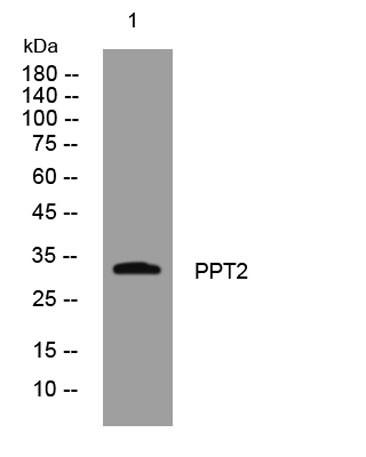
| Molecular Weight (Da) | 33kD |
| Observed band (KD) | |
| Background | This gene encodes a member of the palmitoyl-protein thioesterase family. The encoded glycosylated lysosomal protein has palmitoyl-CoA hydrolase activity in vitro, but does not hydrolyze palmitate from cysteine residues in proteins. Alternative splicing results in multiple transcript variants. Read-through transcription also exists between this gene and the downstream EGFL8 (EGF-like-domain, multiple 8) gene. [provided by RefSeq, Feb 2011], |
| Function | caution:Was originally (PubMed:9341199) referred as a palmitoyl-protein thioesterase (palmitoyl-protein hydrolase).,function:Removes thioester-linked fatty acyl groups from various substrates including S-palmitoyl-CoA. Has the highest S-thioesterase activity for the acyl groups palmitic and myristic acid followed by other short- and long-chain acyl substrates. However, because of structural constraints, is unable to remove palmitate from peptides or proteins.,similarity:Belongs to the palmitoyl-protein thioesterase family.,tissue specificity:Broadly expressed, with highest levels in skeletal muscle., |
| Subcellular location | Lysosome . |
| Expression | Broadly expressed, with highest levels in skeletal muscle. |

Use collapsible tabs for more detailed information that will help customers make a purchasing decision.
Ex: Shipping and return policies, size guides, and other common questions.