 Français
 English

| ELK.No | ES13336 |
| Product name | RPGR1 rabbit pAb |
| Reactivity | Human; Mouse |
| Applications | WB |
| Other name | |
| Size | 50μL |
| Unit price ($) | 148 |
| Human gene ID | 57096 |
| Human Swiss-Prot | Q96KN7 |
| Source | Rabbit |
| Isotype | IgG |
| Target | RPGR1 |
| Fields | |
| Gene name | RPGRIP1 |
| Protein name | RPGR1 |
| Human gene link | View Human Gene |
| Human Swiss link | View Human Swiss-Prot |
| Mouse gene ID | 77945 |
| Mouse gene link | View Mouse Gene |
| Mouse Swiss-Prot | Q9EPQ2 |
| Mouse Swiss link | View Mouse Swiss-Prot |
| Rat gene ID | |
| Rat gene link | |
| Rat Swiss-Prot | |
| Rat Swiss link | |
| Immunogen | Synthesized peptide derived from human RPGR1 AA range: 256-306 |
| Specificity | This antibody detects endogenous levels of RPGR1 at Human/Mouse |
| Formulation | Liquid in PBS containing 50% glycerol, 0.5% BSA and 0.02% sodium azide. |
| Clonality | Polyclonal |
| Dilution | WB 1:500-2000 |
| Purification | The antibody was affinity-purified from rabbit serum by affinity-chromatography using specific immunogen. |
| Concentration | 1 mg/ml |
| Storage stability | -20°C/1 year |
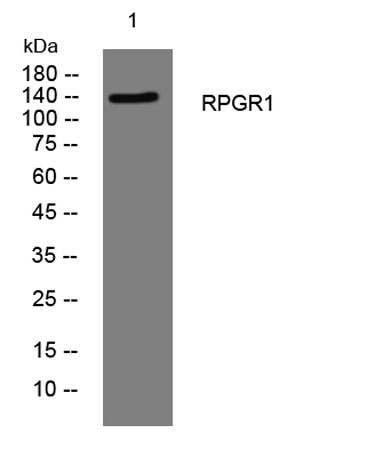
| Molecular Weight (Da) | 141kD |
| Observed band (KD) | |
| Background | This gene encodes a photoreceptor protein that interacts with retinitis pigmentosa GTPase regulator protein and is a key component of cone and rod photoreceptor cells. Mutations in this gene lead to autosomal recessive congenital blindness. [provided by RefSeq, Oct 2008], |
| Function | disease:Defects in RPGRIP1 are the cause of cone-rod dystrophy type 9 (CORD9) [MIM:608194]. CORDs are inherited retinal dystrophies belonging to the group of pigmentary retinopathies. CORDs are characterized by retinal pigment deposits visible on fundus examination, predominantly in the macular region, and initial loss of cone photoreceptors followed by rod degeneration. This leads to decreased visual acuity and sensitivity in the central visual field, followed by loss of peripheral vision. Severe loss of vision occurs earlier than in retinitis pigmentosa.,disease:Defects in RPGRIP1 are the cause of Leber congenital amaurosis type 6 (LCA6) [MIM:605446]. LCA designates a clinically and genetically heterogeneous group of childhood retinal degenerations, generally inherited in an autosomal recessive manner. Affected infants have little or no retinal photoreceptor function as tested by elect |
| Subcellular location | Cell projection, cilium . Situated between the axonemal microtubules and the plasma membrane (By similarity). In the retinal photoreceptor cell layer, localizes at the connecting cilium, a thin bridge linking the cell body and the light-sensing outer segment (By similarity). Colocalizes with RGPR in the photoreceptor connecting cilium (By similarity). . |
| Expression | Strong expression in retina, with weaker expression in testis. Expressed in other neurons such as amacrine cells. Colocalizes with RGPR in the outer segment of rod photoreceptors and cone outer segments. |

Use collapsible tabs for more detailed information that will help customers make a purchasing decision.
Ex: Shipping and return policies, size guides, and other common questions.
