 Français
 English


| ELK.No | ES14443 |
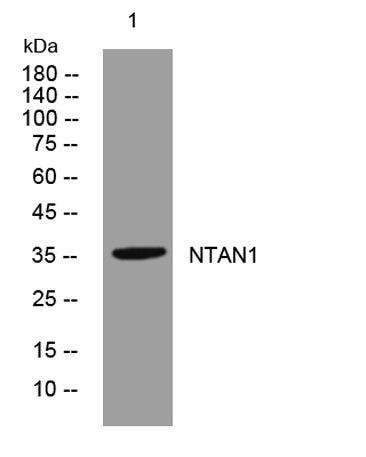
| Product name | NTAN1 rabbit pAb |
| Reactivity | Human; Mouse |
| Applications | WB |
| Other name | |
| Size | 50μL |
| Unit price ($) | 148 |
| Human gene ID | 123803 |
| Human Swiss-Prot | Q96AB6 |
| Source | Rabbit |
| Isotype | IgG |
| Target | NTAN1 |
| Fields | |
| Gene name | NTAN1 |
| Protein name | NTAN1 |
| Human gene link | View Human Gene |
| Human Swiss link | View Human Swiss-Prot |
| Mouse gene ID | 18203 |
| Mouse gene link | View Mouse Gene |
| Mouse Swiss-Prot | Q64311 |
| Mouse Swiss link | View Mouse Swiss-Prot |
| Rat gene ID | |
| Rat gene link | |
| Rat Swiss-Prot | |
| Rat Swiss link | |
| Immunogen | Synthesized peptide derived from human NTAN1 AA range: 83-133 |
| Specificity | This antibody detects endogenous levels of NTAN1 at Human/Mouse |
| Formulation | Liquid in PBS containing 50% glycerol, 0.5% BSA and 0.02% sodium azide. |
| Clonality | Polyclonal |
| Dilution | WB 1:500-2000 |
| Purification | The antibody was affinity-purified from rabbit serum by affinity-chromatography using specific immunogen. |
| Concentration | 1 mg/ml |
| Storage stability | -20°C/1 year |
| Molecular Weight (Da) | 34kD |
| Observed band (KD) | |
| Background | The protein encoded by this gene functions in a step-wise process of protein degradation through the N-end rule pathway. This protein acts as a tertiary destabilizing enzyme that deamidates N-terminal L-Asn residues on proteins to produce N-terminal L-Asp. L-Asp substrates are subsequently conjugated to L-Arg, which is recognized by specific E3 ubiquitin ligases and targeted to the proteasome. Pseudogenes of this gene are located on the long arms of chromosomes 8, 10 and 12. Alternative splicing results in multiple transcript variants that encode different protein isoforms. [provided by RefSeq, Jul 2012], |
| Function | function:Side-chain deamidation of N-terminal asparagine residues to aspartate. Required for the ubiquitin-dependent turnover of intracellular proteins that initiate with Met-Asn. These proteins are acetylated on the retained initiator methionine and can subsequently be modified by the removal of N-acetyl methionine by acylaminoacid hydrolase (AAH). Conversion of the resulting N-terminal asparagine to aspartate by PNAD renders the protein susceptible to arginylation, polyubiquitination and degradation as specified by the N-end rule. This enzyme does not act on substrates with internal or C-terminal asparagines and does not act on glutamine residues in any position.,subunit:Monomer., |
| Subcellular location | Cytoplasm . |
| Expression |

Use collapsible tabs for more detailed information that will help customers make a purchasing decision.
Ex: Shipping and return policies, size guides, and other common questions.