 Français
 English

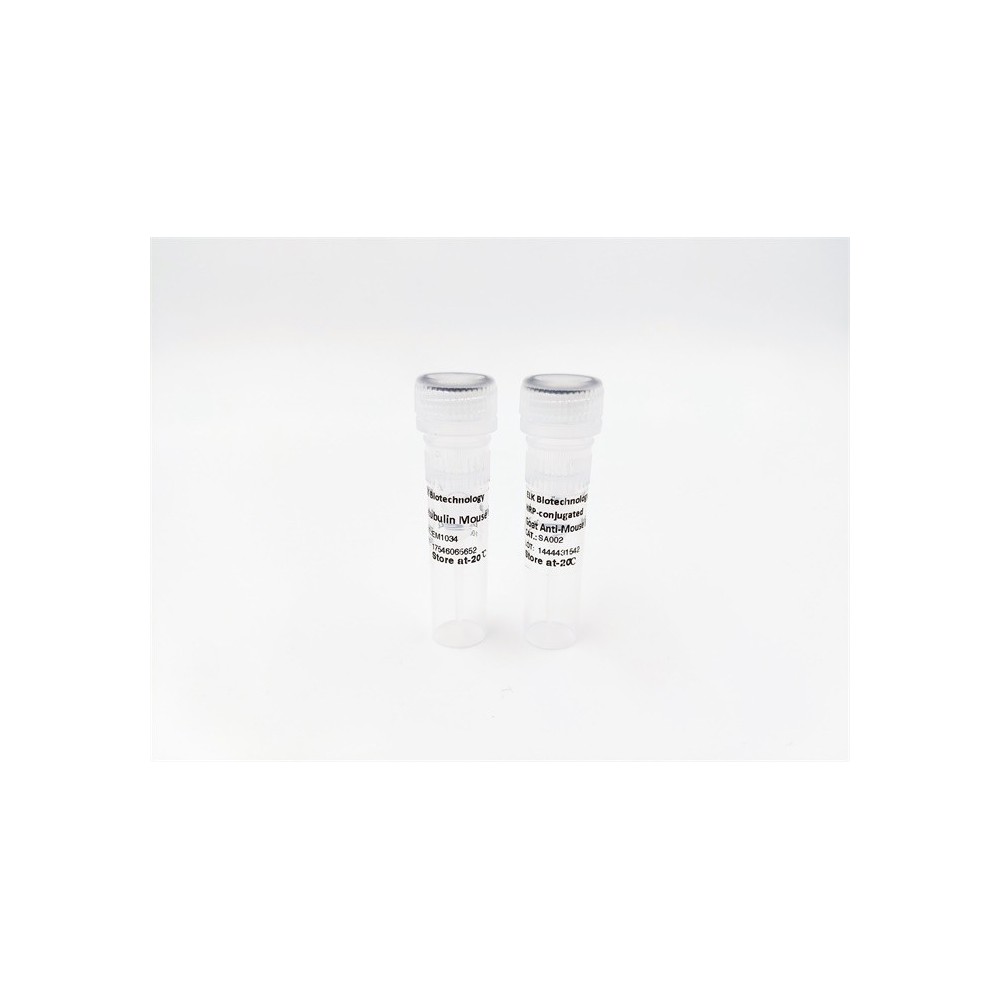

| ELK.No | ES14941 |
| Product name | MKKS rabbit pAb |
| Reactivity | Human; Mouse |
| Applications | WB |
| Other name | McKusick-Kaufman/Bardet-Biedl syndromes putative chaperonin (Bardet-Biedl syndrome 6 protein) |
| Size | 100μL |
| Unit price ($) | 248 |
| Human gene ID | 8195 |
| Human Swiss-Prot | Q9NPJ1 |
| Source | Rabbit |
| Isotype | IgG |
| Target | MKKS |
| Fields | |
| Gene name | MKKS BBS6 |
| Protein name | MKKS |
| Human gene link | View Human Gene |
| Human Swiss link | View Human Swiss-Prot |
| Mouse gene ID | 59030 |
| Mouse gene link | View Mouse Gene |
| Mouse Swiss-Prot | Q9JI70 |
| Mouse Swiss link | View Mouse Swiss-Prot |
| Rat gene ID | |
| Rat gene link | |
| Rat Swiss-Prot | |
| Rat Swiss link | |
| Immunogen | Synthesized peptide derived from human MKKS AA range: 166-216 |
| Specificity | This antibody detects endogenous levels of MKKS at Human/Mouse |
| Formulation | Liquid in PBS containing 50% glycerol, 0.5% BSA and 0.184% sodium azide. |
| Clonality | Polyclonal |
| Dilution | WB 1:500-2000 |
| Purification | The antibody was affinity-purified from rabbit serum by affinity-chromatography using specific immunogen. |
| Concentration | 1 mg/ml |
| Storage stability | -20°C/1 year |
| Molecular Weight (Da) | |
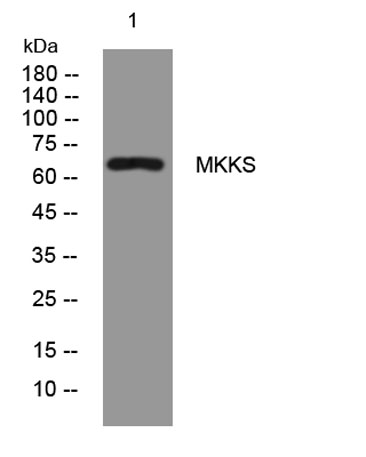
| Observed band (KD) | 65kD |
| Background | This gene encodes a protein which shares sequence similarity with other members of the type II chaperonin family. The encoded protein is a centrosome-shuttling protein and plays an important role in cytokinesis. This protein also interacts with other type II chaperonin members to form a complex known as the BBSome, which involves ciliary membrane biogenesis. This protein is encoded by a downstream open reading frame (dORF). Several upstream open reading frames (uORFs) have been identified, which repress the translation of the dORF, and two of which can encode small mitochondrial membrane proteins. Mutations in this gene have been observed in patients with Bardet-Biedl syndrome type 6, also known as McKusick-Kaufman syndrome. Alternative splicing results in multiple transcript variants. [provided by RefSeq, Nov 2013], |
| Function | disease:Defects in MKKS are the cause of Bardet-Biedl syndrome type 6 (BBS6) [MIM:209900]. Bardet-Biedl syndrome (BBS) is a genetically heterogeneous, autosomal recessive disorder characterized by usually severe pigmentary retinopathy, early onset obesity, polydactyly, hypogenitalism, renal malformation and mental retardation. Secondary features include diabetes mellitus, hypertension and congenital heart disease. A relatively high incidence of BBS is found in the mixed Arab populations of Kuwait and in Bedouin tribes throughout the Middle East, most likely due to the high rate of consaguinity in these populations and a founder effect.,disease:Defects in MKKS are the cause of McKusick-Kaufman syndrome (MKKS) [MIM:236700]. MKKS is an autosomal recessive developmental disorder. It is characterized by hydrometrocolpos, postaxial polydactyly and congenital heart defects.,function:May play a |
| Subcellular location | Cytoplasm, cytoskeleton, microtubule organizing center, centrosome. Cytoplasm, cytosol . Nucleus . The majority of the protein resides within the pericentriolar material (PCM), a proteinaceous tube surrounding centrioles. During interphase, the protein is confined to the lateral surfaces of the PCM but during mitosis it relocalizes throughout the PCM and is found at the intercellular bridge. The MKSS protein is highly mobile and rapidly shuttles between the cytosol and centrosome. |
| Expression | Widely expressed in adult and fetal tissues. |

Use collapsible tabs for more detailed information that will help customers make a purchasing decision.
Ex: Shipping and return policies, size guides, and other common questions.