 Français
 English
Adducin α/β (phospho Ser726/713) rabbit pAb
AO-06-ES1504-100

| ELK.No | ES1504 |
| Product name | Adducin α/β (phospho Ser726/713) rabbit pAb |
| Reactivity | Human;Mouse;Rat |
| Applications | WB;IHC;IF;ELISA |
| Other name | ADD1; ADDA; Alpha-adducin; Erythrocyte adducin subunit alpha; ADD2; ADDB; Beta-adducin; Erythrocyte adducin subunit beta |
| Size | 100μL |
| Unit price ($) | 248 |
| Human gene ID | 118/119 |
| Human Swiss-Prot | P35611/P35612 |
| Source | Rabbit |
| Isotype | IgG |
| Target | Adducin α/β |
| Fields | |
| Gene name | ADD1/ADD2 |
| Protein name | Alpha-adducin/Beta-adducin |
| Human gene link | View Human Gene |
| Human Swiss link | View Human Swiss-Prot |
| Mouse gene ID | 11518/11519 |
| Mouse gene link | View Mouse Gene |
| Mouse Swiss-Prot | |
| Mouse Swiss link | |
| Rat gene ID | 24170/24171 |
| Rat gene link | View Rat Gene |
| Rat Swiss-Prot | Q63028/Q05764 |
| Rat Swiss link | View Rat Swiss-Prot |
| Immunogen | The antiserum was produced against synthesized peptide derived from human ADD1 around the phosphorylation site of Ser726. AA range:688-737 |
| Specificity | Phospho-Adducin α/β (S726/713) Polyclonal Antibody detects endogenous levels of Adducin α/β protein only when phosphorylated at S726/713. |
| Formulation | Liquid in PBS containing 50% glycerol, 0.5% BSA and 0.02% sodium azide. |
| Clonality | Polyclonal |
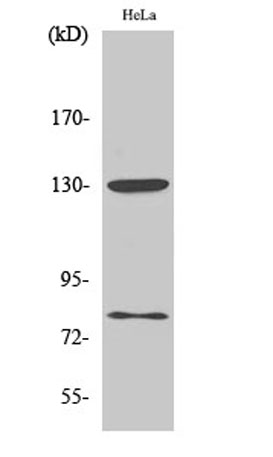
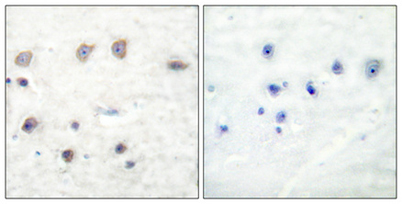
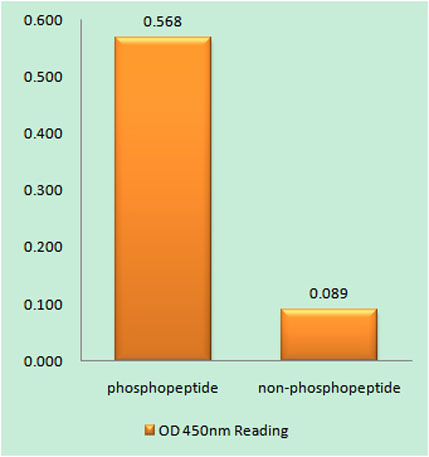
| Dilution | Western Blot: 1/500 - 1/2000. Immunohistochemistry: 1/100 - 1/300. Immunofluorescence: 1/200 - 1/1000. ELISA: 1/40000. Not yet tested in other applications. |
| Purification | The antibody was affinity-purified from rabbit antiserum by affinity-chromatography using epitope-specific immunogen. |
| Concentration | 1 mg/ml |
| Storage stability | -20°C/1 year |
| Molecular Weight (Da) | |
| Observed band (KD) | 80kD |
| Background | adducin 1(ADD1) Homo sapiens Adducins are a family of cytoskeleton proteins encoded by three genes (alpha, beta, gamma). Adducin is a heterodimeric protein that consists of related subunits, which are produced from distinct genes but share a similar structure. Alpha- and beta-adducin include a protease-resistant N-terminal region and a protease-sensitive, hydrophilic C-terminal region. Alpha- and gamma-adducins are ubiquitously expressed. In contrast, beta-adducin is expressed at high levels in brain and hematopoietic tissues. Adducin binds with high affinity to Ca(2+)/calmodulin and is a substrate for protein kinases A and C. Alternative splicing results in multiple variants encoding distinct isoforms; however, not all variants have been fully described. [provided by RefSeq, Jul 2008], |
| Function | alternative products:Additional isoforms seem to exist,domain:Each subunit is comprised of three regions: a NH2-terminal protease-resistant globular head region, a short connecting subdomain, and a protease-sensitive tail region.,function:Membrane-cytoskeleton-associated protein that promotes the assembly of the spectrin-actin network. Binds to calmodulin.,PTM:The N-terminus is blocked.,similarity:Belongs to the aldolase class II family. Adducin subfamily.,subunit:Heterodimer of an alpha and a beta subunit or an alpha and a gamma subunit. Binds ROCK1.,tissue specificity:Expressed in all tissues. Found in much higher levels in reticulocytes than the beta subunit., |
| Subcellular location | Cytoplasm, cytoskeleton. Cell membrane; Peripheral membrane protein; Cytoplasmic side. |
| Expression | Expressed in all tissues. Found in much higher levels in reticulocytes than the beta subunit. |

Use collapsible tabs for more detailed information that will help customers make a purchasing decision.
Ex: Shipping and return policies, size guides, and other common questions.