 Français
 English

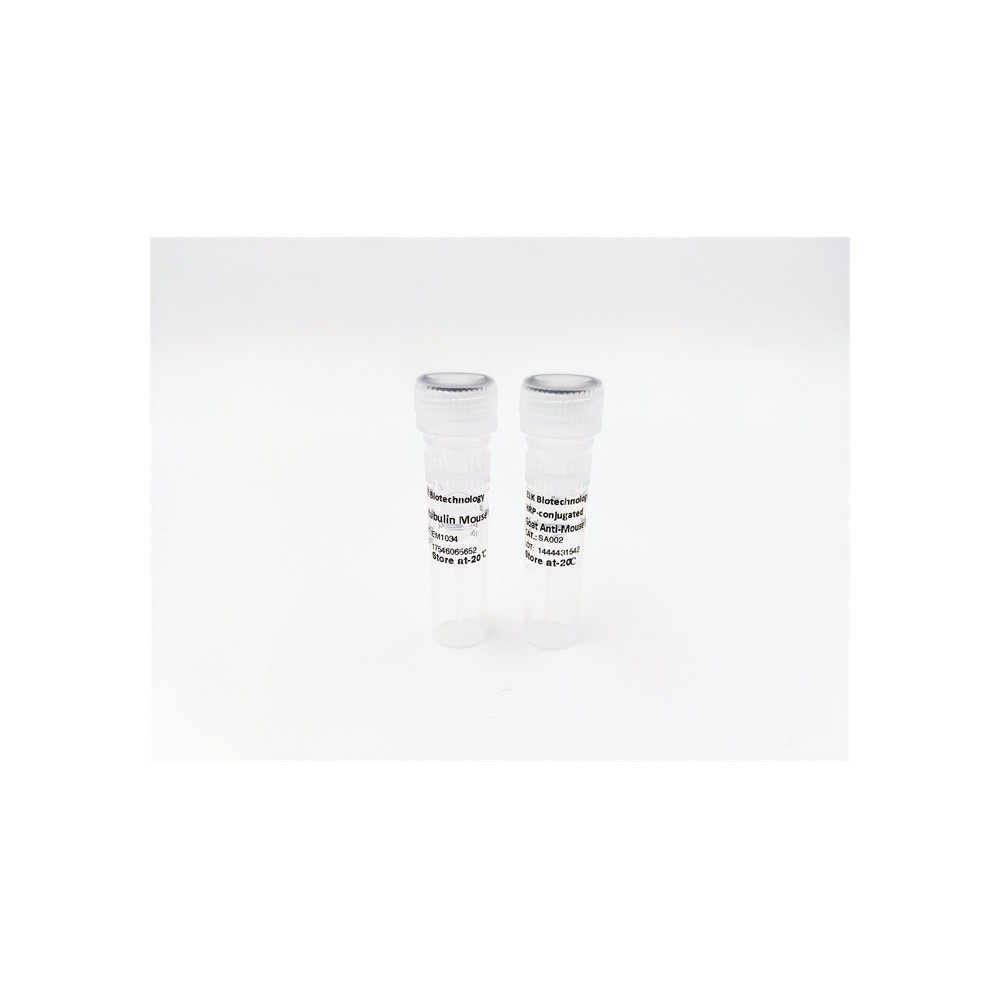

| ELK.No | ES15231 |
| Product name | KTNB1 rabbit pAb |
| Reactivity | Human; Mouse |
| Applications | WB;ELISA;IHC |
| Other name | |
| Size | 50μL |
| Unit price ($) | 148 |
| Human gene ID | 10300 |
| Human Swiss-Prot | Q9BVA0 |
| Source | Rabbit |
| Isotype | IgG |
| Target | KTNB1 |
| Fields | |
| Gene name | KATNB1 |
| Protein name | KTNB1 |
| Human gene link | View Human Gene |
| Human Swiss link | View Human Swiss-Prot |
| Mouse gene ID | 74187 |
| Mouse gene link | View Mouse Gene |
| Mouse Swiss-Prot | Q8BG40 |
| Mouse Swiss link | View Mouse Swiss-Prot |
| Rat gene ID | |
| Rat gene link | |
| Rat Swiss-Prot | |
| Rat Swiss link | |
| Immunogen | Synthesized peptide derived from human KTNB1 AA range: 72-122 |
| Specificity | This antibody detects endogenous levels of KTNB1 at Human/Mouse |
| Formulation | Liquid in PBS containing 50% glycerol, 0.5% BSA and 0.02% sodium azide. |
| Clonality | Polyclonal |
| Dilution | WB 1:500-2000;IHC-p 1:50-300; ELISA 2000-20000 |
| Purification | The antibody was affinity-purified from rabbit serum by affinity-chromatography using specific immunogen. |
| Concentration | 1 mg/ml |
| Storage stability | -20°C/1 year |
| Molecular Weight (Da) | 72kD |
| Observed band (KD) | |
| Background | Microtubules, polymers of alpha and beta tubulin subunits, form the mitotic spindle of a dividing cell and help to organize membranous organelles during interphase. Katanin is a heterodimer that consists of a 60 kDa ATPase (p60 subunit A 1) and an 80 kDa accessory protein (p80 subunit B 1). The p60 subunit acts to sever and disassemble microtubules, while the p80 subunit targets the enzyme to the centrosome. Katanin is a member of the AAA family of ATPases. [provided by RefSeq, Jul 2008], |
| Function | function:Participates in a complex which severs microtubules in an ATP-dependent manner. May act to target the enzymatic subunit of this complex to sites of action such as the centrosome. Microtubule severing may promote rapid reorganization of cellular microtubule arrays and the release of microtubules from the centrosome following nucleation. Microtubule release from the mitotic spindle poles may allow depolymerization of the microtubule end proximal to the spindle pole, leading to poleward microtubule flux and poleward motion of chromosome. Microtubule release within the cell body of neurons may be required for their transport into neuronal processes by microtubule-dependent motor proteins. This transport is required for axonal growth.,similarity:Belongs to the WD repeat KATNB1 family.,similarity:Contains 6 WD repeats.,subcellular location:Predominantly cytoplasmic. Localized to the i |
| Subcellular location | Cytoplasm . Cytoplasm, cytoskeleton, microtubule organizing center, centrosome . Cytoplasm, cytoskeleton, spindle pole . Cytoplasm, cytoskeleton . Cytoplasm, cytoskeleton, spindle . Predominantly cytoplasmic. Localized to the interphase centrosome and mitotic spindle poles (PubMed:9658175). Localizes within the cytoplasm, partially overlapping with microtubules, in interphase and to the mitotic spindle and spindle poles during mitosis (PubMed:26929214). . |
| Expression |



Use collapsible tabs for more detailed information that will help customers make a purchasing decision.
Ex: Shipping and return policies, size guides, and other common questions.