 Français
 English


| ELK.No | ES15528 |
| Product name | IFIX rabbit pAb |
| Reactivity | Human; Mouse |
| Applications | WB |
| Other name | |
| Size | 100μL |
| Unit price ($) | 248 |
| Human gene ID | 149628 |
| Human Swiss-Prot | Q6K0P9 |
| Source | Rabbit |
| Isotype | IgG |
| Target | IFIX |
| Fields | |
| Gene name | PYHIN1 IFIX |
| Protein name | IFIX |
| Human gene link | View Human Gene |
| Human Swiss link | View Human Swiss-Prot |
| Mouse gene ID | 236312 |
| Mouse gene link | View Mouse Gene |
| Mouse Swiss-Prot | Q8BV49 |
| Mouse Swiss link | View Mouse Swiss-Prot |
| Rat gene ID | |
| Rat gene link | |
| Rat Swiss-Prot | |
| Rat Swiss link | |
| Immunogen | Synthesized peptide derived from human IFIX AA range: 338-388 |
| Specificity | This antibody detects endogenous levels of IFIX at Human/Mouse |
| Formulation | Liquid in PBS containing 50% glycerol, 0.5% BSA and 0.02% sodium azide. |
| Clonality | Polyclonal |
| Dilution | WB 1:500-2000 |
| Purification | The antibody was affinity-purified from rabbit serum by affinity-chromatography using specific immunogen. |
| Concentration | 1 mg/ml |
| Storage stability | -20°C/1 year |
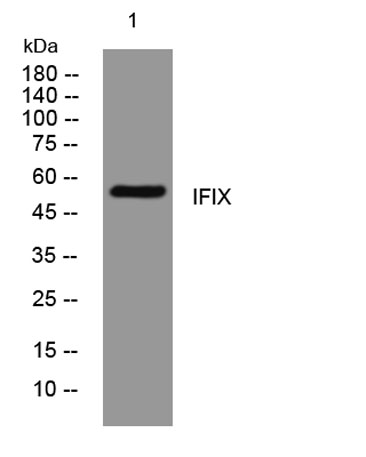
| Molecular Weight (Da) | 54kD |
| Observed band (KD) | |
| Background | The protein encoded by this gene belongs to the HIN-200 family of interferon-inducible proteins that share a 200-amino acid signature motif at their C-termini. HIN200 proteins are primarily nuclear and are involved in transcriptional regulation of genes important for cell cycle control, differentiation, and apoptosis. Downregulation of this gene is associated with breast cancer. This protein acts as a tumor suppressor by promoting ubiquitination and subsequent degradation of MDM2, which leads to stabilization of p53/TP53. Alternatively spliced transcript variants encoding different isoforms have been described for this gene. [provided by RefSeq, Aug 2011], |
| Function | domain:The HIN-200 domain mediates interaction with MDM2.,function:Major mediator of the tumor suppressor activity of IFN in breast cancer cells. Promotes ubiquitination and subsequent degradation of MDM2, which leads to p53/TP53 stabilization. Promotes ubiquitination and subsequent degradation of HDAC1, which in turn enhances maspin expression, and impairs invasive activity of cancer cells.,induction:By IFNalpha and IFNgamma in hematopoietic cancer cells.,similarity:Belongs to the HIN-200 family.,similarity:Contains 1 DAPIN domain.,similarity:Contains 1 HIN-200 domain.,subunit:Interacts with MDM2.,tissue specificity:Expressed in spleen, lymph node and peripheral blood leukocytes, and at lower levels in thymus, bone marrow and fetal liver. Down-regulated in breast tumors., |
| Subcellular location | [Isoform 1]: Nucleus, nucleoplasm.; [Isoform 3]: Nucleus, nucleoplasm.; [Isoform 5]: Nucleus. Nucleus speckle. |
| Expression | Expressed in spleen, lymph node and peripheral blood leukocytes, and at lower levels in thymus, bone marrow and fetal liver. Down-regulated in breast tumors. |

Use collapsible tabs for more detailed information that will help customers make a purchasing decision.
Ex: Shipping and return policies, size guides, and other common questions.