 Français
 English

| ELK.No | ES1556 |
| Product name | A20 rabbit pAb |
| Reactivity | Human;Mouse |
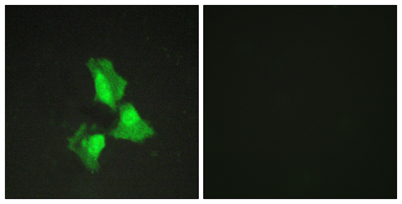
| Applications | WB;IF;ELISA |
| Other name | TNFAIP3; OTUD7C; Tumor necrosis factor alpha-induced protein 3; TNF alpha-induced protein 3; OTU domain-containing protein 7C; Putative DNA-binding protein A20; Zinc finger protein A20 |
| Size | 100μL |
| Unit price ($) | 248 |
| Human gene ID | 7128 |
| Human Swiss-Prot | P21580 |
| Source | Rabbit |
| Isotype | IgG |
| Target | A20 |
| Fields | >>NF-kappa B signaling pathway;>>Necroptosis;>>NOD-like receptor signaling pathway;>>IL-17 signaling pathway;>>TNF signaling pathway;>>Measles;>>Epstein-Barr virus infection |
| Gene name | TNFAIP3 |
| Protein name | Tumor necrosis factor alpha-induced protein 3 |
| Human gene link | View Human Gene |
| Human Swiss link | View Human Swiss-Prot |
| Mouse gene ID | 21929 |
| Mouse gene link | View Mouse Gene |
| Mouse Swiss-Prot | Q60769 |
| Mouse Swiss link | View Mouse Swiss-Prot |
| Rat gene ID | |
| Rat gene link | |
| Rat Swiss-Prot | |
| Rat Swiss link | |
| Immunogen | The antiserum was produced against synthesized peptide derived from human TNAP3. AA range:321-370 |
| Specificity | A20 Polyclonal Antibody detects endogenous levels of A20 protein. |
| Formulation | Liquid in PBS containing 50% glycerol, 0.5% BSA and 0.02% sodium azide. |
| Clonality | Polyclonal |
| Dilution | Western Blot: 1/500 - 1/2000. Immunofluorescence: 1/200 - 1/1000. ELISA: 1/20000. Not yet tested in other applications. |
| Purification | The antibody was affinity-purified from rabbit antiserum by affinity-chromatography using epitope-specific immunogen. |
| Concentration | 1 mg/ml |
| Storage stability | -20°C/1 year |
| Molecular Weight (Da) | |
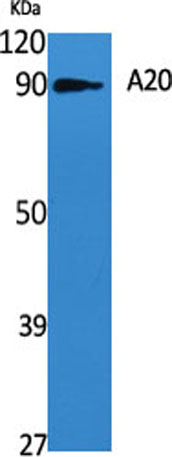
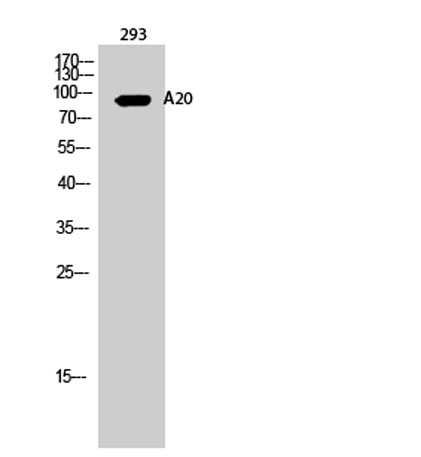
| Observed band (KD) | 89kD |
| Background | This gene was identified as a gene whose expression is rapidly induced by the tumor necrosis factor (TNF). The protein encoded by this gene is a zinc finger protein and ubiqitin-editing enzyme, and has been shown to inhibit NF-kappa B activation as well as TNF-mediated apoptosis. The encoded protein, which has both ubiquitin ligase and deubiquitinase activities, is involved in the cytokine-mediated immune and inflammatory responses. Several transcript variants encoding the same protein have been found for this gene. [provided by RefSeq, Jul 2012], |
| Function | function:Interacts with NAF1 and inhibits TNF-induced NF-kappa-B-dependent gene expression by interfering with an RIP- or TRAF2-mediated transactivation signal. Inhibitor of programmed cell death. Has a role in the function of the lymphoid system and may contribute to the in vivo effects of TNF (By similarity). Has deubiquitinating activity that is directed towards 'Lys-48' or 'Lys-63'-linked polyubiquitin chains.,induction:By TNF-alpha.,similarity:Belongs to the peptidase C64 family.,similarity:Contains 1 OTU domain.,similarity:Contains 7 A20-type zinc fingers.,subunit:Homodimer. Interacts with NAF1, TAX1BP1 and TRAF2., |
| Subcellular location | Cytoplasm. Nucleus. Lysosome.; [A20p50]: Cytoplasm. |
| Expression | Epithelium,Testis,Trachea, |

Use collapsible tabs for more detailed information that will help customers make a purchasing decision.
Ex: Shipping and return policies, size guides, and other common questions.