 Français
 English


| ELK.No | ES15857 |
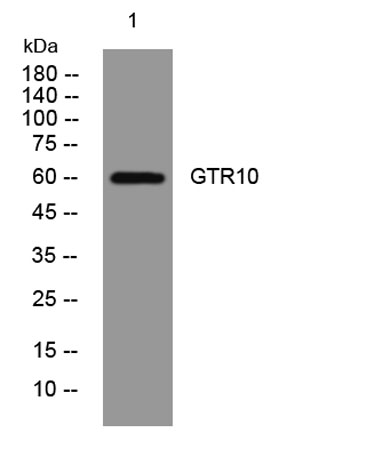
| Product name | GTR10 rabbit pAb |
| Reactivity | Human; Mouse |
| Applications | WB |
| Other name | |
| Size | 100μL |
| Unit price ($) | 248 |
| Human gene ID | 81031 |
| Human Swiss-Prot | O95528 |
| Source | Rabbit |
| Isotype | IgG |
| Target | GTR10 |
| Fields | |
| Gene name | SLC2A10 GLUT10 |
| Protein name | GTR10 |
| Human gene link | View Human Gene |
| Human Swiss link | View Human Swiss-Prot |
| Mouse gene ID | 170441 |
| Mouse gene link | View Mouse Gene |
| Mouse Swiss-Prot | Q8VHD6 |
| Mouse Swiss link | View Mouse Swiss-Prot |
| Rat gene ID | |
| Rat gene link | |
| Rat Swiss-Prot | |
| Rat Swiss link | |
| Immunogen | Synthesized peptide derived from human GTR10 AA range: 233-283 |
| Specificity | This antibody detects endogenous levels of GTR10 at Human/Mouse |
| Formulation | Liquid in PBS containing 50% glycerol, 0.5% BSA and 0.02% sodium azide. |
| Clonality | Polyclonal |
| Dilution | WB 1:500-2000 |
| Purification | The antibody was affinity-purified from rabbit serum by affinity-chromatography using specific immunogen. |
| Concentration | 1 mg/ml |
| Storage stability | -20°C/1 year |
| Molecular Weight (Da) | 60kD |
| Observed band (KD) | |
| Background | This gene encodes a member of the class III facilitative glucose transporter family. The encoded protein plays a role in regulation of glucose homeostasis. Mutations in this gene have been associated with arterial tortuosity syndrome.[provided by RefSeq, Dec 2009], |
| Function | disease:Defects in SLC2A10 are the cause of arterial tortuosity syndrome (ATS) [MIM:208050]. ATS is an autosomal recessive disorder characterized by tortuosity and elongation of major arteries, often resulting in death at young age. Other typical features include aneurysms of large arteries and stenosis of the pulmonary artery, in association with facial features and several connective tissue manifestations such as soft skin and joint laxity. Histopathological findings include fragmentation of elastic fibers in the tunica media of large arteries.,function:Facilitative glucose transporter.,similarity:Belongs to the major facilitator superfamily. Sugar transporter (TC 2.A.1.1) family. Glucose transporter subfamily.,tissue specificity:Widely expressed; highest levels in liver and pancreas., |
| Subcellular location | Endomembrane system ; Multi-pass membrane protein . Cytoplasm, perinuclear region . |
| Expression | Widely expressed; highest levels in liver and pancreas. |

Use collapsible tabs for more detailed information that will help customers make a purchasing decision.
Ex: Shipping and return policies, size guides, and other common questions.