 Français
 English

| ELK.No | ES1608 |
| Product name | ADH7 rabbit pAb |
| Reactivity | Human;Monkey |
| Applications | WB;ELISA |
| Other name | ADH7; Alcohol dehydrogenase class 4 mu/sigma chain; Alcohol dehydrogenase class IV mu/sigma chain; Gastric alcohol dehydrogenase; Retinol dehydrogenase |
| Size | 50μL |
| Unit price ($) | 148 |
| Human gene ID | 131 |
| Human Swiss-Prot | P40394 |
| Source | Rabbit |
| Isotype | IgG |
| Target | ADH7 |
| Fields | >>Glycolysis / Gluconeogenesis;>>Fatty acid degradation;>>Tyrosine metabolism;>>Pyruvate metabolism;>>Retinol metabolism;>>Metabolism of xenobiotics by cytochrome P450;>>Drug metabolism - cytochrome P450;>>Metabolic pathways;>>Alcoholic liver disease |
| Gene name | ADH7 |
| Protein name | Alcohol dehydrogenase class 4 mu/sigma chain |
| Human gene link | View Human Gene |
| Human Swiss link | View Human Swiss-Prot |
| Mouse gene ID | |
| Mouse gene link | |
| Mouse Swiss-Prot | Q64437 |
| Mouse Swiss link | View Mouse Swiss-Prot |
| Rat gene ID | |
| Rat gene link | |
| Rat Swiss-Prot | |
| Rat Swiss link | |
| Immunogen | The antiserum was produced against synthesized peptide derived from human ADH7. AA range:211-260 |
| Specificity | ADH7 Polyclonal Antibody detects endogenous levels of ADH7 protein. |
| Formulation | Liquid in PBS containing 50% glycerol, 0.5% BSA and 0.02% sodium azide. |
| Clonality | Polyclonal |
| Dilution | Western Blot: 1/500 - 1/2000. ELISA: 1/20000. Not yet tested in other applications. |
| Purification | The antibody was affinity-purified from rabbit antiserum by affinity-chromatography using epitope-specific immunogen. |
| Concentration | 1 mg/ml |
| Storage stability | -20°C/1 year |
| Molecular Weight (Da) | |
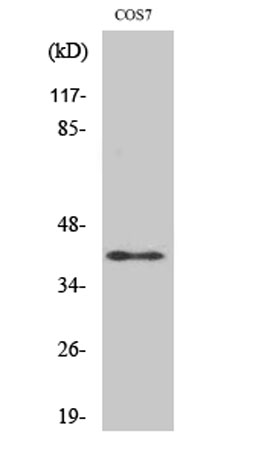
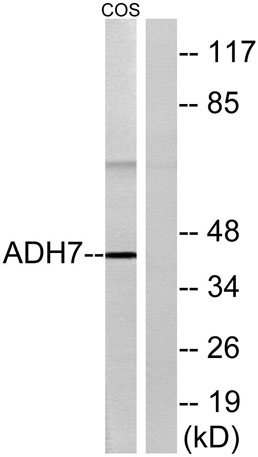
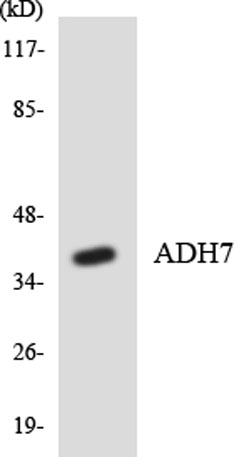
| Observed band (KD) | 40kD |
| Background | This gene encodes class IV alcohol dehydrogenase 7 mu or sigma subunit, which is a member of the alcohol dehydrogenase family. Members of this family metabolize a wide variety of substrates, including ethanol, retinol, other aliphatic alcohols, hydroxysteroids, and lipid peroxidation products. The enzyme encoded by this gene is inefficient in ethanol oxidation, but is the most active as a retinol dehydrogenase; thus it may participate in the synthesis of retinoic acid, a hormone important for cellular differentiation. The expression of this gene is much more abundant in stomach than liver, thus differing from the other known gene family members. Alternative splicing results in multiple transcript variants. [provided by RefSeq, Oct 2009], |
| Function | catalytic activity:An alcohol + NAD(+) = an aldehyde or ketone + NADH.,cofactor:Binds 2 zinc ions per subunit.,cofactor:Zinc.,function:Could function in retinol oxidation for the synthesis of retinoic acid, a hormone important for cellular differentiation. Medium-chain (octanol) and aromatic (m-nitrobenzaldehyde) compounds are the best substrates. Ethanol is not a good substrate but at the high ethanol concentrations reached in the digestive tract, it plays a role in the ethanol oxidation and contributes to the first pass ethanol metabolism.,miscellaneous:There are 7 different ADH's isozymes in human: three belongs to class-I: alpha, beta, and gamma, one to class-II: pi, one to class-III: chi, one to class-IV: ADH7 and one to class-V: ADH6.,similarity:Belongs to the zinc-containing alcohol dehydrogenase family. Class-IV subfamily.,subunit:Homodimer.,tissue specificity:Preferentially expr |
| Subcellular location | Cytoplasm. |
| Expression | Preferentially expressed in stomach. |

Use collapsible tabs for more detailed information that will help customers make a purchasing decision.
Ex: Shipping and return policies, size guides, and other common questions.