 Français
 English


| ELK.No | ES16221 |
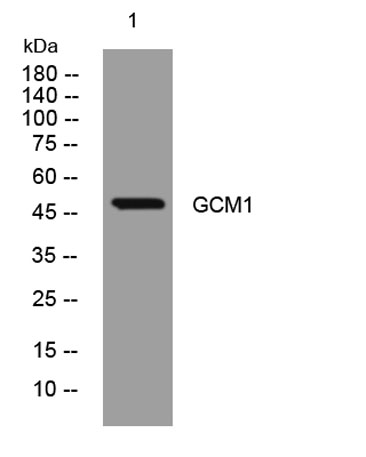
| Product name | GCM1 rabbit pAb |
| Reactivity | Human; Mouse;Rat |
| Applications | WB |
| Other name | |
| Size | 50μL |
| Unit price ($) | 148 |
| Human gene ID | 8521 |
| Human Swiss-Prot | Q9NP62 |
| Source | Rabbit |
| Isotype | IgG |
| Target | GCM1 |
| Fields | >>Parathyroid hormone synthesis, secretion and action |
| Gene name | GCM1 GCMA |
| Protein name | GCM1 |
| Human gene link | View Human Gene |
| Human Swiss link | View Human Swiss-Prot |
| Mouse gene ID | 14531 |
| Mouse gene link | View Mouse Gene |
| Mouse Swiss-Prot | P70348 |
| Mouse Swiss link | View Mouse Swiss-Prot |
| Rat gene ID | 29394 |
| Rat gene link | View Rat Gene |
| Rat Swiss-Prot | Q9Z288 |
| Rat Swiss link | View Rat Swiss-Prot |
| Immunogen | Synthesized peptide derived from human GCM1 AA range: 298-348 |
| Specificity | This antibody detects endogenous levels of GCM1 at Human/Mouse/Rat |
| Formulation | Liquid in PBS containing 50% glycerol, 0.5% BSA and 0.02% sodium azide. |
| Clonality | Polyclonal |
| Dilution | WB 1:500-2000 |
| Purification | The antibody was affinity-purified from rabbit serum by affinity-chromatography using specific immunogen. |
| Concentration | 1 mg/ml |
| Storage stability | -20°C/1 year |
| Molecular Weight (Da) | 48kD |
| Observed band (KD) | |
| Background | This gene encodes a DNA-binding protein with a gcm-motif (glial cell missing motif). The encoded protein is a homolog of the Drosophila glial cells missing gene (gcm). This protein binds to the GCM-motif (A/G)CCCGCAT, a novel sequence among known targets of DNA-binding proteins. The N-terminal DNA-binding domain confers the unique DNA-binding activity of this protein. [provided by RefSeq, Jul 2008], |
| Function | function:Transcription factor that is necessary for placental development. Binds to the trophoblast-specific element 2 (TSE2) of the aromatase gene enhancer.,similarity:Contains 1 GCM DNA-binding domain.,tissue specificity:Placenta specific., |
| Subcellular location | Nucleus . |
| Expression | Highly expressed in the placenta (PubMed:10542267). Expressed in trophoblast cells of the villi (PubMed:27917469). |

Use collapsible tabs for more detailed information that will help customers make a purchasing decision.
Ex: Shipping and return policies, size guides, and other common questions.