 Français
 English


| ELK.No | ES16757 |
| Product name | ELP1 rabbit pAb |
| Reactivity | Human; Mouse;Rat |
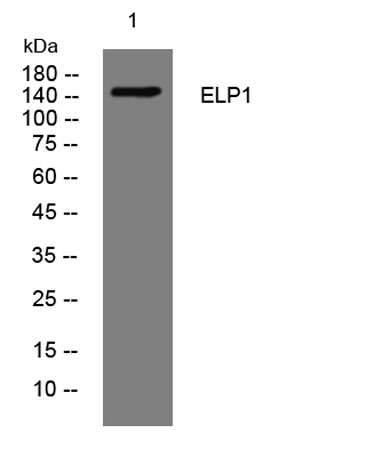
| Applications | WB |
| Other name | |
| Size | 100μL |
| Unit price ($) | 248 |
| Human gene ID | 8518 |
| Human Swiss-Prot | O95163 |
| Source | Rabbit |
| Isotype | IgG |
| Target | ELP1 |
| Fields | |
| Gene name | IKBKAP ELP1 IKAP |
| Protein name | ELP1 |
| Human gene link | View Human Gene |
| Human Swiss link | View Human Swiss-Prot |
| Mouse gene ID | 230233 |
| Mouse gene link | View Mouse Gene |
| Mouse Swiss-Prot | Q7TT37 |
| Mouse Swiss link | View Mouse Swiss-Prot |
| Rat gene ID | 140934 |
| Rat gene link | View Rat Gene |
| Rat Swiss-Prot | Q8VHU4 |
| Rat Swiss link | View Rat Swiss-Prot |
| Immunogen | Synthesized peptide derived from human ELP1 AA range: 267-317 |
| Specificity | This antibody detects endogenous levels of ELP1 at Human/Mouse/Rat |
| Formulation | Liquid in PBS containing 50% glycerol, 0.5% BSA and 0.02% sodium azide. |
| Clonality | Polyclonal |
| Dilution | WB 1:500-2000 |
| Purification | The antibody was affinity-purified from rabbit serum by affinity-chromatography using specific immunogen. |
| Concentration | 1 mg/ml |
| Storage stability | -20°C/1 year |
| Molecular Weight (Da) | 147kD |
| Observed band (KD) | |
| Background | The protein encoded by this gene is a scaffold protein and a regulator for three different kinases involved in proinflammatory signaling. The encoded protein can bind NF-kappa-B-inducing kinase and I-kappa-B kinases through separate domains and assemble them into an active kinase complex. Mutations in this gene have been associated with familial dysautonomia. Alternative splicing results in multiple transcript variants encoding different isoforms. [provided by RefSeq, Jan 2016], |
| Function | disease:Defects in IKBKAP are the cause of familial dysautonomia (FD) [MIM:223900]; also known as Riley-Day syndrome or hereditary sensory and autonomic neuropathy type III. This autosomal recessive disorder is due to the poor development and survival, and progressive degeneration of the sensory, sympathetic and parasympathetic neurons. FD individuals are affected with a variety of symptoms such as decreased sensitivity to pain and temperature, cardiovascular instability, recurrent pneumonias, vomiting crises, and gastrointestinal dysfunction. It is primarily confined to individuals of Ashkenazi Jewish descent, with an incidence of 1/3600 live births.,function:Acts as subunit of the RNA polymerase II elongator complex, which is a histone acetyltransferase component of the RNA polymerase II (Pol II) holoenzyme and is involved in transcriptional elongation. Elongator may play a role in chr |
| Subcellular location | Cytoplasm . Nucleus . |
| Expression |

Use collapsible tabs for more detailed information that will help customers make a purchasing decision.
Ex: Shipping and return policies, size guides, and other common questions.