 Français
 English

| ELK.No | ES1684 |
| Product name | APPL1 rabbit pAb |
| Reactivity | Human;Mouse |
| Applications | WB;ELISA |
| Other name | APPL1; APPL; DIP13A; KIAA1428; DCC-interacting protein 13-alpha; Dip13-alpha; Adapter protein containing PH domain; PTB domain and leucine zipper motif 1 |
| Size | 50μL |
| Unit price ($) | 148 |
| Human gene ID | 26060 |
| Human Swiss-Prot | Q9UKG1 |
| Source | Rabbit |
| Isotype | IgG |
| Target | APPL1 |
| Fields | >>Longevity regulating pathway;>>Pathways in cancer;>>Colorectal cancer |
| Gene name | APPL1 |
| Protein name | DCC-interacting protein 13-alpha |
| Human gene link | View Human Gene |
| Human Swiss link | View Human Swiss-Prot |
| Mouse gene ID | 72993 |
| Mouse gene link | View Mouse Gene |
| Mouse Swiss-Prot | Q8K3H0 |
| Mouse Swiss link | View Mouse Swiss-Prot |
| Rat gene ID | |
| Rat gene link | |
| Rat Swiss-Prot | |
| Rat Swiss link | |
| Immunogen | The antiserum was produced against synthesized peptide derived from human APPL1. AA range:121-170 |
| Specificity | APPL1 Polyclonal Antibody detects endogenous levels of APPL1 protein. |
| Formulation | Liquid in PBS containing 50% glycerol, 0.5% BSA and 0.02% sodium azide. |
| Clonality | Polyclonal |
| Dilution | Western Blot: 1/500 - 1/2000. ELISA: 1/40000. Not yet tested in other applications. |
| Purification | The antibody was affinity-purified from rabbit antiserum by affinity-chromatography using epitope-specific immunogen. |
| Concentration | 1 mg/ml |
| Storage stability | -20°C/1 year |
| Molecular Weight (Da) | |
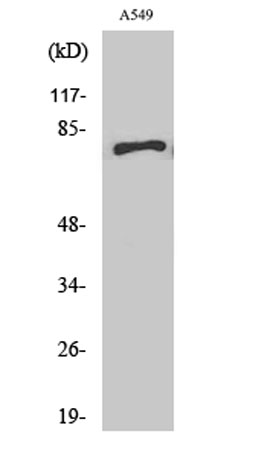
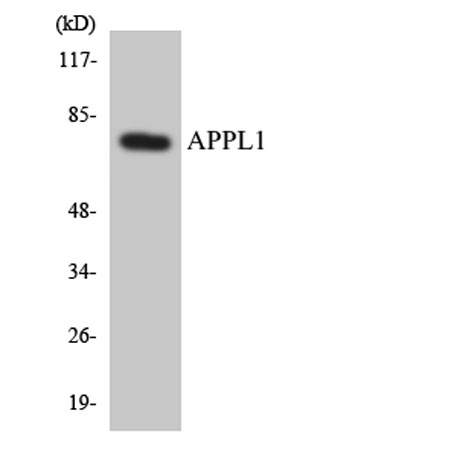
| Observed band (KD) | 80kD |
| Background | adaptor protein, phosphotyrosine interacting with PH domain and leucine zipper 1(APPL1) Homo sapiens The protein encoded by this gene has been shown to be involved in the regulation of cell proliferation, and in the crosstalk between the adiponectin signalling and insulin signalling pathways. The encoded protein binds many other proteins, including RAB5A, DCC, AKT2, PIK3CA, adiponectin receptors, and proteins of the NuRD/MeCP1 complex. This protein is found associated with endosomal membranes, but can be released by EGF and translocated to the nucleus. [provided by RefSeq, Jul 2008], |
| Function | domain:Overexpression of an N-terminal domain (residues 1-319) or a C-terminal region (residues 273-709) has a proapoptotic effect.,function:Required for the regulation of cell proliferation in response to extracellular signals from an early endosomal compartment. Links Rab5 to nuclear signal transduction.,PTM:Phosphorylated upon DNA damage, probably by ATM or ATR.,similarity:Contains 1 PH domain.,similarity:Contains 1 PID domain.,subcellular location:Early endosomal membrane-bound and nuclear. Translocated into the nucleus upon release from endosomal membranes following internalization of EGF.,subunit:Binds RAB5A/Rab5 through an N-terminal domain. This interaction is essential for its recruitment to endosomal membranes as well as its role in cell proliferation. Binds DCC and the catalytic domain of the inactive form of AKT2 through its PID domain. Binds PIK3CA and subunits of the NuRD/M |
| Subcellular location | Early endosome membrane ; Peripheral membrane protein . Nucleus . Cytoplasm . Endosome . Cell projection, ruffle . Cytoplasmic vesicle, phagosome . Early endosomal membrane-bound and nuclear. Translocated into the nucleus upon release from endosomal membranes following internalization of EGF. . |
| Expression | High levels in heart, ovary, pancreas and skeletal muscle. |

Use collapsible tabs for more detailed information that will help customers make a purchasing decision.
Ex: Shipping and return policies, size guides, and other common questions.