 Français
 English


| ELK.No | ES17014 |
| Product name | DB118 rabbit pAb |
| Reactivity | Human;Rat;Mouse; |
| Applications | WB |
| Other name | |
| Size | 100μL |
| Unit price ($) | 248 |
| Human gene ID | 117285 |
| Human Swiss-Prot | Q96PH6 |
| Source | Rabbit |
| Isotype | IgG |
| Target | DB118 |
| Fields | |
| Gene name | DEFB118 C20orf63 DEFB18 ESC42 |
| Protein name | DB118 |
| Human gene link | View Human Gene |
| Human Swiss link | View Human Swiss-Prot |
| Mouse gene ID | |
| Mouse gene link | |
| Mouse Swiss-Prot | |
| Mouse Swiss link | |
| Rat gene ID | |
| Rat gene link | |
| Rat Swiss-Prot | |
| Rat Swiss link | |
| Immunogen | Synthesized peptide derived from human DB118 AA range: 38-88 |
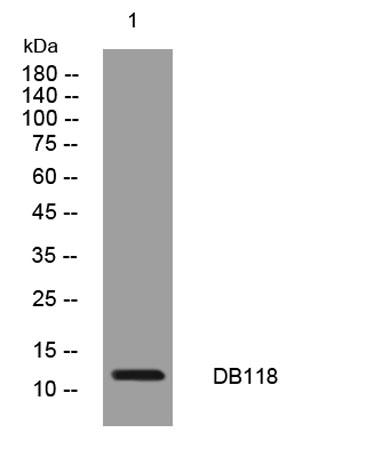
| Specificity | This antibody detects endogenous levels of DB118 at Human |
| Formulation | Liquid in PBS containing 50% glycerol, 0.5% BSA and 0.02% sodium azide. |
| Clonality | Polyclonal |
| Dilution | WB 1:500-2000 |
| Purification | The antibody was affinity-purified from rabbit serum by affinity-chromatography using specific immunogen. |
| Concentration | 1 mg/ml |
| Storage stability | -20°C/1 year |
| Molecular Weight (Da) | 14kD |
| Observed band (KD) | |
| Background | This gene encodes a member of the beta subfamily of defensins. Beta-defensins are antimicrobial peptides that protect tissues and organs from infection by a variety of microorganisms. Expression of this gene is regulated by androgen, and the encoded protein binds to sperm and exhibits antibacterial activity against E. coli. This gene is found in a cluster with other beta-defensin genes on the long arm of chromosome 20. [provided by RefSeq, Nov 2014], |
| Function | function:Has antibacterial activity .,similarity:Belongs to the beta-defensin family.,tissue specificity:High-level and epididymis-specific expression. Most abundant in the epithelium of the caput and is also present in the lumen and bound to sperm. Expressed also in pancreas., |
| Subcellular location | Secreted . |
| Expression | High-level and epididymis-specific expression (PubMed:12600824). Most abundant in the epithelium of the caput and present in the epididymis lumen and bound to sperm (PubMed:12600824). Also expressed in pancreas (PubMed:12600824). |

Use collapsible tabs for more detailed information that will help customers make a purchasing decision.
Ex: Shipping and return policies, size guides, and other common questions.