 Français
 English
CYLD (phospho-Ser418) rabbit pAb
AO-06-ES17131-50

| ELK.No | ES17131 |
| Product name | CYLD (phospho-Ser418) rabbit pAb |
| Reactivity | Human;Rat;Mouse; |
| Applications | WB |
| Other name | Ubiquitin carboxyl-terminal hydrolase CYLD (EC 3.4.19.12) (Deubiquitinating enzyme CYLD) (Ubiquitin thioesterase CYLD) (Ubiquitin-specific-processing protease CYLD) |
| Size | 50μL |
| Unit price ($) | 148 |
| Human gene ID | 1540 |
| Human Swiss-Prot | Q9NQC7 |
| Source | Rabbit |
| Isotype | IgG |
| Target | CYLD |
| Fields | >>NF-kappa B signaling pathway;>>Necroptosis;>>Osteoclast differentiation;>>RIG-I-like receptor signaling pathway;>>C-type lectin receptor signaling pathway |
| Gene name | CYLD CYLD1 KIAA0849 HSPC057 |
| Protein name | CYLD (Ser418) |
| Human gene link | View Human Gene |
| Human Swiss link | View Human Swiss-Prot |
| Mouse gene ID | 74256 |
| Mouse gene link | View Mouse Gene |
| Mouse Swiss-Prot | Q80TQ2 |
| Mouse Swiss link | View Mouse Swiss-Prot |
| Rat gene ID | 312937 |
| Rat gene link | View Rat Gene |
| Rat Swiss-Prot | Q66H62 |
| Rat Swiss link | View Rat Swiss-Prot |
| Immunogen | Synthesized phosho peptide around human CYLD (Ser418) |
| Specificity | This antibody detects endogenous levels of Human CYLD (phospho-Ser418) |
| Formulation | Liquid in PBS containing 50% glycerol, 0.5% BSA and 0.02% sodium azide. |
| Clonality | Polyclonal |
| Dilution | WB 1:1000-2000 |
| Purification | The antibody was affinity-purified from rabbit serum by affinity-chromatography using specific immunogen. |
| Concentration | 1 mg/ml |
| Storage stability | -20°C/1 year |
| Molecular Weight (Da) | |
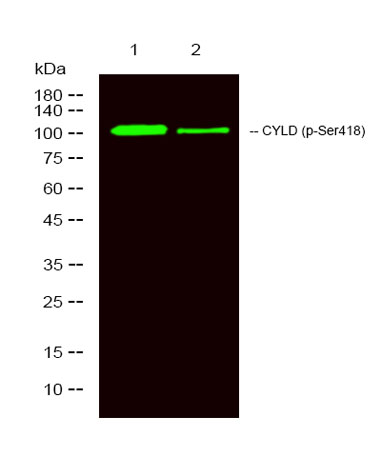
| Observed band (KD) | 105kD |
| Background | This gene is encodes a cytoplasmic protein with three cytoskeletal-associated protein-glycine-conserved (CAP-GLY) domains that functions as a deubiquitinating enzyme. Mutations in this gene have been associated with cylindromatosis, multiple familial trichoepithelioma, and Brooke-Spiegler syndrome. Alternate transcriptional splice variants, encoding different isoforms, have been characterized. [provided by RefSeq, Jul 2008], |
| Function | catalytic activity:Ubiquitin C-terminal thioester + H(2)O = ubiquitin + a thiol.,disease:Defects in CYLD are the cause of Brooke-Spiegler syndrome (BRSS) [MIM:605041]. BRSS is an autosomal dominant disorder characterized by the appearance of multiple skin appendage tumors such as cylindroma, trichoepithelioma, and spiradenoma. These tumors are typically located in the head and neck region, appear in early adulthood, and gradually increase in size and number throughout life.,disease:Defects in CYLD are the cause of familial cylindromatosis [MIM:132700]; also known as Ancell-Spiegler cylindromas or turban tumor syndrome or dermal eccrine cylindromatosis. CYLD is an autosomal dominant and highly tumor type-specific disorder. The tumors (known as cylindromas because of their characteristic microscopic architecture) are believed to arise from or recapitulate the appearance of the eccrine or a |
| Subcellular location | Cytoplasm . Cytoplasm, perinuclear region. Cytoplasm, cytoskeleton. Cell membrane; Peripheral membrane protein; Cytoplasmic side. Cytoplasm, cytoskeleton, microtubule organizing center, centrosome . Cytoplasm, cytoskeleton, spindle . Cytoplasm, cytoskeleton, cilium basal body . Detected at the microtubule cytoskeleton during interphase. Detected at the midbody during telophase. During metaphase, it remains localized to the centrosome but is also present along the spindle (PubMed:25134987). . |
| Expression | Detected in fetal brain, testis, and skeletal muscle, and at a lower level in adult brain, leukocytes, liver, heart, kidney, spleen, ovary and lung. Isoform 2 is found in all tissues except kidney. |

Use collapsible tabs for more detailed information that will help customers make a purchasing decision.
Ex: Shipping and return policies, size guides, and other common questions.