 Français
 English
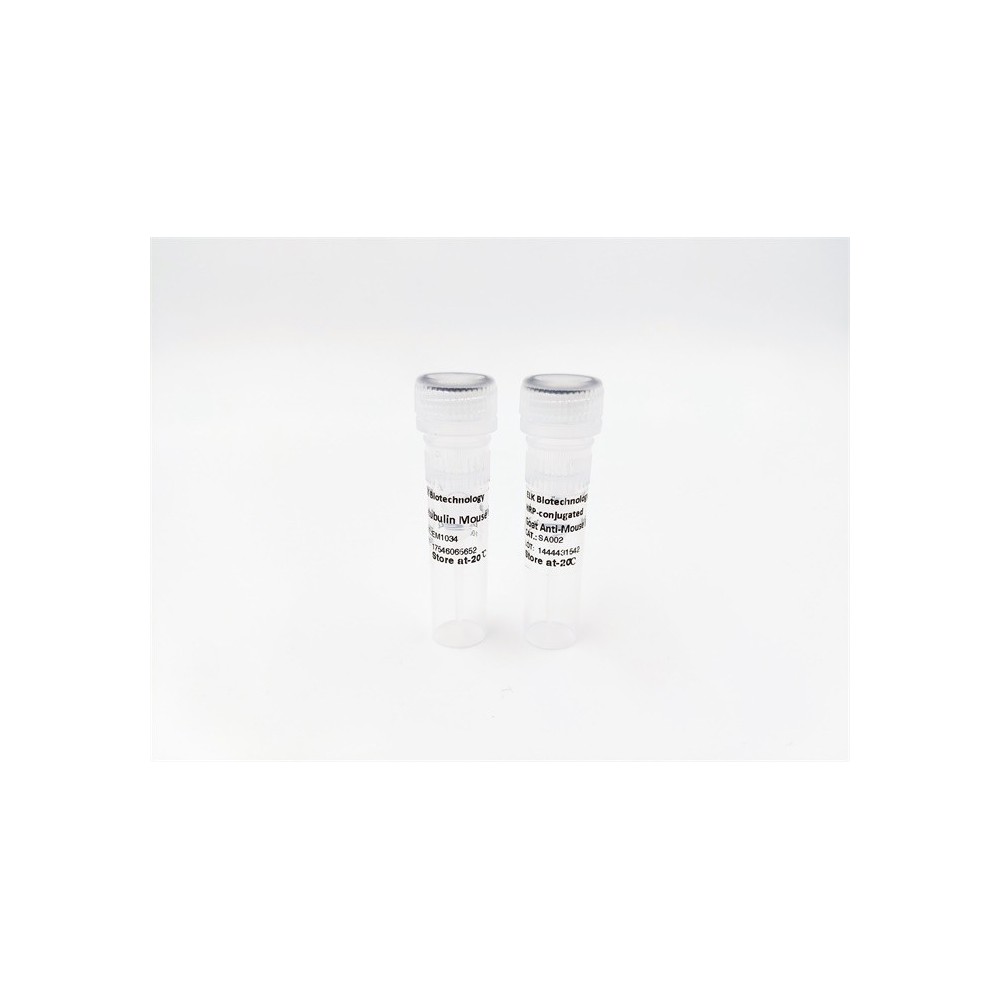

| ELK.No | ES17188 |
| Product name | CTDP1 rabbit pAb |
| Reactivity | Human; Mouse |
| Applications | WB |
| Other name | RNA polymerase II subunit A C-terminal domain phosphatase (EC 3.1.3.16) (TFIIF-associating CTD phosphatase) |
| Size | 100μL |
| Unit price ($) | 248 |
| Human gene ID | 9150 |
| Human Swiss-Prot | Q9Y5B0 |
| Source | Rabbit |
| Isotype | IgG |
| Target | CTDP1 |
| Fields | |
| Gene name | CTDP1 FCP1 |
| Protein name | CTDP1 |
| Human gene link | View Human Gene |
| Human Swiss link | View Human Swiss-Prot |
| Mouse gene ID | 67655 |
| Mouse gene link | View Mouse Gene |
| Mouse Swiss-Prot | Q7TSG2 |
| Mouse Swiss link | View Mouse Swiss-Prot |
| Rat gene ID | |
| Rat gene link | |
| Rat Swiss-Prot | |
| Rat Swiss link | |
| Immunogen | Synthesized peptide derived from human CTDP1 AA range: 73-123 |
| Specificity | This antibody detects endogenous levels of CTDP1 at Human/Mouse |
| Formulation | Liquid in PBS containing 50% glycerol, 0.5% BSA and 0.255% sodium azide. |
| Clonality | Polyclonal |
| Dilution | WB 1:500-2000 |
| Purification | The antibody was affinity-purified from rabbit serum by affinity-chromatography using specific immunogen. |
| Concentration | 1 mg/ml |
| Storage stability | -20°C/1 year |
| Molecular Weight (Da) | |
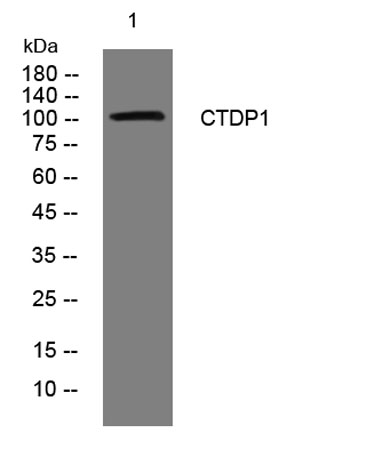
| Observed band (KD) | 105kD |
| Background | This gene encodes a protein which interacts with the carboxy-terminus of the RAP74 subunit of transcription initiation factor TFIIF, and functions as a phosphatase that processively dephosphorylates the C-terminus of POLR2A (a subunit of RNA polymerase II), making it available for initiation of gene expression. Mutations in this gene are associated with congenital cataracts, facial dysmorphism and neuropathy syndrome (CCFDN). Alternatively spliced transcript variants encoding different isoforms have been described for this gene. [provided by RefSeq, Feb 2011], |
| Function | catalytic activity:A phosphoprotein + H(2)O = a protein + phosphate.,disease:Defects in CTDP1 are a cause of congenital cataracts facial dysmorphism and neuropathy syndrome (CCFDN) [MIM:604168]. CCFDN is an autosomal recessive developmental disorder that occurs in an endogamous group of Vlax Roma (Gypsies). The syndrome is characterized by a complex clinical phenotype with seemingly unrelated features involving multiple organs and systems. Developmental abnormalities include congenital cataracts and microcorneae, hypomyelination of the peripheral nervous system, impaired physical growth, delayed early motor and intellectual development, facial dysmorphism and hypogonadism. Central nervous system involvement, with cerebral and spinal cord atrophy, may be the result of disrupted development with superimposed degenerative changes. Affected individuals are prone to severe rhabdomyolysis afte |
| Subcellular location | Nucleus . Cytoplasm, cytoskeleton, microtubule organizing center, centrosome . Cytoplasm, cytoskeleton, spindle pole . Midbody . Found at centrosomes in prometaphase, at spindle and spindle poles in metaphase and at spindle midzone and midbody in anaphase and telophase-G1 respectively. |
| Expression | Ubiquitously expressed. |

Use collapsible tabs for more detailed information that will help customers make a purchasing decision.
Ex: Shipping and return policies, size guides, and other common questions.