 Français
 English

| ELK.No | ES17197 |
| Product name | CSTN3 rabbit pAb |
| Reactivity | Human; Mouse;Rat |
| Applications | WB |
| Other name | Calsyntenin-3 (Alcadein-beta) (Alc-beta) |
| Size | 100μL |
| Unit price ($) | 248 |
| Human gene ID | 9746 |
| Human Swiss-Prot | Q9BQT9 |
| Source | Rabbit |
| Isotype | IgG |
| Target | CSTN3 |
| Fields | |
| Gene name | CLSTN3 CS3 KIAA0726 |
| Protein name | CSTN3 |
| Human gene link | View Human Gene |
| Human Swiss link | View Human Swiss-Prot |
| Mouse gene ID | 232370 |
| Mouse gene link | View Mouse Gene |
| Mouse Swiss-Prot | Q99JH7 |
| Mouse Swiss link | View Mouse Swiss-Prot |
| Rat gene ID | 171393 |
| Rat gene link | View Rat Gene |
| Rat Swiss-Prot | Q8R553 |
| Rat Swiss link | View Rat Swiss-Prot |
| Immunogen | Synthesized peptide derived from human CSTN3 AA range: 660-710 |
| Specificity | This antibody detects endogenous levels of CSTN3 at Human/Mouse/Rat |
| Formulation | Liquid in PBS containing 50% glycerol, 0.5% BSA and 0.237% sodium azide. |
| Clonality | Polyclonal |
| Dilution | WB 1:500-2000 |
| Purification | The antibody was affinity-purified from rabbit serum by affinity-chromatography using specific immunogen. |
| Concentration | 1 mg/ml |
| Storage stability | -20°C/1 year |
| Molecular Weight (Da) | |
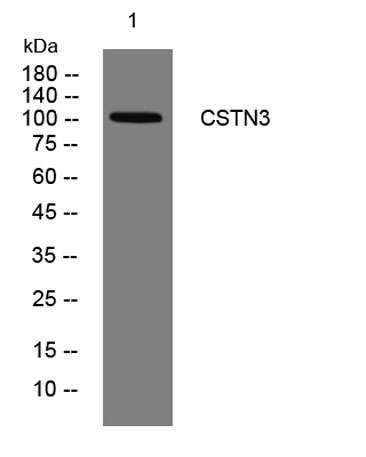
| Observed band (KD) | 105kD |
| Background | |
| Function | domain:Binds synaptic Ca(2+) with its cytoplasmic domain.,function:May modulate calcium-mediated postsynaptic signals (By similarity). Complex formation with APBA2 and APP, stabilizes APP metabolism and enhances APBA2-mediated suppression of beta-APP40 secretion, due to the retardation of intracellular APP maturation.,PTM:Proteolytically processed under normal cellular conditions. A primary zeta-cleavage generates a large extracellular (soluble) N-terminal domain (sAlc) and a short C-terminal transmembrane fragment (CTF1). A secondary cleavage catalyzed by gamma-secretase within the transmembrane domain releases the beta-Alc-beta chain in the extracellular milieu and produces an intracellular fragment (AlcICD). This processing is strongly suppressed in the tripartite complex formed with APBA2 and APP, which seems to prevent the association with gamma-secretase.,similarity:Contains 2 cadh |
| Subcellular location | Cell membrane ; Single-pass type I membrane protein . Endoplasmic reticulum membrane . Golgi apparatus membrane . Cell junction, synapse, postsynapse . Cell projection, dendrite . Most prominent in the postsynaptic specializations of asymmetric (type I) synapses with both axodendritic and axospinous localization. . |
| Expression | According to PubMed:12498782, expressed predominantly in the brain and in kidney. Low levels in heart, skeletal muscle, liver, placenta, pancreas and lung. According to PubMed:12972431, predominant expression in brain, and only marginal in kidney. In brain, present throughout all cortical layers, highest levels in GABAergic neurons (based on morphology and distribution pattern). |

Use collapsible tabs for more detailed information that will help customers make a purchasing decision.
Ex: Shipping and return policies, size guides, and other common questions.