 Français
 English
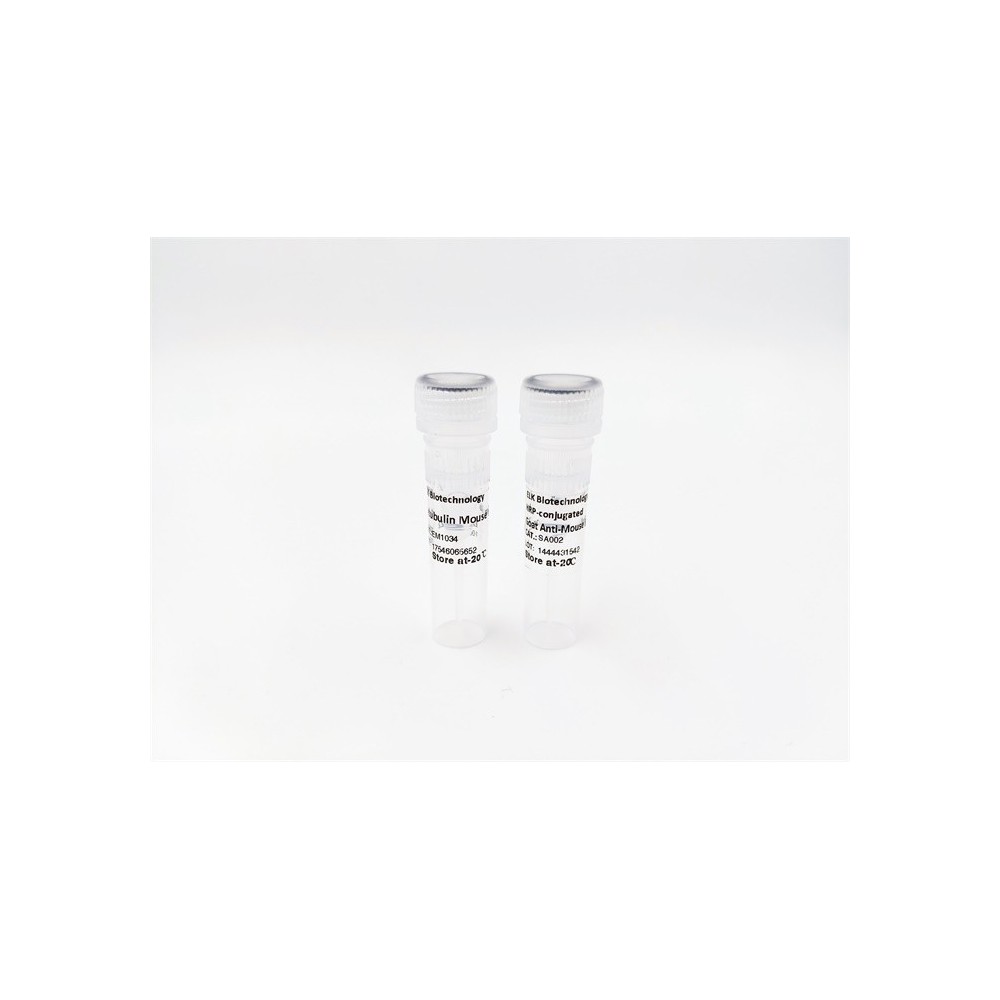

| ELK.No | ES17365 |
| Product name | CMPK2 rabbit pAb |
| Reactivity | Human; Mouse |
| Applications | WB |
| Other name | |
| Size | 100μL |
| Unit price ($) | 248 |
| Human gene ID | 129607 |
| Human Swiss-Prot | Q5EBM0 |
| Source | Rabbit |
| Isotype | IgG |
| Target | CMPK2 |
| Fields | >>Pyrimidine metabolism;>>Metabolic pathways;>>Nucleotide metabolism;>>Biosynthesis of cofactors |
| Gene name | CMPK2 |
| Protein name | CMPK2 |
| Human gene link | View Human Gene |
| Human Swiss link | View Human Swiss-Prot |
| Mouse gene ID | 22169 |
| Mouse gene link | View Mouse Gene |
| Mouse Swiss-Prot | Q3U5Q7 |
| Mouse Swiss link | View Mouse Swiss-Prot |
| Rat gene ID | |
| Rat gene link | |
| Rat Swiss-Prot | |
| Rat Swiss link | |
| Immunogen | Synthesized peptide derived from human CMPK2 AA range: 57-107 |
| Specificity | This antibody detects endogenous levels of CMPK2 at Human/Mouse |
| Formulation | Liquid in PBS containing 50% glycerol, 0.5% BSA and 0.02% sodium azide. |
| Clonality | Polyclonal |
| Dilution | WB 1:500-2000 |
| Purification | The antibody was affinity-purified from rabbit serum by affinity-chromatography using specific immunogen. |
| Concentration | 1 mg/ml |
| Storage stability | -20°C/1 year |
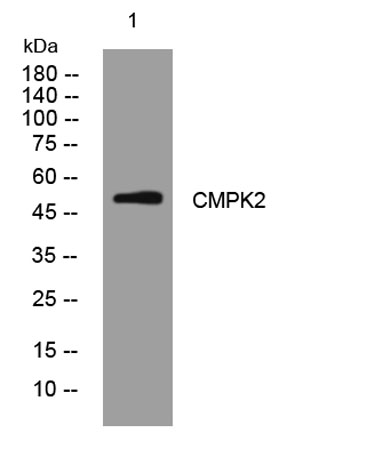
| Molecular Weight (Da) | 49kD |
| Observed band (KD) | |
| Background | This gene encodes one of the enzymes in the nucleotide synthesis salvage pathway that may participate in terminal differentiation of monocytic cells. Multiple transcript variants encoding different isoforms have been found for this gene. [provided by RefSeq, Feb 2012], |
| Function | catalytic activity:ATP + (d)CMP = ADP + (d)CDP.,function:May participate in dUTP and dCTP synthesis in mitochondria. Is able to phosphorylate dUMP, dCMP, CMP, UMP and monophosphates of the pyrimidine nucleoside analogs ddC, dFdC, araC, BVDU and FdUrd with ATP as phosphate donor. Efficacy is highest for dUMP followed by dCMP; CMP and UMP are poor substrates. May be involved in mtDNA depletion caused by long term treatment with ddC or other pyrimidine analogs.,similarity:Belongs to the thymidylate kinase family.,tissue specificity:Among all investigated tumors, leukemia cells show the most abundant expression., |
| Subcellular location | Mitochondrion . |
| Expression | Among all investigated tumors, leukemia cells show the most abundant expression. |

Use collapsible tabs for more detailed information that will help customers make a purchasing decision.
Ex: Shipping and return policies, size guides, and other common questions.