 Français
 English
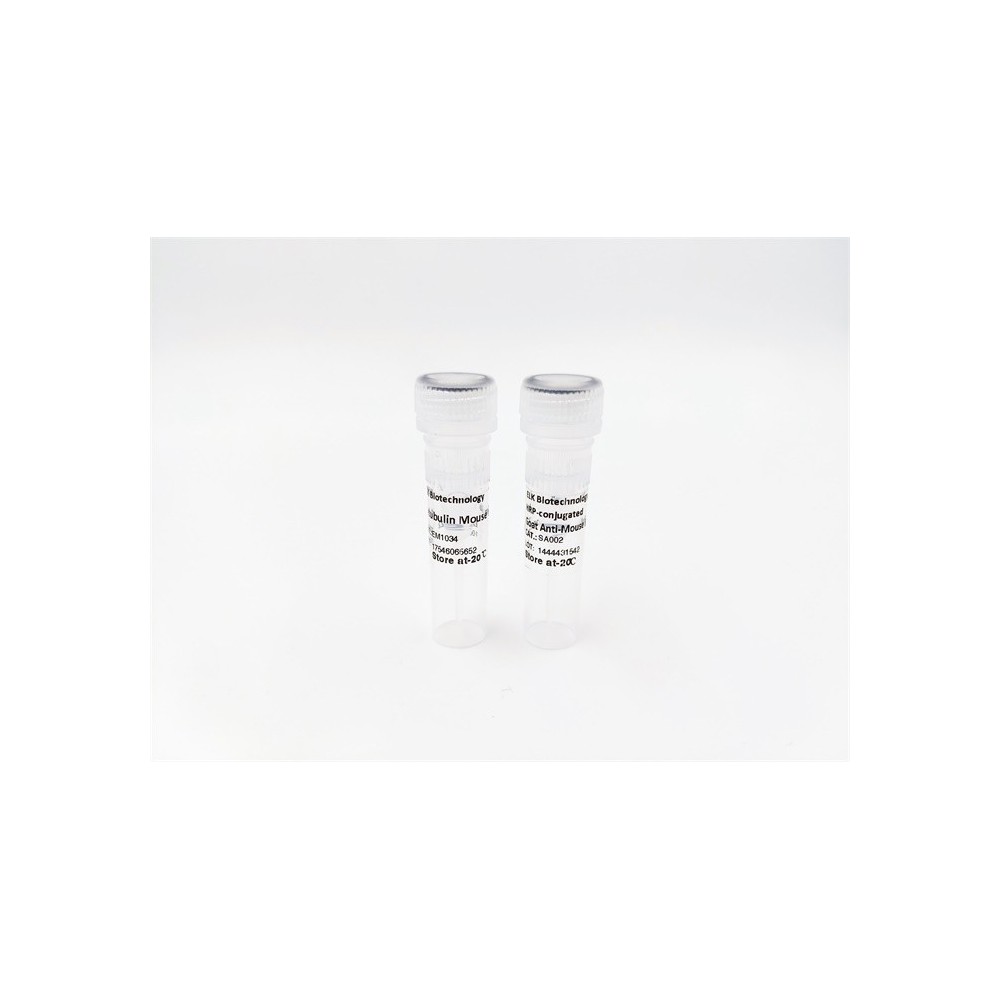

| ELK.No | ES18060 |
| Product name | BFSP1 rabbit pAb |
| Reactivity | Human; Mouse;Rat |
| Applications | WB |
| Other name | |
| Size | 50μL |
| Unit price ($) | 148 |
| Human gene ID | 631 |
| Human Swiss-Prot | Q12934 |
| Source | Rabbit |
| Isotype | IgG |
| Target | BFSP1 |
| Fields | |
| Gene name | BFSP1 |
| Protein name | BFSP1 |
| Human gene link | View Human Gene |
| Human Swiss link | View Human Swiss-Prot |
| Mouse gene ID | 12075 |
| Mouse gene link | View Mouse Gene |
| Mouse Swiss-Prot | A2AMT1 |
| Mouse Swiss link | View Mouse Swiss-Prot |
| Rat gene ID | 25394 |
| Rat gene link | View Rat Gene |
| Rat Swiss-Prot | Q02435 |
| Rat Swiss link | View Rat Swiss-Prot |
| Immunogen | Synthesized peptide derived from human BFSP1 AA range: 494-544 |
| Specificity | This antibody detects endogenous levels of BFSP1 at Human/Mouse/Rat |
| Formulation | Liquid in PBS containing 50% glycerol, 0.5% BSA and 0.02% sodium azide. |
| Clonality | Polyclonal |
| Dilution | WB 1:500-2000 |
| Purification | The antibody was affinity-purified from rabbit serum by affinity-chromatography using specific immunogen. |
| Concentration | 1 mg/ml |
| Storage stability | -20°C/1 year |
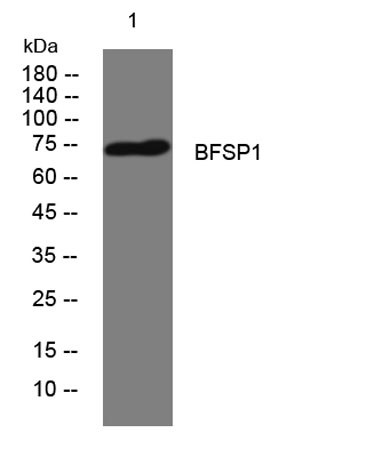
| Molecular Weight (Da) | 73kD |
| Observed band (KD) | |
| Background | This gene encodes a lens-specific intermediate filament-like protein named filensin. The encoded protein is expressed in lens fiber cells after differentiation has begun. This protein functions as a component of the beaded filament which is a cytoskeletal structure found in lens fiber cells. Mutations in this gene are the cause of autosomal recessive cortical juvenile-onset cataract. Alternate splicing results in multiple transcript variants. [provided by RefSeq, Jul 2013], |
| Function | disease:Defects in BFSP1 are the cause of autosomal recessive cortical juvenile-onset cataract [MIM:611391]. Cataract is the most frequent cause of visual impairment and blindness worldwide. While congenital cataracts are less frequent than age related cataracts, if not treated promptly they can result in irreversible neural blindness. The frequency of non-syndromic congenital cataract is estimated to be 1-6 cases per 10'000 children with one additional case being diagnosed during childhood. Developmental or juvenile onset cataract is distinguished from congenital cataract by initial clarity of the lens at birth and development of opacities progressively with maturation during childhood or adolescence. Approximately 25% of non-syndromic cataracts are inherited, and they are phenotypically and genetically heterogeneous, with autosomal dominant generally considered to be more common than a |
| Subcellular location | Cell membrane ; Peripheral membrane protein ; Cytoplasmic side . Cytoplasm . Cytoplasm, cytoskeleton . Cytoplasm, cell cortex . |
| Expression | Expressed in the cortex and nucleus of the retina lens (at protein level). |

Use collapsible tabs for more detailed information that will help customers make a purchasing decision.
Ex: Shipping and return policies, size guides, and other common questions.