 Français
 English

| ELK.No | ES18206 |
| Product name | ATG3 rabbit pAb |
| Reactivity | Human; Mouse;Rat |
| Applications | WB |
| Other name | |
| Size | 100μL |
| Unit price ($) | 248 |
| Human gene ID | 64422 |
| Human Swiss-Prot | Q9NT62 |
| Source | Rabbit |
| Isotype | IgG |
| Target | ATG3 |
| Fields | >>Autophagy - other;>>Autophagy - animal;>>Kaposi sarcoma-associated herpesvirus infection |
| Gene name | ATG3 APG3 APG3L |
| Protein name | ATG3 |
| Human gene link | View Human Gene |
| Human Swiss link | View Human Swiss-Prot |
| Mouse gene ID | 67841 |
| Mouse gene link | View Mouse Gene |
| Mouse Swiss-Prot | Q9CPX6 |
| Mouse Swiss link | View Mouse Swiss-Prot |
| Rat gene ID | 171415 |
| Rat gene link | View Rat Gene |
| Rat Swiss-Prot | Q6AZ50 |
| Rat Swiss link | View Rat Swiss-Prot |
| Immunogen | Synthesized peptide derived from human ATG3 AA range: 28-78 |
| Specificity | This antibody detects endogenous levels of ATG3 at Human/Mouse/Rat |
| Formulation | Liquid in PBS containing 50% glycerol, 0.5% BSA and 0.02% sodium azide. |
| Clonality | Polyclonal |
| Dilution | WB 1:500-2000 |
| Purification | The antibody was affinity-purified from rabbit serum by affinity-chromatography using specific immunogen. |
| Concentration | 1 mg/ml |
| Storage stability | -20°C/1 year |
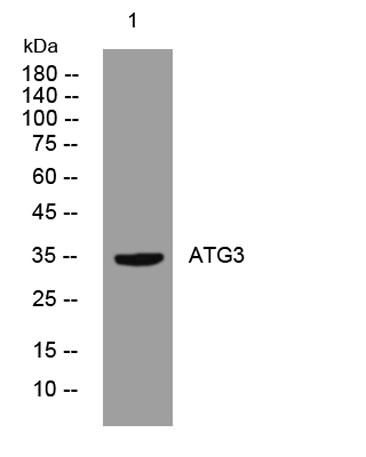
| Molecular Weight (Da) | 35kD |
| Observed band (KD) | |
| Background | This gene encodes a ubiquitin-like-conjugating enzyme and is a component of ubiquitination-like systems involved in autophagy, the process of degradation, turnover and recycling of cytoplasmic constituents in eukaryotic cells. This protein is known to play a role in regulation of autophagy during cell death. A pseudogene of this gene is located on chromosome 20. Alternative splicing results in multiple transcript variants encoding different isoforms. [provided by RefSeq, Jul 2013], |
| Function | function:GABARAPL1 (GABARAPL2 or GABARAP or MAP1LC3)-modifier protein conjugating enzyme involved in its E2-like covalent binding to PE. ATG7 (E1-like enzyme) facilitates this reaction by forming an E1-E2 complex with ATG3 (E2-like enzyme). Preferred substrate is MAP1LC3A. Formation of the GABARAPL1-PE conjugate is essential for autophagy.,similarity:Belongs to the ATG3 family.,subunit:Interacts with ATG7 and ATG12. The complex, composed of ATG3 and ATG7, plays a role in the conjugation of ATG12 to ATG5.,tissue specificity:Widely expressed, with a highest expression in heart, skeletal muscle, kidney, liver and placenta., |
| Subcellular location | Cytoplasm . |
| Expression | Widely expressed, with a highest expression in heart, skeletal muscle, kidney, liver and placenta. |

Use collapsible tabs for more detailed information that will help customers make a purchasing decision.
Ex: Shipping and return policies, size guides, and other common questions.