 Français
 English

| ELK.No | ES18218 |
| Product name | AT8A1 rabbit pAb |
| Reactivity | Human; Mouse |
| Applications | WB |
| Other name | |
| Size | 100μL |
| Unit price ($) | 248 |
| Human gene ID | 10396 |
| Human Swiss-Prot | Q9Y2Q0 |
| Source | Rabbit |
| Isotype | IgG |
| Target | AT8A1 |
| Fields | |
| Gene name | ATP8A1 ATPIA |
| Protein name | AT8A1 |
| Human gene link | View Human Gene |
| Human Swiss link | View Human Swiss-Prot |
| Mouse gene ID | 11980 |
| Mouse gene link | View Mouse Gene |
| Mouse Swiss-Prot | P70704 |
| Mouse Swiss link | View Mouse Swiss-Prot |
| Rat gene ID | |
| Rat gene link | |
| Rat Swiss-Prot | |
| Rat Swiss link | |
| Immunogen | Synthesized peptide derived from human AT8A1 AA range: 159-209 |
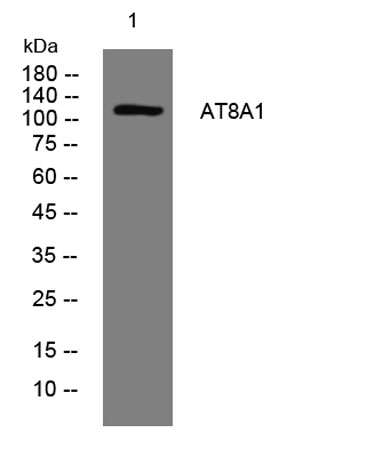
| Specificity | This antibody detects endogenous levels of AT8A1 at Human/Mouse |
| Formulation | Liquid in PBS containing 50% glycerol, 0.5% BSA and 0.02% sodium azide. |
| Clonality | Polyclonal |
| Dilution | WB 1:500-2000 |
| Purification | The antibody was affinity-purified from rabbit serum by affinity-chromatography using specific immunogen. |
| Concentration | 1 mg/ml |
| Storage stability | -20°C/1 year |
| Molecular Weight (Da) | 128kD |
| Observed band (KD) | |
| Background | The P-type adenosinetriphosphatases (P-type ATPases) are a family of proteins which use the free energy of ATP hydrolysis to drive uphill transport of ions across membranes. Several subfamilies of P-type ATPases have been identified. One subfamily catalyzes transport of heavy metal ions. Another subfamily transports non-heavy metal ions (NMHI). The protein encoded by this gene is a member of the third subfamily of P-type ATPases and acts to transport amphipaths, such as phosphatidylserine. Two transcript variants encoding different isoforms have been found for this gene. [provided by RefSeq, Jul 2008], |
| Function | catalytic activity:ATP + H(2)O + phospholipid(In) = ADP + phosphate + phospholipid(Out).,function:May play a role in the transport of aminophospholipids from the outer to the inner leaflet of various membranes and the maintenance of asymmetric distribution of phospholipids, mainly in secretory vesicles.,similarity:Belongs to the cation transport ATPase (P-type) family. Type IV subfamily.,tissue specificity:Found in most adult tissues except liver, testis and placenta. Most abundant in heart, brain and skeletal muscle. Also detected in fetal tissues. The long isoform is only detected in brain, skeletal muscle and heart and is the most abundant form in skeletal muscle., |
| Subcellular location | Cytoplasmic vesicle, secretory vesicle, chromaffin granule membrane ; Multi-pass membrane protein . Cytoplasmic granule . Cell membrane . Endoplasmic reticulum . Golgi apparatus . Exit from the endoplasmic reticulum requires the presence of TMEM30A, but not TMEM30B (PubMed:20947505). In the presence of TMEM30A, predominantly located in cytoplasmic punctate structures and localizes to the plasma membrane (PubMed:20947505). Localizes to plasma membranes of red blood cells (By similarity). . |
| Expression | Found in most adult tissues except liver, testis and placenta. Most abundant in heart, brain and skeletal muscle. Also detected in fetal tissues. Isoform 1 is only detected in brain, skeletal muscle and heart and is the most abundant form in skeletal muscle. Highly expressed in platelets (PubMed:30674456). |

Use collapsible tabs for more detailed information that will help customers make a purchasing decision.
Ex: Shipping and return policies, size guides, and other common questions.