 Français
 English

| ELK.No | ES18219 |
| Product name | AT2B4 rabbit pAb |
| Reactivity | Human;Rat |
| Applications | WB |
| Other name | |
| Size | 50μL |
| Unit price ($) | 148 |
| Human gene ID | 493 |
| Human Swiss-Prot | P23634 |
| Source | Rabbit |
| Isotype | IgG |
| Target | AT2B4 |
| Fields | >>Calcium signaling pathway;>>cGMP-PKG signaling pathway;>>cAMP signaling pathway;>>Adrenergic signaling in cardiomyocytes;>>Aldosterone synthesis and secretion;>>Endocrine and other factor-regulated calcium reabsorption;>>Salivary secretion;>>Pancreatic secretion;>>Mineral absorption |
| Gene name | ATP2B4 ATP2B2 MXRA1 |
| Protein name | AT2B4 |
| Human gene link | View Human Gene |
| Human Swiss link | View Human Swiss-Prot |
| Mouse gene ID | |
| Mouse gene link | |
| Mouse Swiss-Prot | |
| Mouse Swiss link | |
| Rat gene ID | 29600 |
| Rat gene link | View Rat Gene |
| Rat Swiss-Prot | Q64542 |
| Rat Swiss link | View Rat Swiss-Prot |
| Immunogen | Synthesized peptide derived from human AT2B4 AA range: 168-218 |
| Specificity | This antibody detects endogenous levels of AT2B4 at Human/Rat |
| Formulation | Liquid in PBS containing 50% glycerol, 0.5% BSA and 0.02% sodium azide. |
| Clonality | Polyclonal |
| Dilution | WB 1:500-2000 |
| Purification | The antibody was affinity-purified from rabbit serum by affinity-chromatography using specific immunogen. |
| Concentration | 1 mg/ml |
| Storage stability | -20°C/1 year |
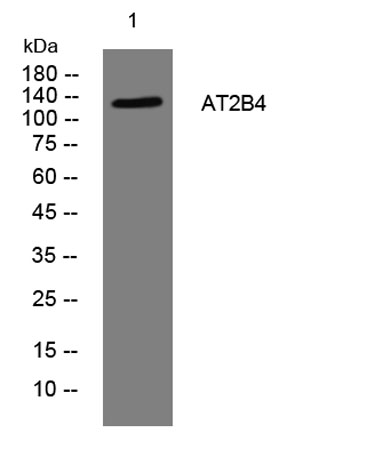
| Molecular Weight (Da) | 137kD |
| Observed band (KD) | |
| Background | The protein encoded by this gene belongs to the family of P-type primary ion transport ATPases characterized by the formation of an aspartyl phosphate intermediate during the reaction cycle. These enzymes remove bivalent calcium ions from eukaryotic cells against very large concentration gradients and play a critical role in intracellular calcium homeostasis. The mammalian plasma membrane calcium ATPase isoforms are encoded by at least four separate genes and the diversity of these enzymes is further increased by alternative splicing of transcripts. The expression of different isoforms and splice variants is regulated in a developmental, tissue- and cell type-specific manner, suggesting that these pumps are functionally adapted to the physiological needs of particular cells and tissues. This gene encodes the plasma membrane calcium ATPase isoform 4. Alternatively spliced transcript variants encoding different isoforms have been identified. [provided by RefSeq, Jul 2008], |
| Function | alternative products:There is a combination of two alternatively spliced domains at N-terminal site A (X and Z) and at C-terminal site B/C (A, B, D and K). The splice sites have mostly been studied independently. Full isoforms so far detected are isoform XA and isoform XB. Experimental confirmation may be lacking for some isoforms,catalytic activity:ATP + H(2)O + Ca(2+)(Cis) = ADP + phosphate + Ca(2+)(Trans).,function:This magnesium-dependent enzyme catalyzes the hydrolysis of ATP coupled with the transport of calcium out of the cell.,similarity:Belongs to the cation transport ATPase (P-type) family.,similarity:Belongs to the cation transport ATPase (P-type) family. Type IIB subfamily.,tissue specificity:Isoform XB is the most abundant isoform and is expressed ubiquitously. Isoforms containing segment Z have only been detected in heart, while isoforms containing segment a have been found |
| Subcellular location | Cell membrane ; Multi-pass membrane protein . Cell projection, cilium, flagellum membrane ; Multi-pass membrane protein . |
| Expression | Isoform XB is the most abundant isoform and is expressed ubiquitously. Isoforms containing segment Z have only been detected in heart, while isoforms containing segment a have been found in heart, stomach and brain cortex. |

Use collapsible tabs for more detailed information that will help customers make a purchasing decision.
Ex: Shipping and return policies, size guides, and other common questions.