 Français
 English

| ELK.No | ES18233 |
| Product name | ASGL1 rabbit pAb |
| Reactivity | Human; Mouse;Rat |
| Applications | WB |
| Other name | |
| Size | 100μL |
| Unit price ($) | 248 |
| Human gene ID | 80150 |
| Human Swiss-Prot | Q7L266 |
| Source | Rabbit |
| Isotype | IgG |
| Target | ASGL1 |
| Fields | >>Alanine, aspartate and glutamate metabolism;>>Metabolic pathways |
| Gene name | ASRGL1 ALP CRASH |
| Protein name | ASGL1 |
| Human gene link | View Human Gene |
| Human Swiss link | View Human Swiss-Prot |
| Mouse gene ID | 66514 |
| Mouse gene link | View Mouse Gene |
| Mouse Swiss-Prot | Q8C0M9 |
| Mouse Swiss link | View Mouse Swiss-Prot |
| Rat gene ID | 246307 |
| Rat gene link | View Rat Gene |
| Rat Swiss-Prot | Q8VI04 |
| Rat Swiss link | View Rat Swiss-Prot |
| Immunogen | Synthesized peptide derived from human ASGL1 AA range: 57-107 |
| Specificity | This antibody detects endogenous levels of ASGL1 at Human/Mouse/Rat |
| Formulation | Liquid in PBS containing 50% glycerol, 0.5% BSA and 0.02% sodium azide. |
| Clonality | Polyclonal |
| Dilution | WB 1:500-2000 |
| Purification | The antibody was affinity-purified from rabbit serum by affinity-chromatography using specific immunogen. |
| Concentration | 1 mg/ml |
| Storage stability | -20°C/1 year |
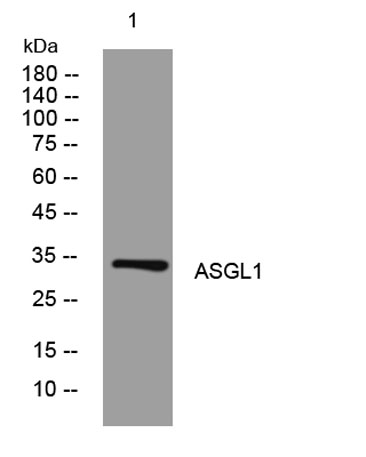
| Molecular Weight (Da) | 34kD |
| Observed band (KD) | |
| Background | |
| Function | catalytic activity:L-asparagine + H(2)O = L-aspartate + NH(3).,function:Acts in asparagine catabolism. May be involved in astroglial production of L-aspartate, which can act as an excitatory neurotransmitter in some brain regions.,induction:By 5-alpha-di-hydrotestosterone and progesterone.,similarity:Belongs to the Ntn-hydrolase family.,subcellular location:Midpiece of sperm tail.,tissue specificity:Expressed in brain, kidney, testis and tissues of the gastrointestinal tract. Present in sperm (at protein level). Over-expressed in uterine, mammary, prostatic and ovarian carcinoma., |
| Subcellular location | Cytoplasm . Midpiece of sperm tail. |
| Expression | Expressed in brain, kidney, testis and tissues of the gastrointestinal tract. Present in sperm (at protein level). Over-expressed in uterine, mammary, prostatic and ovarian carcinoma. |

Use collapsible tabs for more detailed information that will help customers make a purchasing decision.
Ex: Shipping and return policies, size guides, and other common questions.