 Français
 English
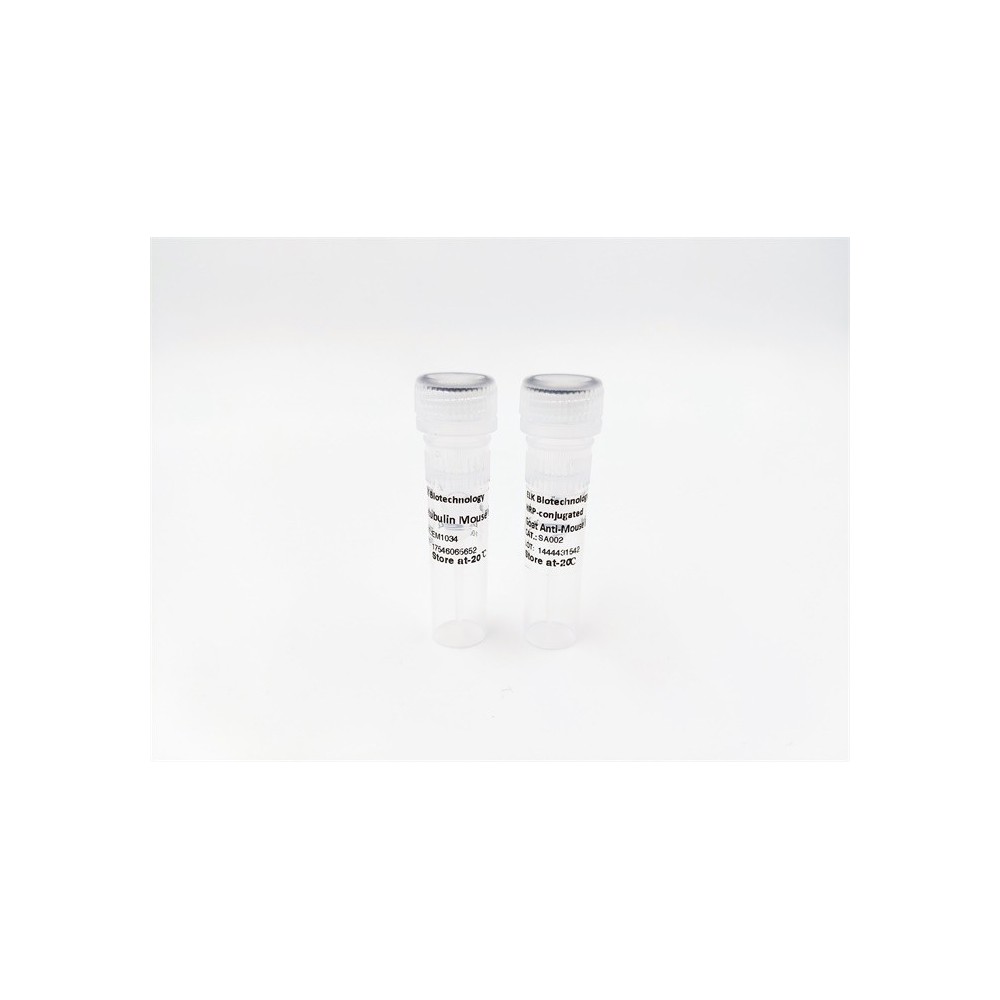

| ELK.No | ES1837 |
| Product name | CAR rabbit pAb |
| Reactivity | Human;Mouse;Rat |
| Applications | WB;ELISA |
| Other name | CXADR; CAR; Coxsackievirus and adenovirus receptor; CAR; hCAR; CVB3-binding protein; Coxsackievirus B-adenovirus receptor; HCVADR |
| Size | 50μL |
| Unit price ($) | 148 |
| Human gene ID | 1525 |
| Human Swiss-Prot | P78310 |
| Source | Rabbit |
| Isotype | IgG |
| Target | CAR |
| Fields | >>Viral myocarditis |
| Gene name | CXADR |
| Protein name | Coxsackievirus and adenovirus receptor |
| Human gene link | View Human Gene |
| Human Swiss link | View Human Swiss-Prot |
| Mouse gene ID | 13052 |
| Mouse gene link | View Mouse Gene |
| Mouse Swiss-Prot | P97792 |
| Mouse Swiss link | View Mouse Swiss-Prot |
| Rat gene ID | 89843 |
| Rat gene link | View Rat Gene |
| Rat Swiss-Prot | Q9R066 |
| Rat Swiss link | View Rat Swiss-Prot |
| Immunogen | The antiserum was produced against synthesized peptide derived from human CXADR. AA range:1-50 |
| Specificity | CAR Polyclonal Antibody detects endogenous levels of CAR protein. |
| Formulation | Liquid in PBS containing 50% glycerol, 0.5% BSA and 0.02% sodium azide. |
| Clonality | Polyclonal |
| Dilution | Western Blot: 1/500 - 1/2000. ELISA: 1/20000. Not yet tested in other applications. |
| Purification | The antibody was affinity-purified from rabbit antiserum by affinity-chromatography using epitope-specific immunogen. |
| Concentration | 1 mg/ml |
| Storage stability | -20°C/1 year |
| Molecular Weight (Da) | |
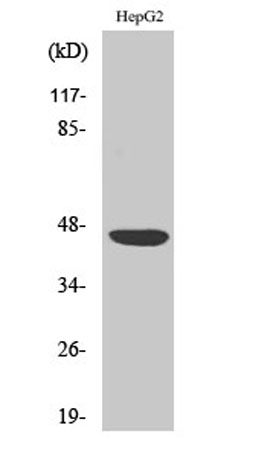
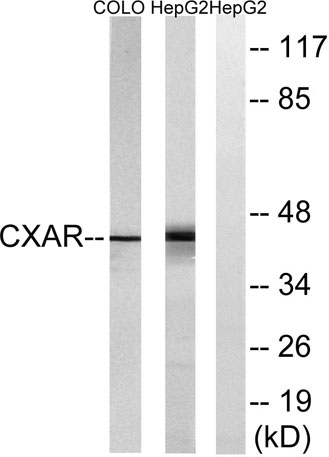
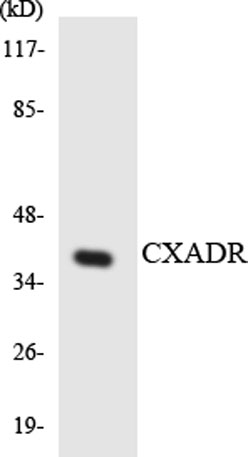
| Observed band (KD) | 40kD |
| Background | The protein encoded by this gene is a type I membrane receptor for group B coxsackieviruses and subgroup C adenoviruses. Several transcript variants encoding different isoforms have been found for this gene. Pseudogenes of this gene are found on chromosomes 15, 18, and 21. [provided by RefSeq, May 2011], |
| Function | domain:The Ig-like C2-type 1 domain probably mediates homodimerization and interaction with JAML.,domain:The PDZ-binding motif mediates interaction with MPDZ and BAIAP1.,function:Component of the epithelial apical junction complex that is essential for the tight junction integrity. Proposed to function as a homophilic cell adhesion molecule. Recruits MPDZ to intercellular contact sites. Probably involved in transepithelial migration of polymorphonuclear leukocytes (PMN) through adhesive interactions with AMICA1/JAML located in the plasma membrane of PMN.,PTM:N-glycosylated.,PTM:Palmitoylated on Cys-259 and/or Cys-260; required for proper localization to the plasma membrane.,similarity:Contains 2 Ig-like C2-type (immunoglobulin-like) domains.,subcellular location:In epithelial cells localizes to the apical junction complex composced of tight and adherens junctions. In airway epithelial ce |
| Subcellular location | [Isoform 1]: Cell membrane ; Single-pass type I membrane protein . Basolateral cell membrane ; Single-pass type I membrane protein . Cell junction, tight junction . Cell junction, adherens junction . In epithelial cells localizes to the apical junction complex composed of tight and adherens junctions (PubMed:12297051). In airway epithelial cells localized to basolateral membrane but not to apical surface (PubMed:11316797). .; [Isoform 3]: Secreted .; [Isoform 4]: Secreted .; [Isoform 5]: Secreted . |
| Expression | Expressed in pancreas, brain, heart, small intestine, testis, prostate and at a lower level in liver and lung. Isoform 5 is ubiquitously expressed. Isoform 3 is expressed in heart, lung and pancreas. In skeletal muscle, isoform 1 is found at the neuromuscular junction and isoform 2 is found in blood vessels. In cardiac muscle, isoform 1 and isoform 2 are found at intercalated disks. In heart expressed in subendothelial layers of the vessel wall but not in the luminal endothelial surface. Expression is elevated in hearts with dilated cardiomyopathy. |

Use collapsible tabs for more detailed information that will help customers make a purchasing decision.
Ex: Shipping and return policies, size guides, and other common questions.