 Français
 English
ALK (phospho-Tyr1078) rabbit pAb
AO-06-ES18394-50

| ELK.No | ES18394 |
| Product name | ALK (phospho-Tyr1078) rabbit pAb |
| Reactivity | Human;Rat;Mouse; |
| Applications | WB |
| Other name | ALK tyrosine kinase receptor (EC 2.7.10.1) (Anaplastic lymphoma kinase) (CD antigen CD246) |
| Size | 50μL |
| Unit price ($) | 148 |
| Human gene ID | 238 |
| Human Swiss-Prot | Q9UM73 |
| Source | Rabbit |
| Isotype | IgG |
| Target | ALK |
| Fields | >>Pathways in cancer;>>Non-small cell lung cancer;>>PD-L1 expression and PD-1 checkpoint pathway in cancer |
| Gene name | ALK |
| Protein name | ALK (Tyr1078) |
| Human gene link | View Human Gene |
| Human Swiss link | View Human Swiss-Prot |
| Mouse gene ID | 11682 |
| Mouse gene link | View Mouse Gene |
| Mouse Swiss-Prot | P97793 |
| Mouse Swiss link | View Mouse Swiss-Prot |
| Rat gene ID | |
| Rat gene link | |
| Rat Swiss-Prot | |
| Rat Swiss link | |
| Immunogen | Synthesized phosho peptide around human ALK (Tyr1078) |
| Specificity | This antibody detects endogenous levels of Human ALK (phospho-Tyr1078) |
| Formulation | Liquid in PBS containing 50% glycerol, 0.5% BSA and 0.02% sodium azide. |
| Clonality | Polyclonal |
| Dilution | WB 1:1000-2000 |
| Purification | The antibody was affinity-purified from rabbit serum by affinity-chromatography using specific immunogen. |
| Concentration | 1 mg/ml |
| Storage stability | -20°C/1 year |
| Molecular Weight (Da) | |
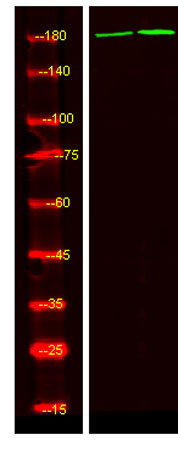
| Observed band (KD) | 150-240kD |
| Background | This gene encodes a receptor tyrosine kinase, which belongs to the insulin receptor superfamily. This protein comprises an extracellular domain, an hydrophobic stretch corresponding to a single pass transmembrane region, and an intracellular kinase domain. It plays an important role in the development of the brain and exerts its effects on specific neurons in the nervous system. This gene has been found to be rearranged, mutated, or amplified in a series of tumours including anaplastic large cell lymphomas, neuroblastoma, and non-small cell lung cancer. The chromosomal rearrangements are the most common genetic alterations in this gene, which result in creation of multiple fusion genes in tumourigenesis, including ALK (chromosome 2)/EML4 (chromosome 2), ALK/RANBP2 (chromosome 2), ALK/ATIC (chromosome 2), ALK/TFG (chromosome 3), ALK/NPM1 (chromosome 5), ALK/SQSTM1 (chromosome |
| Function | catalytic activity:ATP + a [protein]-L-tyrosine = ADP + a [protein]-L-tyrosine phosphate.,disease:A chromosomal aberration involving ALK is associated with anaplastic large-cell lymphoma (ALCL). Translocation t(2;17)(p23;q25) with ALO17.,disease:A chromosomal aberration involving ALK is associated with inflammatory myofibroblastic tumors (IMTs). Translocation t(2;11)(p23;p15) with CARS; translocation t(2;4)(p23;q21) with SEC31A.,disease:A chromosomal aberration involving ALK is found in a form of non-Hodgkin lymphoma. Translocation t(2;5)(p23;q35) with NPM1. The resulting chimeric NPM1-ALK protein homodimerize and the kinase becomes constitutively activated. The constitutively active fusion proteins are responsible for 5-10% of non-Hodgkin lymphomas.,function:Orphan receptor with a tyrosine-protein kinase activity. Appears to play an important role in the normal development and function |
| Subcellular location | Cell membrane ; Single-pass type I membrane protein . Membrane attachment is essential for promotion of neuron-like differentiation and cell proliferation arrest through specific activation of the MAP kinase pathway. . |
| Expression | Expressed in brain and CNS. Also expressed in the small intestine and testis, but not in normal lymphoid cells. |

Use collapsible tabs for more detailed information that will help customers make a purchasing decision.
Ex: Shipping and return policies, size guides, and other common questions.