 Français
 English

| ELK.No | ES18451 |
| Product name | ADR1 rabbit pAb |
| Reactivity | Human; Mouse |
| Applications | WB |
| Other name | |
| Size | 100μL |
| Unit price ($) | 248 |
| Human gene ID | 51094 |
| Human Swiss-Prot | Q96A54 |
| Source | Rabbit |
| Isotype | IgG |
| Target | ADR1 |
| Fields | >>AMPK signaling pathway;>>Longevity regulating pathway;>>Adipocytokine signaling pathway;>>Non-alcoholic fatty liver disease;>>Alcoholic liver disease |
| Gene name | ADIPOR1 PAQR1 TESBP1A CGI-45 |
| Protein name | ADR1 |
| Human gene link | View Human Gene |
| Human Swiss link | View Human Swiss-Prot |
| Mouse gene ID | 72674 |
| Mouse gene link | View Mouse Gene |
| Mouse Swiss-Prot | Q91VH1 |
| Mouse Swiss link | View Mouse Swiss-Prot |
| Rat gene ID | |
| Rat gene link | |
| Rat Swiss-Prot | |
| Rat Swiss link | |
| Immunogen | Synthesized peptide derived from human ADR1 AA range: 277-327 |
| Specificity | This antibody detects endogenous levels of ADR1 at Human/Mouse |
| Formulation | Liquid in PBS containing 50% glycerol, 0.5% BSA and 0.02% sodium azide. |
| Clonality | Polyclonal |
| Dilution | WB 1:500-2000 |
| Purification | The antibody was affinity-purified from rabbit serum by affinity-chromatography using specific immunogen. |
| Concentration | 1 mg/ml |
| Storage stability | -20°C/1 year |
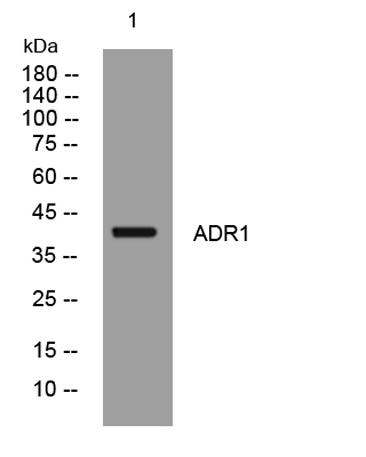
| Molecular Weight (Da) | 41kD |
| Observed band (KD) | |
| Background | This gene encodes a protein which acts as a receptor for adiponectin, a hormone secreted by adipocytes which regulates fatty acid catabolism and glucose levels. Binding of adiponectin to the encoded protein results in activation of an AMP-activated kinase signaling pathway which affects levels of fatty acid oxidation and insulin sensitivity. A pseudogene of this gene is located on chromosome 14. Multiple alternatively spliced transcript variants have been found for this gene. [provided by RefSeq, Mar 2014], |
| Function | function:Receptor for globular and full-length adiponectin (APM1), an essential hormone secreted by adipocytes that acts as an antidiabetic. Probably involved in metabolic pathways that regulate lipid metabolism such as fatty acid oxidation. Mediates increased AMPK, PPARA ligand activity, fatty acid oxidation and glucose uptake by adiponectin. Has some high-affinity receptor for globular adiponectin but low-affinity receptor for full-length adiponectin.,similarity:Belongs to the ADIPOR family.,subcellular location:Localized to the cell membrane and intracellular organelles.,subunit:May form homo and heteromultimers.,tissue specificity:Widely expressed. Highly expressed in skeletal muscle. Expressed at intermediate level in brain, heart, spleen, kidney, liver, placenta, lung and peripheral blood leukocytes. Weakly expressed in colon, thymus and small intestine., |
| Subcellular location | Cell membrane ; Multi-pass membrane protein . Localized to the cell membrane and intracellular organelles. . |
| Expression | Widely expressed (PubMed:16044242). Highly expressed in heart and skeletal muscle (PubMed:12802337). Expressed at intermediate level in brain, spleen, kidney, liver, placenta, lung and peripheral blood leukocytes (PubMed:12802337). Weakly expressed in colon, thymus and small intestine (PubMed:12802337). |

Use collapsible tabs for more detailed information that will help customers make a purchasing decision.
Ex: Shipping and return policies, size guides, and other common questions.