 Français
 English

| ELK.No | ES18505 |
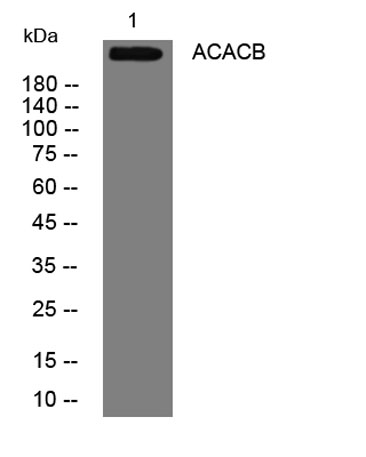
| Product name | ACACB rabbit pAb |
| Reactivity | Human;Rat;Mouse; |
| Applications | WB |
| Other name | |
| Size | 100μL |
| Unit price ($) | 248 |
| Human gene ID | 32 |
| Human Swiss-Prot | O00763 |
| Source | Rabbit |
| Isotype | IgG |
| Target | ACACB |
| Fields | >>Fatty acid biosynthesis;>>Pyruvate metabolism;>>Propanoate metabolism;>>Metabolic pathways;>>AMPK signaling pathway;>>Insulin signaling pathway;>>Adipocytokine signaling pathway;>>Glucagon signaling pathway;>>Insulin resistance;>>Alcoholic liver disease |
| Gene name | ACACB ACC2 ACCB |
| Protein name | ACACB |
| Human gene link | View Human Gene |
| Human Swiss link | View Human Swiss-Prot |
| Mouse gene ID | |
| Mouse gene link | |
| Mouse Swiss-Prot | |
| Mouse Swiss link | |
| Rat gene ID | |
| Rat gene link | |
| Rat Swiss-Prot | |
| Rat Swiss link | |
| Immunogen | Synthesized peptide derived from human ACACB |
| Specificity | This antibody detects endogenous levels of ACACB at Human |
| Formulation | Liquid in PBS containing 50% glycerol, 0.5% BSA and 0.02% sodium azide. |
| Clonality | Polyclonal |
| Dilution | WB 1:500-2000 |
| Purification | The antibody was affinity-purified from rabbit serum by affinity-chromatography using specific immunogen. |
| Concentration | 1 mg/ml |
| Storage stability | -20°C/1 year |
| Molecular Weight (Da) | 270kD |
| Observed band (KD) | |
| Background | Acetyl-CoA carboxylase (ACC) is a complex multifunctional enzyme system. ACC is a biotin-containing enzyme which catalyzes the carboxylation of acetyl-CoA to malonyl-CoA, the rate-limiting step in fatty acid synthesis. ACC-beta is thought to control fatty acid oxidation by means of the ability of malonyl-CoA to inhibit carnitine-palmitoyl-CoA transferase I, the rate-limiting step in fatty acid uptake and oxidation by mitochondria. ACC-beta may be involved in the regulation of fatty acid oxidation, rather than fatty acid biosynthesis. There is evidence for the presence of two ACC-beta isoforms. [provided by RefSeq, Jul 2008], |
| Function | catalytic activity:ATP + acetyl-CoA + HCO(3)(-) = ADP + phosphate + malonyl-CoA.,catalytic activity:ATP + biotin-carboxyl-carrier protein + CO(2) = ADP + phosphate + carboxybiotin-carboxyl-carrier protein.,cofactor:Binds 2 manganese ions per subunit.,cofactor:Biotin.,enzyme regulation:Activated by citrate. Inhibited by malonyl-CoA.,function:ACC-beta may be involved in the provision of malonyl-CoA or in the regulation of fatty acid oxidation, rather than fatty acid biosynthesis. Carries out three functions: biotin carboxyl carrier protein, biotin carboxylase and carboxyltransferase.,pathway:Lipid metabolism; malonyl-CoA biosynthesis; malonyl-CoA from acetyl-CoA: step 1/1.,similarity:Contains 1 ATP-grasp domain.,similarity:Contains 1 biotin carboxylation domain.,similarity:Contains 1 biotinyl-binding domain.,similarity:Contains 1 carboxyltransferase domain.,subcellular location:May associa |
| Subcellular location | Mitochondrion . |
| Expression | Widely expressed with highest levels in heart, skeletal muscle, liver, adipose tissue, mammary gland, adrenal gland and colon (PubMed:9099716). Isoform 3 is expressed in skeletal muscle, adipose tissue and liver (at protein level) (PubMed:19190759). Isoform 3 is detected at high levels in adipose tissue with lower levels in heart, liver, skeletal muscle and testis (PubMed:19190759). |

Use collapsible tabs for more detailed information that will help customers make a purchasing decision.
Ex: Shipping and return policies, size guides, and other common questions.