 Français
 English
53BP1 (phospho-Ser1778) rabbit pAb
AO-06-ES18530-50

| ELK.No | ES18530 |
| Product name | 53BP1 (phospho-Ser1778) rabbit pAb |
| Reactivity | Human;Rat;Mouse; |
| Applications | WB |
| Other name | Tumor suppressor p53-binding protein 1 (53BP1) (p53-binding protein 1) (p53BP1) |
| Size | 50μL |
| Unit price ($) | 148 |
| Human gene ID | 7158 |
| Human Swiss-Prot | Q12888 |
| Source | Rabbit |
| Isotype | IgG |
| Target | 53BP1 |
| Fields | >>NOD-like receptor signaling pathway |
| Gene name | TP53BP1 |
| Protein name | 53BP1 (Ser1778) |
| Human gene link | View Human Gene |
| Human Swiss link | View Human Swiss-Prot |
| Mouse gene ID | 27223 |
| Mouse gene link | View Mouse Gene |
| Mouse Swiss-Prot | P70399 |
| Mouse Swiss link | View Mouse Swiss-Prot |
| Rat gene ID | |
| Rat gene link | |
| Rat Swiss-Prot | |
| Rat Swiss link | |
| Immunogen | Synthesized phosho peptide around human 53BP1 (Ser1778) |
| Specificity | This antibody detects endogenous levels of Human 53BP1 (phospho-Ser1778) |
| Formulation | Liquid in PBS containing 50% glycerol, 0.5% BSA and 0.02% sodium azide. |
| Clonality | Polyclonal |
| Dilution | WB 1:1000-2000 |
| Purification | The antibody was affinity-purified from rabbit serum by affinity-chromatography using specific immunogen. |
| Concentration | 1 mg/ml |
| Storage stability | -20°C/1 year |
| Molecular Weight (Da) | |
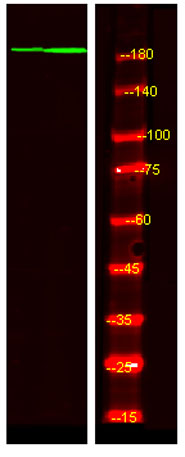
| Observed band (KD) | 213kD |
| Background | |
| Function | function:May have a role in checkpoint signaling during mitosis (By similarity). Enhances TP53-mediated transcriptional activation. Plays a role in the response to DNA damage.,PTM:Asymmetrically dimethylated on Arg residues by PRMT1. Methylation is required for DNA binding.,PTM:Phosphorylated at basal level in the absence of DNA damage. Hyper-phosphorylated in an ATM-dependent manner in response to DNA damage induced by ionizing radiation. Hyper-phosphorylated in an ATR-dependent manner in response to DNA damage induced by UV irradiation.,similarity:Contains 2 BRCT domains.,subcellular location:Associated with kinetochores. Both nuclear and cytoplasmic in some cells. Recruited to sites of DNA damage, such as double stand breaks. Methylation of histone H4 at 'Lys-20' is required for efficient localization to double strand breaks.,subunit:Interacts with IFI202A (By similarity). Binds to th |
| Subcellular location | Nucleus . Chromosome . Chromosome, centromere, kinetochore . Localizes to the nucleus in absence of DNA damage (PubMed:28241136). Following DNA damage, recruited to sites of DNA damage, such as double stand breaks (DSBs): recognizes and binds histone H2A monoubiquitinated at 'Lys-15' (H2AK15Ub) and histone H4 dimethylated at 'Lys-20' (H4K20me2), two histone marks that are present at DSBs sites (PubMed:23333306, PubMed:23760478, PubMed:24703952, PubMed:28241136, PubMed:17190600). Associated with kinetochores during mitosis (By similarity). . |
| Expression | Cerebellum,Cervix,Epithelium,Myeloid leukemia cell,Skeletal muscle, |

Use collapsible tabs for more detailed information that will help customers make a purchasing decision.
Ex: Shipping and return policies, size guides, and other common questions.