 Français
 English
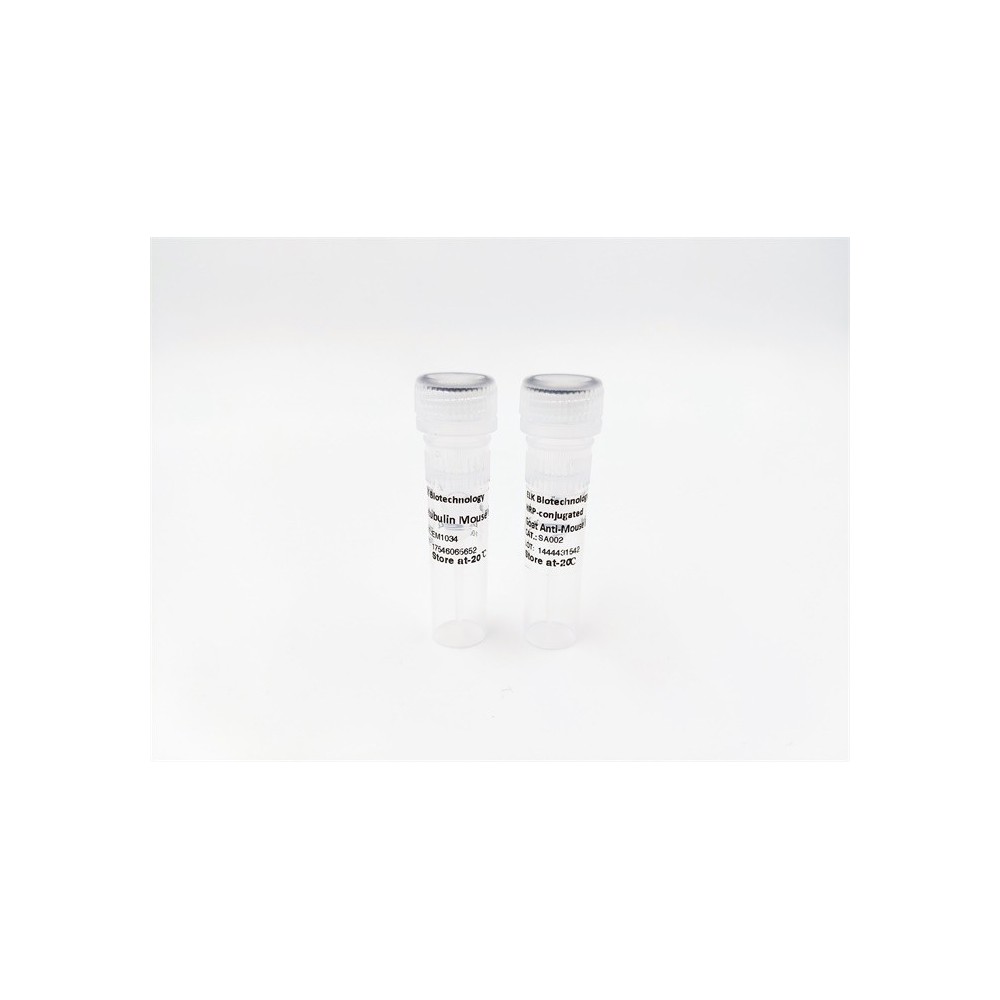

| ELK.No | ES1875 |
| Product name | CBG rabbit pAb |
| Reactivity | Human;Rat;Mouse; |
| Applications | WB;ELISA |
| Other name | GBA3; CBG; CBGL1; Cytosolic beta-glucosidase; Cytosolic beta-glucosidase-like protein 1 |
| Size | 100μL |
| Unit price ($) | 248 |
| Human gene ID | 57733 |
| Human Swiss-Prot | Q9H227 |
| Source | Rabbit |
| Isotype | IgG |
| Target | CBG |
| Fields | >>Starch and sucrose metabolism;>>Metabolic pathways |
| Gene name | GBA3 |
| Protein name | Cytosolic beta-glucosidase |
| Human gene link | View Human Gene |
| Human Swiss link | View Human Swiss-Prot |
| Mouse gene ID | |
| Mouse gene link | |
| Mouse Swiss-Prot | |
| Mouse Swiss link | |
| Rat gene ID | |
| Rat gene link | |
| Rat Swiss-Prot | |
| Rat Swiss link | |
| Immunogen | The antiserum was produced against synthesized peptide derived from human GBA3. AA range:291-340 |
| Specificity | CBG Polyclonal Antibody detects endogenous levels of CBG protein. |
| Formulation | Liquid in PBS containing 50% glycerol, 0.5% BSA and 0.02% sodium azide. |
| Clonality | Polyclonal |
| Dilution | Western Blot: 1/500 - 1/2000. ELISA: 1/20000. Not yet tested in other applications. |
| Purification | The antibody was affinity-purified from rabbit antiserum by affinity-chromatography using epitope-specific immunogen. |
| Concentration | 1 mg/ml |
| Storage stability | -20°C/1 year |
| Molecular Weight (Da) | |
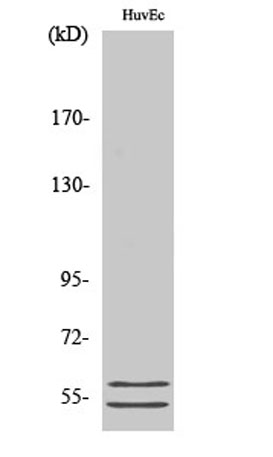
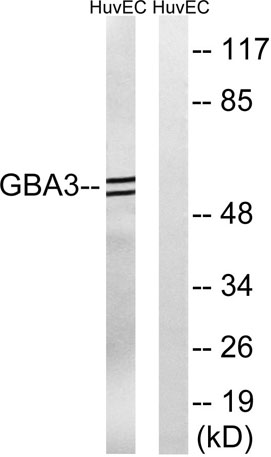
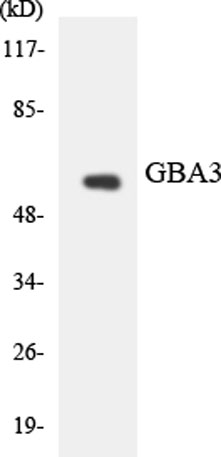
| Observed band (KD) | 54-58kD |
| Background | The protein encoded by this gene is an enzyme that can hydrolyze several types of glycosides. This gene is a polymorphic pseudogene, with the most common allele being the functional allele that encodes the full-length protein. Some individuals, as represented by the reference genome allele, contain a single nucleotide polymorphism that results in a premature stop codon in the coding region, and therefore this allele is pseudogenic due to the failure to produce a functional full-length protein. Alternative splicing of this gene results in multiple transcript variants. [provided by RefSeq, Mar 2013], |
| Function | catalytic activity:Hydrolysis of terminal, non-reducing beta-D-glucosyl residues with release of beta-D-glucose.,enzyme regulation:Inhibited by 2,4-dinitrophenyl-2-fluoro-2-deoxy-beta-D-glucopyranoside and sodium taurocholate.,function:Glycosidase probably involved in the intestinal absorption and metabolism of dietary flavonoid glycosides. Able to hydrolyze a broad variety of glycosides including phytoestrogens, flavonols, flavones, flavanones and cyanogens.,PTM:The N-terminus is blocked.,similarity:Belongs to the glycosyl hydrolase 1 family.,similarity:Belongs to the glycosyl hydrolase 1 family. Klotho subfamily.,tissue specificity:Present in small intestine (at protein level). Expressed in liver, small intestine, colon, spleen and kidney. Down-regulated in renal cell carcinomas and hepatocellular carcinomas., |
| Subcellular location | Cytoplasm, cytosol . |
| Expression | Present in small intestine (at protein level). Expressed in liver, small intestine, colon, spleen and kidney. Down-regulated in renal cell carcinomas and hepatocellular carcinomas. |

Use collapsible tabs for more detailed information that will help customers make a purchasing decision.
Ex: Shipping and return policies, size guides, and other common questions.