 Français
 English

| ELK.No | ES1991 |
| Product name | CLC-4 rabbit pAb |
| Reactivity | Human;Mouse;Rat |
| Applications | WB;IF;ELISA |
| Other name | CLCN4; H(+)/Cl(-) exchange transporter 4; Chloride channel protein 4; ClC-4; Chloride transporter ClC-4 |
| Size | 50μL |
| Unit price ($) | 148 |
| Human gene ID | 1183 |
| Human Swiss-Prot | P51793 |
| Source | Rabbit |
| Isotype | IgG |
| Target | CLC-4 |
| Fields | >>Neutrophil extracellular trap formation |
| Gene name | CLCN4 |
| Protein name | H(+)/Cl(-) exchange transporter 4 |
| Human gene link | View Human Gene |
| Human Swiss link | View Human Swiss-Prot |
| Mouse gene ID | 12727 |
| Mouse gene link | View Mouse Gene |
| Mouse Swiss-Prot | Q61418 |
| Mouse Swiss link | View Mouse Swiss-Prot |
| Rat gene ID | |
| Rat gene link | |
| Rat Swiss-Prot | P51794 |
| Rat Swiss link | View Rat Swiss-Prot |
| Immunogen | The antiserum was produced against synthesized peptide derived from human CLCN4. AA range:221-270 |
| Specificity | CLC-4 Polyclonal Antibody detects endogenous levels of CLC-4 protein. |
| Formulation | Liquid in PBS containing 50% glycerol, 0.5% BSA and 0.02% sodium azide. |
| Clonality | Polyclonal |
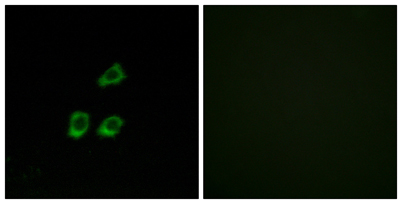
| Dilution | Western Blot: 1/500 - 1/2000. Immunofluorescence: 1/200 - 1/1000. ELISA: 1/40000. Not yet tested in other applications. |
| Purification | The antibody was affinity-purified from rabbit antiserum by affinity-chromatography using epitope-specific immunogen. |
| Concentration | 1 mg/ml |
| Storage stability | -20°C/1 year |
| Molecular Weight (Da) | |
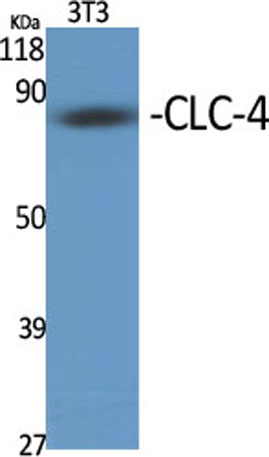
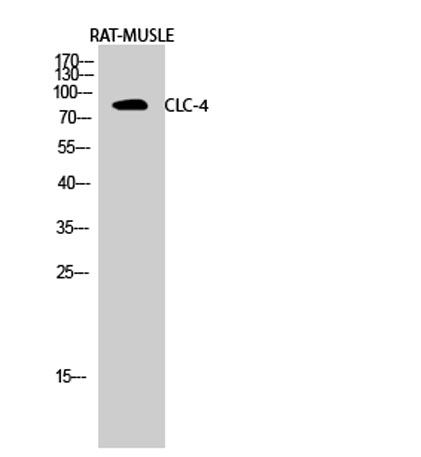
| Observed band (KD) | 85kD |
| Background | chloride voltage-gated channel 4(CLCN4) Homo sapiens The CLCN family of voltage-dependent chloride channel genes comprises nine members (CLCN1-7, Ka and Kb) which demonstrate quite diverse functional characteristics while sharing significant sequence homology. Chloride channel 4 has an evolutionary conserved CpG island and is conserved in both mouse and hamster. This gene is mapped in close proximity to APXL (Apical protein Xenopus laevis-like) and OA1 (Ocular albinism type I), which are both located on the human X chromosome at band p22.3. The physiological role of chloride channel 4 remains unknown but may contribute to the pathogenesis of neuronal disorders. Alternate splicing results in two transcript variants that encode different proteins. [provided by RefSeq, Mar 2012], |
| Function | function:Proton-coupled chloride transporter. Functions as antiport system and exchanges chloride ions against protons.,miscellaneous:The CLC channel family contains both chloride channels and proton-coupled anion transporters that exchange chloride or another anion for protons. The presence of conserved gating glutamate residues is typical for family members that function as antiporters.,similarity:Belongs to the chloride channel (TC 2.A.49) family.,similarity:Contains 2 CBS domains.,tissue specificity:Abundant in skeletal muscle and also detectable in brain and heart., |
| Subcellular location | Early endosome membrane ; Multi-pass membrane protein . Late endosome membrane ; Multi-pass membrane protein . Endoplasmic reticulum membrane ; Multi-pass membrane protein . Lysosome membrane ; Multi-pass membrane protein . Recycling endosome membrane ; Multi-pass membrane protein . Localizes to late endosome membrane, lysosome membrane and recycling endosome membrane in the presence of CLCN3. . |
| Expression | Abundant in skeletal muscle and also detectable in brain and heart. |

Use collapsible tabs for more detailed information that will help customers make a purchasing decision.
Ex: Shipping and return policies, size guides, and other common questions.