 Français
 English
FoxO1A (Acetyl Lys245) rabbit pAb
AO-06-ES20066-50

| ELK.No | ES20066 |
| Product name | FoxO1A (Acetyl Lys245) rabbit pAb |
| Reactivity | Human;Mouse;Rat |
| Applications | WB; ELISA |
| Other name | Forkhead box protein O1 (Forkhead box protein O1A;Forkhead in rhabdomyosarcoma) |
| Size | 50μL |
| Unit price ($) | 148 |
| Human gene ID | 2308 |
| Human Swiss-Prot | Q12778 |
| Source | Rabbit |
| Isotype | IgG |
| Target | FoxO1 |
| Fields | >>FoxO signaling pathway;>>AMPK signaling pathway;>>Longevity regulating pathway;>>Longevity regulating pathway - multiple species;>>Cellular senescence;>>Insulin signaling pathway;>>Thyroid hormone signaling pathway;>>Glucagon signaling pathway;>>Insulin resistance;>>AGE-RAGE signaling pathway in diabetic complications;>>Alcoholic liver disease;>>Shigellosis;>>Human papillomavirus infection;>>Pathways in cancer;>>Transcriptional misregulation in cancer;>>Prostate cancer |
| Gene name | FOXO1 FKHR FOXO1A |
| Protein name | FoxO1A (Acetyl Lys245) |
| Human gene link | View Human Gene |
| Human Swiss link | View Human Swiss-Prot |
| Mouse gene ID | 56458 |
| Mouse gene link | View Mouse Gene |
| Mouse Swiss-Prot | Q9R1E0 |
| Mouse Swiss link | View Mouse Swiss-Prot |
| Rat gene ID | 84482 |
| Rat gene link | View Rat Gene |
| Rat Swiss-Prot | G3V7R4 |
| Rat Swiss link | View Rat Swiss-Prot |
| Immunogen | Synthesized peptide derived from human FoxO1A (Acetyl Lys245) |
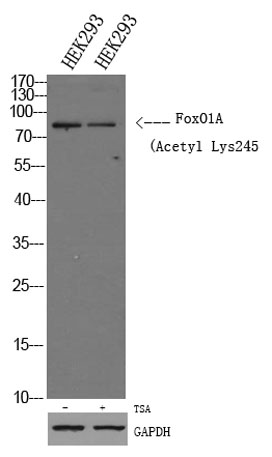
| Specificity | This antibody detects endogenous levels of Human,Mouse,Rat FoxO1A (Acetyl Lys245) |
| Formulation | Liquid in PBS containing 50% glycerol, 0.5% BSA and 0.02% sodium azide. |
| Clonality | Polyclonal |
| Dilution | WB 1:1000-2000 ELISA 1:5000-20000 |
| Purification | The antibody was affinity-purified from rabbit serum by affinity-chromatography using specific immunogen. |
| Concentration | 1 mg/ml |
| Storage stability | -20°C/1 year |
| Molecular Weight (Da) | |
| Observed band (KD) | 72kD |
| Background | disease:Chromosomal aberrations involving FOXO1 are a cause of rhabdomyosarcoma 2 (RMS2) [MIM:268220]; also known as alveolar rhabdomyosarcoma. Translocation (2;13)(q35;q14) with PAX3; translocation t(1;13)(p36;q14) with PAX7. The resulting protein is a transcriptional activator.,function:Transcription factor.,PTM:Phosphorylated by AKT1; insulin-induced (By similarity). IGF1 rapidly induces phosphorylation of Ser-256, Thr-24, and Ser-319. Phosphorylation of Ser-256 decreases DNA-binding activity and promotes the phosphorylation of Thr-24, and Ser-319, permitting phosphorylation of Ser-322 and Ser-325, probably by CK1, leading to nuclear exclusion and loss of function. Phosphorylation of Ser-329 is independent of IGF1 and leads to reduced function. Phosphorylated upon DNA damage, probably by ATM or ATR.,similarity:Contains 1 fork-head DNA-binding domain.,subcellular location:Shuttles between cytoplasm and nucleus.,subunit:Interacts with LRPPRC.,tissue specificity:Ubiquitous., |
| Function | blood vessel development, vasculature development, transcription, regulation of transcription, DNA-dependent,regulation of transcription from RNA polymerase II promoter, anti-apoptosis, cell surface receptor linked signal transduction, enzyme linked receptor protein signaling pathway, transmembrane receptor protein tyrosine kinase signaling pathway, insulin receptor signaling pathway, response to endogenous stimulus, response to hormone stimulus, positive regulation of biosynthetic process, response to organic substance, positive regulation of macromolecule biosynthetic process, positive regulation of macromolecule metabolic process, positive regulation of gene expression, regulation of cell death, positive regulation of cellular biosynthetic process, response to insulin stimulus, cellular response to insulin stimulus, cellular response to hormone stimulus, regulation of cell proliferati |
| Subcellular location | Cytoplasm . Nucleus . Shuttles between the cytoplasm and nucleus. Largely nuclear in unstimulated cells (PubMed:11311120, PubMed:12228231, PubMed:19221179, PubMed:21245099, PubMed:20543840, PubMed:25009184). In osteoblasts, colocalizes with ATF4 and RUNX2 in the nucleus (By similarity). Serum deprivation increases localization to the nucleus, leading to activate expression of SOX9 and subsequent chondrogenesis (By similarity). Insulin-induced phosphorylation at Ser-256 by PKB/AKT1 leads, via stimulation of Thr-24 phosphorylation, to binding of 14-3-3 proteins and nuclear export to the cytoplasm where it is degraded by the ubiquitin-proteosomal pathway (PubMed:11237865, PubMed:12228231). Phosphorylation at Ser-249 by CDK1 disrupts binding of 14-3-3 proteins and promotes nuclear accumulation |
| Expression | Ubiquitous. |

Use collapsible tabs for more detailed information that will help customers make a purchasing decision.
Ex: Shipping and return policies, size guides, and other common questions.